The Shipping Option Customers Choose Can Change Your Profit
The Order Looked Profitable
The order comes in.
The product price looks good.
The margin looks healthy.
Everything seems fine.
Then someone checks the shipping cost.
Suddenly, that profitable order does not look quite as profitable anymore.
The customer chose an available shipping option that cost the merchant far more than expected.
Nothing was technically wrong with the order.
The problem was the shipping choice.
And when this happens repeatedly, shipping can quietly eat into the margin of otherwise good orders.
Not Every Order Needs The Same Shipping
A small order and a large order do not necessarily make sense with the same shipping options.
A lightweight product going across a nearby region is different from a heavy product going to a distant destination.
A low-value order is different from a high-value order.
A fragile product may need a different shipping approach.
Yet customers often see the same general set of shipping choices unless the merchant has created rules around them.
That can make shipping decisions less aligned with the actual order.
One Shipping Option Can Change The Math
Imagine a merchant selling home products.
A customer places a relatively small order.
The merchant is comfortable with the order's product margin.
At checkout, the customer selects an expensive shipping method.
The order is still completed.
The customer is happy.
But after fulfillment costs are accounted for, the merchant realizes there was very little left from the sale.
The shipping option did not look dangerous at checkout.
It became a problem when the merchant looked at the economics of the entire order.
Show More Appropriate Choices
Merchants do not necessarily need to remove every expensive shipping option.
They need more control over when different options make sense.
For example, a merchant may want one shipping method available for certain order types while hiding another when it does not make commercial sense.
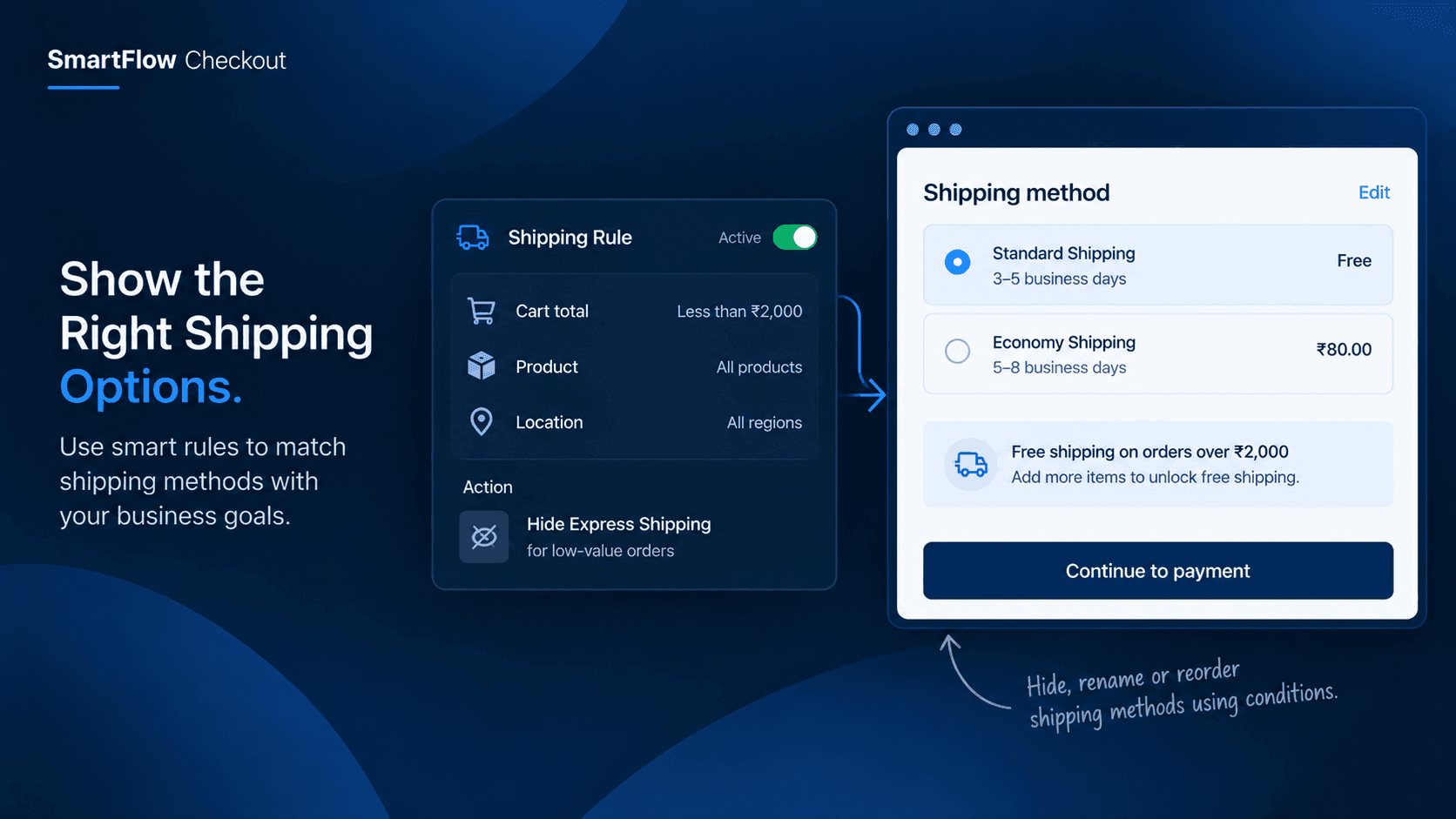
SmartFlow Checkout allows merchants to hide, rename, and reorder shipping methods using conditions related to the customer, order, address, cart products, shipping information, and time.
That means shipping choices can be made more relevant to the situation instead of treating every order identically.
Think About The Whole Order
Shipping should not be considered separately from the order.
The merchant can look at factors such as:
What is being purchased?
How much is the order worth?
Where is it going?
What shipping options make sense there?
Does the timing affect which option should be shown?
These details can change the right shipping experience.
SmartFlow allows merchants to build rules around this kind of order context.
A Heavy Product Changes Everything
Consider a merchant selling products with very different weights.
A small accessory may be inexpensive to ship.
A large item may have a completely different fulfillment cost.
Showing the same shipping choices for both can create unnecessary problems.
The customer sees a shipping method.
The merchant sees the cost.
Those two perspectives do not always match.
Conditional shipping rules let the merchant create a more appropriate experience for different product situations.
Location Can Matter Too
Shipping economics can also change dramatically by destination.
A method that works well in one region may be expensive or unsuitable in another.
For example, a merchant may want to show certain shipping options only for customers in supported areas.
Another method may make more sense for a different destination.
SmartFlow Checkout can use address-related conditions when controlling shipping methods.
That gives merchants more flexibility to match the available options to where the order is going.
Order Value Can Matter
Order value is another useful signal.
Suppose a merchant has a shipping method that makes sense for larger orders but becomes expensive relative to the value of smaller purchases.
The merchant may want different shipping behavior depending on the order.
Instead of making every customer see the same options, the merchant can create rules around the order itself.
The result is not necessarily fewer choices.
It is more relevant choices.
Give Customers Clearer Options
There is another benefit to controlling shipping methods.
Too many choices can create confusion.
A customer reaches checkout and sees several delivery options.
Some may not be relevant to their order.
Some may be unnecessarily expensive.
Some may not be appropriate for the product they purchased.
A cleaner shipping experience can make the decision easier.
The merchant can prioritize the methods that make sense instead of displaying every possible option simply because it exists.
Rename Shipping Methods For Clarity
Sometimes the problem is not the shipping method itself.
It is the name.
A technical or unclear shipping label can leave customers wondering what they are actually choosing.
SmartFlow Checkout can also rename shipping methods.
That gives merchants another way to make delivery choices easier to understand.
Instead of forcing customers to interpret confusing shipping names, the merchant can present clearer language that matches the actual customer experience.
Reorder What Customers See
The order of shipping options can also influence the experience.
The most appropriate option does not need to be buried underneath several alternatives.
SmartFlow Checkout supports shipping-method reordering, allowing merchants to decide how available choices are presented.
That can make the checkout decision simpler:
Recommended option first → alternatives afterward
The customer still has choices, but the merchant can guide the experience toward the options that make the most sense.
Build Rules Around Real Situations
The useful part of conditional shipping is that merchants do not have to create one universal rule for the entire store.
Different situations can have different logic.
A heavy product may need one approach.
A high-value order may need another.
A particular destination may require different options.
A certain time period may call for different delivery choices.
The merchant can build the shipping experience around those real business situations.
Protect The Margin Without Hiding Shipping
There is an important distinction here.
The goal is not to hide shipping costs from customers.
It is to avoid offering shipping options that do not make sense for a particular order.
Customers should still understand what delivery choices are available and what they mean.
The merchant simply has more control over which options appear in the first place.
That creates a healthier balance between customer choice and business economics.
The Customer Sees A Choice
From the customer's perspective, the experience can remain simple.
They reach checkout.
They see relevant shipping options.
They choose one.
They complete the order.
They do not need to know that the store has rules working behind the scenes.
The complexity stays with the merchant's configuration rather than becoming the customer's problem.
That is what good checkout logic should do.
Shipping Should Work For The Business
Shipping is often treated as an operational detail.
But it directly affects the economics of an order.
If the wrong shipping option repeatedly creates unnecessary costs, the merchant eventually pays for that decision.
The right approach is not to make checkout complicated.
It is to make the rules smarter behind the scenes.
SmartFlow Checkout gives merchants the controls to decide which shipping methods should appear, how they should be named, and how they should be ordered based on the circumstances of the order.
One Store, Smarter Shipping Logic
A Shopify store may serve many different types of orders.
That does not mean every customer needs to see exactly the same shipping experience.
A merchant can create rules that reflect the products they sell, the customers they serve, the destinations they ship to, and the economics of their orders.
That makes shipping feel less like a fixed setting and more like part of the store's business logic.
Frequently Asked Questions
Can Shopify merchants hide specific shipping methods?
SmartFlow Checkout supports hiding shipping methods based on configured conditions.
Can shipping methods be renamed?
Yes. SmartFlow Checkout supports renaming shipping methods so merchants can present clearer delivery choices to customers.
Can merchants change the order of shipping options?
Yes. Shipping methods can be reordered through SmartFlow Checkout's delivery customization functionality.
What can shipping rules be based on?
SmartFlow Checkout supports conditions involving customers, orders, addresses, cart products, shipping information, and time.
Why would a merchant use conditional shipping rules?
Different orders can have very different shipping economics. Conditional rules help merchants show shipping choices that are more appropriate to the specific order instead of applying the same options everywhere.
Don't Let Shipping Quietly Eat The Margin
The customer sees a shipping option.
You see the cost behind it.
When those two things do not line up, a perfectly good order can become much less profitable than it looked at checkout.
The solution is not necessarily to remove shipping choices.
It is to make them smarter.
With SmartFlow Checkout, merchants can hide, rename, and reorder shipping methods based on the conditions that actually matter to their business.
Because the right shipping option is not simply the one the customer can choose.
It is the one that makes sense for the order.