Your AI Should Know Your Business, Not Just The Internet
Your AI Knows A Lot
You ask an AI a question.
It gives you an answer immediately.
The answer sounds reasonable.
But then you realize something.
It does not know how your company does things.
It does not know your internal policy.
It does not know the process your team agreed on.
It does not know which pricing rule your company actually follows.
It knows plenty about the world.
It just does not necessarily know your business.
And that difference matters.
Your Business Already Has The Answers
Think about the information your team uses every day.
There are company policies.
Product information.
Internal processes.
Pricing documents.
Customer guidelines.
Operating procedures.
Previous decisions.
Team documentation.
The knowledge is already there.
The problem is that it usually lives in different places and is understood by people who have been around long enough to remember it.
A new employee asks a question.
Someone answers.
Another employee asks the same question three weeks later.
Someone answers again.
The company already knew the answer.
It just was not available in the right context.
Generic Knowledge Isn't Enough
Imagine someone asks an AI:
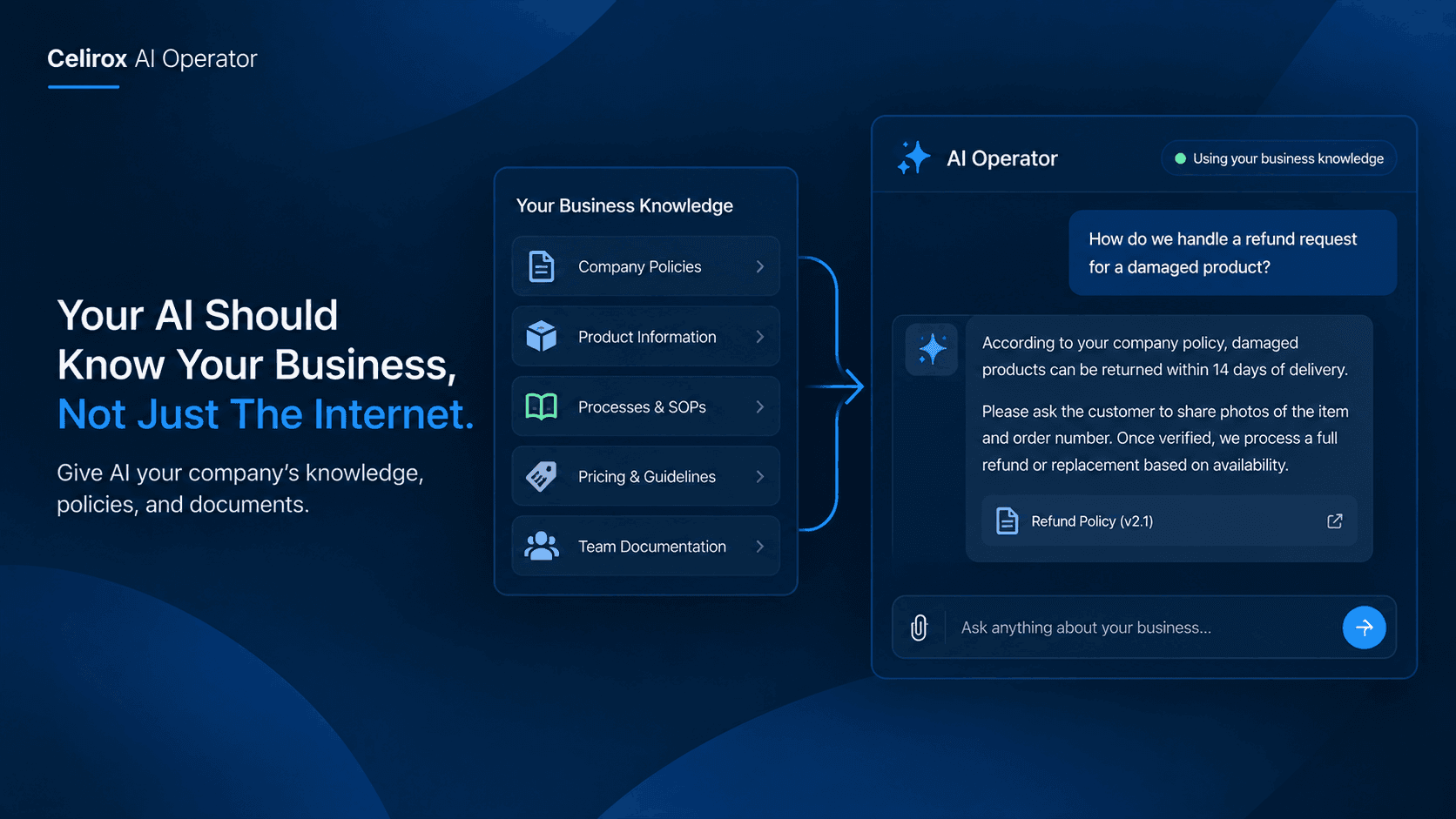
"How should we handle a refund request?"
A general AI can explain common refund practices.
But that is not necessarily what the employee needs.
The employee needs:
"How does our company handle this refund request?"
Those are completely different questions.
The first requires general knowledge.
The second requires business knowledge.
That is where a business-specific AI becomes useful.
Give AI Your Business Context
Celirox AI Operator includes a Global Knowledge Base that allows business-specific information to become part of the AI's working context.
Instead of treating every question as if it belongs to an unknown company, the AI can work with the information your business has provided.
That can include the knowledge your team relies on to make decisions and complete everyday work.
The difference is simple:
Generic AI:
"Here is what is generally true."
Business-specific AI:
"Here is how your business handles it."
Consider A New Employee
Imagine hiring someone new.
On their first week, they ask:
"Which process do we follow for this type of customer request?"
Someone explains it.
A few days later:
"Where can I find the latest product information?"
Another question.
Then another.
This is normal.
Every business has information that experienced employees know almost automatically.
But new employees do not have that context yet.
A business-specific AI can give them another way to access the company's own knowledge without making someone stop what they are doing every time a question comes up.
The Answer Depends On The Company
Consider something as simple as pricing.
Two companies can sell similar products.
They can have completely different pricing policies.
One may offer volume-based pricing.
Another may use fixed pricing.
One may have a special process for enterprise customers.
Another may not.
An AI trained only on general information cannot automatically know which approach belongs to your company.
Your internal business knowledge provides that missing context.
That is why the source of the answer matters.
Stop Explaining The Same Thing
One of the hidden costs of scattered knowledge is repetition.
A manager answers the same question.
Then another manager answers it.
Then someone searches through old documents.
Then someone asks in Slack:
"Does anyone know how we handle this?"
Eventually, somebody finds the answer.
The business has spent time rediscovering information it already had.
A centralized business knowledge layer can reduce that repetition.
Instead of starting from zero every time, the AI can work from the information the business has already established.
Knowledge Should Follow The Work
Company knowledge is useful only when people can access it when they need it.
Imagine someone working on a customer request.
They need to know the correct internal process.
They should not have to remember which folder contains the policy document.
They should not have to search through months of Slack conversations.
They should not have to interrupt another employee.
The useful experience is much simpler:
Ask the question → AI uses company knowledge → Get an answer based on the business context
The information stays connected to the work.
Your Documents Become More Useful
Businesses spend time creating documents.
Policies are written.
Processes are documented.
Product information is maintained.
Guidelines are created.
But documentation only creates value when people actually use it.
A knowledge base gives that information a more active role.
Instead of existing only as files that someone has to find and read, business knowledge can become part of the context the AI uses when helping the team.
That changes documentation from something people occasionally search into something that can support everyday work.
Make AI Understand The Difference
This is the important distinction.
Business-specific AI is not about teaching an AI everything that exists.
It is about giving it the information that makes your business different.
Your policies.
Your processes.
Your terminology.
Your product knowledge.
Your internal decisions.
Your way of working.
Those details are what turn a generic assistant into something that is actually useful inside a company.
It Helps More Than New Employees
Business knowledge is not only useful for onboarding.
Experienced employees also forget things.
Teams change.
Processes evolve.
Policies get updated.
Someone may remember how something worked six months ago while the current process is different.
Having business knowledge available to the AI can make it easier to work from the information the company has established instead of relying entirely on memory.
That matters as a company grows.
From Company Knowledge To Action
The bigger opportunity is not simply answering questions.
AI Operator is designed to work with business context while helping teams perform work.
That means company knowledge can become part of a broader workflow.
For example:
An employee needs to understand a company process.
The AI uses the relevant business knowledge.
The employee gets the context.
Then the AI can help with the next step of the work where the connected tools and workflow support it.
The knowledge is no longer isolated from the task.
It becomes part of how the task gets done.
Keep Your Business Knowledge Yours
Every company develops knowledge that cannot simply be found through a web search.
It comes from experience.
It comes from decisions.
It comes from internal documentation.
It comes from the way the company actually operates.
That is the information that makes your business unique.
A business-specific knowledge base gives your AI access to that context so it can work more like an assistant inside your company rather than a general-purpose answer machine.
The Goal Isn't More AI
Businesses do not need AI simply because AI is available.
They need AI that is useful.
And usefulness often comes from context.
An AI that knows everything generally can still give an unhelpful answer if it does not know how your company works.
An AI that understands your business-specific information can give an answer that is much more relevant to the person actually doing the work.
That is the difference between:
"What is the answer?"
and:
"What is the answer for our business?"
Frequently Asked Questions
What is a business-specific AI?
A business-specific AI uses information and context from a particular company so it can provide assistance based on that company's own knowledge, processes, and way of working.
What is a Global Knowledge Base?
The Global Knowledge Base gives AI Operator a central source of business-specific knowledge that can be used as context when the AI assists with questions and work.
Why isn't general AI enough for a business?
General AI can provide broad knowledge, but businesses often need answers based on their own policies, processes, products, and internal decisions.
Who benefits from a business knowledge base?
Both new and experienced employees can benefit. New employees can access company knowledge without repeatedly asking teammates, while experienced employees can avoid searching through scattered documentation for information they need.
Is this just another document search?
The bigger purpose is not simply finding a file. The knowledge becomes context for an AI assistant that can help employees understand information and work with it as part of their broader workflow.
Teach Your AI How Your Business Works
Your company has spent years building knowledge.
It exists in documents.
It exists in processes.
It exists in product information.
It exists in decisions your team has already made.
That knowledge should not disappear every time someone asks a question.
Celirox AI Operator's Global Knowledge Base brings your business-specific knowledge into the AI's context, helping turn a general AI assistant into one that understands how your company actually works.
Because the most useful AI for your team is not necessarily the one that knows the most about everything.
It is the one that understands your business.