Every New Product Shouldn't Mean More Admin Work
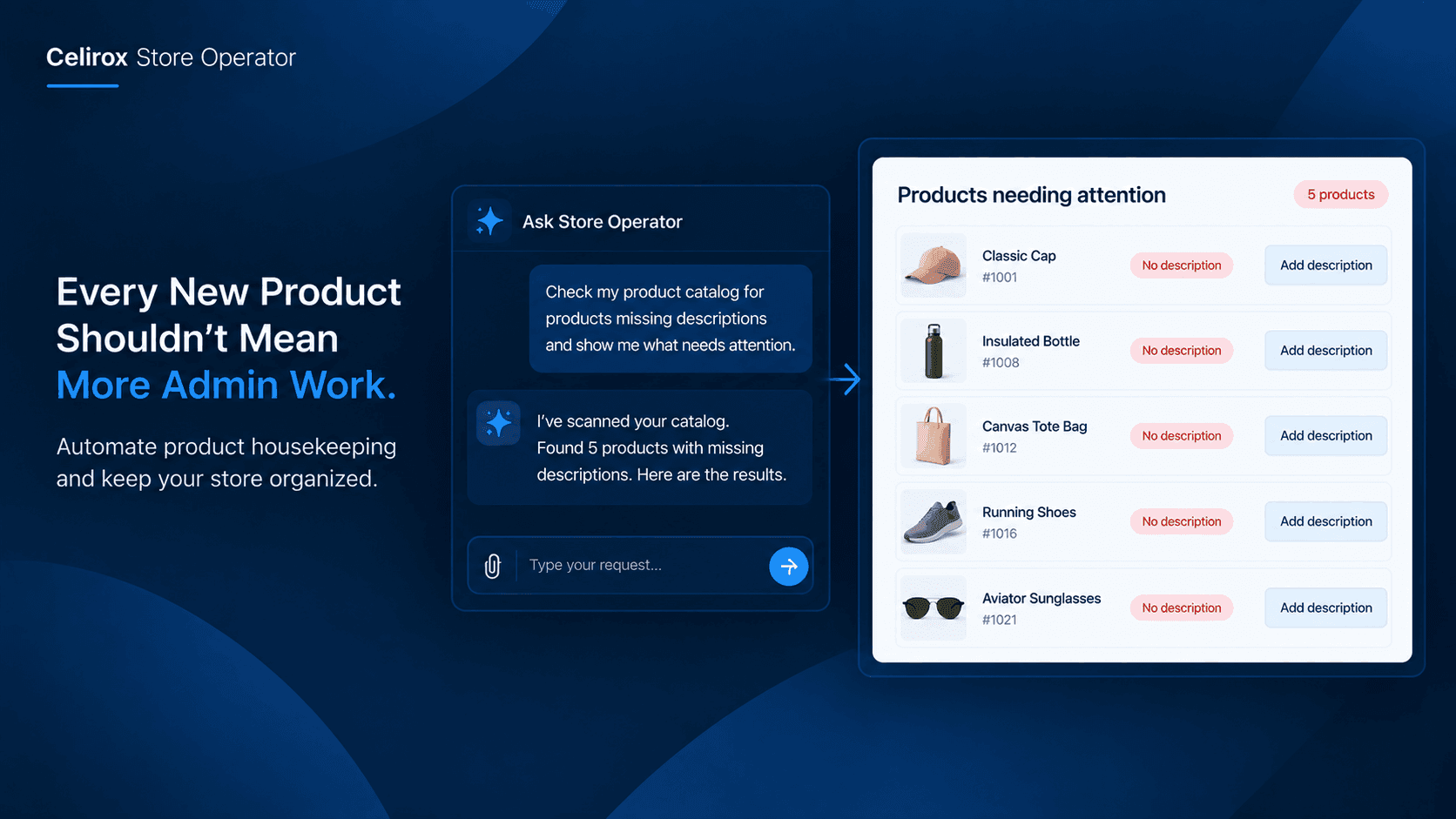
A new product goes live.
For a moment, it feels like the job is finished.
The photos are uploaded. The price is set. The description is there. The product is finally visible in the store.
Then the merchant starts checking everything else.
Did the product get the right information?
Is anything missing?
Does the catalog still follow the store's usual standards?
Are there products that were uploaded quickly and never received the final cleanup?
For one product, this is easy.
For a store adding products every week, it becomes another recurring admin job.
And that is the real problem.
The work is not difficult. It is repetitive.
Adding The Product Isn't The End
Imagine a small fashion brand preparing for a seasonal launch.
The owner has twenty new products ready to publish.
The team spends most of its attention getting the important parts right: photography, pricing, inventory, descriptions, and launch timing.
But after everything is published, someone still has to go back through the catalog.
They check whether every product has a description.
They look for incomplete information.
They search for products that were rushed through the upload process.
Then they make the same checks again the next time a batch of products is added.
Nothing about this work is particularly strategic.
But it still takes time.
As the catalog grows, these small checks become part of the weekly workload.
Repetition Creates Small Problems
The biggest issue with repetitive catalog work is not always the time it consumes.
It is what happens when the work gets skipped.
A merchant can remember to check ten products.
It is much easier to miss one product when there are fifty.
That forgotten product may remain incomplete for days before someone notices.
The same thing happens when a busy launch forces the team to prioritize getting products live over doing the final housekeeping afterward.
There is nothing unusual about this.
Store owners have dozens of competing responsibilities.
Product maintenance simply tends to lose against tasks that feel more urgent.
That is why routine checks are good candidates for automation.
Build The Check Into The Routine
Instead of relying on someone to remember to inspect the catalog every time products are added, merchants can turn recurring housekeeping into a store workflow.
Store Operator is designed around plain-English instructions rather than requiring merchants to build every workflow manually through complicated settings. Its chat interface lets merchants describe what they want, review the products and rules involved, and deploy the workflow. :contentReference[oaicite:0]{index=0}
For example, a merchant might define a routine such as:
"Regularly check my product catalog for products missing descriptions and flag them for attention."
That is a very different experience from remembering to open Shopify every Friday and manually search through the catalog.
The business rule stays simple.
The repetitive checking becomes something the store can handle as part of its normal operation.
Don't Let Missing Details Hide
Product housekeeping becomes particularly useful when the store is growing quickly.
A merchant may have:
- New products being added every week
- Products imported in batches
- Seasonal launches
- Products temporarily prepared before final content is ready
- Multiple people working on the catalog
In that environment, incomplete product information is easy to overlook.
Store Operator's Auto-Hygiene capability supports keeping a store clean by identifying products with missing descriptions, alongside other routine store-maintenance tasks. :contentReference[oaicite:1]{index=1}
That matters because the merchant does not need to discover the problem through a customer complaint.
The issue can become part of the store's regular operational process.
Give The AI A Clear Rule
Good automation starts with a clear business rule.
The merchant does not need to explain every click.
They need to explain what the store should accomplish.
For example:
"Every week, check the product catalog for missing descriptions and show me what needs attention."
The important part is that the merchant defines the desired outcome.
Store Operator's workflow is built around this kind of plain-English instruction. The system can confirm the relevant details before deployment rather than forcing the merchant to translate a simple business request into a complicated technical configuration. :contentReference[oaicite:2]{index=2}
This makes automation more approachable for merchants who know exactly what they want the store to do but do not want to spend time building the underlying process themselves.
Keep Launch Work Separate
There is another advantage to separating product launches from product housekeeping.
When a new collection is being prepared, the team should be focused on getting the important launch decisions right.
Which products are launching?
What are the prices?
When does the collection go live?
What inventory is available?
What promotion supports the launch?
Routine cleanup should not compete with those decisions.
A merchant can establish operational workflows around the repetitive checks while keeping human attention on the parts of the launch that actually require judgment.
That is where automation becomes useful.
It does not replace the merchant's product decisions.
It removes some of the repeated checking surrounding those decisions.
Review Before You Change
Automation should not mean that every store change happens without oversight.
Store Operator uses an approve-to-execute model for critical backend automation and storefront changes. The system can explain the reasoning behind a proposed action, while the merchant provides the final approval where appropriate. :contentReference[oaicite:3]{index=3}
That distinction is important for product operations.
A merchant may be comfortable automatically identifying incomplete products.
They may want to review a proposed change before anything more consequential happens.
The workflow can therefore be designed around the merchant's level of control rather than treating every task as something the AI should perform without review.
Turn Housekeeping Into Operations
The larger lesson is that product maintenance should not depend entirely on memory.
If a task happens repeatedly, it deserves a repeatable process.
A store owner might start with one simple workflow:
Check → Find incomplete products → Review → Fix
Later, other routine store processes can be handled in the same operational mindset.
Store Operator supports workflows for tasks such as tagging, inventory monitoring, notifications, store hygiene, and other recurring operational work through plain-English commands. :contentReference[oaicite:4]{index=4}
The point is not to automate everything.
The point is to stop spending human time on work that follows the same pattern every time.
Measure The Work You Remove
Once a repetitive process becomes automated, merchants can think about its value differently.
Instead of asking:
"Did we save five minutes today?"
they can ask:
"How much recurring administrative work have we removed from the team's week?"
Store Operator provides tracking around deployed features and operational improvements, including reporting on manual labor saved and other measurable outcomes. :contentReference[oaicite:5]{index=5}
That creates a useful feedback loop.
If a workflow consistently removes work without creating new problems, keep it.
If the process needs adjustment, change the rule.
Automation should become part of the store's operating process, not another tool that gets configured once and forgotten.
A Better Way To Add Products
A growing catalog should create more opportunities for sales.
It should not automatically create more repetitive administration.
The merchant's job is to decide what products belong in the store, how they should be positioned, what they should cost, and how they should support the business.
The repetitive housekeeping around that catalog is different.
It follows rules.
It happens again and again.
And it is exactly the kind of work worth turning into a reliable workflow.
With Celirox Store Operator, merchants can describe operational tasks in plain English and build recurring workflows around the work that otherwise keeps returning to their Shopify admin. :contentReference[oaicite:6]{index=6}
The goal is simple:
Add more products without adding the same amount of admin work.
When routine product housekeeping becomes part of the store's operating process, merchants can spend less time checking what should have been done and more time deciding what the business should do next.
Frequently Asked Questions
What kind of product housekeeping can Store Operator help with?
Store Operator can help merchants create workflows around recurring store-operations tasks. For example, merchants can use plain-English instructions to define rules for product organization, maintenance, monitoring, and other repetitive Shopify work.
Can Store Operator check for products with missing descriptions?
Yes. Store Operator's Auto-Hygiene capabilities include identifying products with missing descriptions and other routine store-maintenance issues. :contentReference[oaicite:7]{index=7}
Does the merchant need to build complicated automation rules?
Store Operator is designed around plain-English instructions. Merchants can describe what they want the store to do, review the relevant details, and deploy the workflow rather than manually building every step. :contentReference[oaicite:8]{index=8}
Can a workflow run repeatedly?
Yes. Store Operator supports recurring operational workflows, allowing merchants to turn tasks that happen regularly into repeatable store processes. :contentReference[oaicite:9]{index=9}
Does automation mean Store Operator changes everything automatically?
Not necessarily. Store Operator includes an approve-to-execute approach for critical backend automation and storefront changes, allowing merchants to review consequential actions where appropriate. :contentReference[oaicite:10]{index=10}
Why automate product housekeeping instead of doing it manually?
The individual checks may be simple, but they become time-consuming when repeated across a growing catalog. Automating the repetitive part helps merchants spend less time remembering and performing the same checks.
Can merchants still decide how their products should be organized?
Yes. The merchant defines the business rules and desired outcome. Store Operator helps turn those instructions into repeatable operational workflows.
How should a merchant start?
Start with one repetitive task that happens regularly, such as checking for incomplete product information. Define the desired outcome clearly, review the workflow, and expand to other housekeeping tasks only when the first process works reliably.
Add Products Without Adding Admin
A growing product catalog should mean more opportunities for the business, not an endless list of small administrative jobs.
The merchant should be able to focus on deciding which products to launch, how to position them, and when to bring them to customers. Repeated catalog checks should not constantly pull the team back into the same Shopify admin screens.
That is where a simple operational workflow can make a meaningful difference.
Instead of relying on someone to remember the same product housekeeping every week, merchants can define the rule once and make it part of the store's normal operating process.
Add the products. Keep the standards. Reduce the repetition.
Celirox Store Operator helps merchants use plain-English instructions to create repeatable workflows around the store work that keeps coming back. :contentReference[oaicite:11]{index=11}