Protect Dropshipping Margins With Smarter COD and Payment Rules
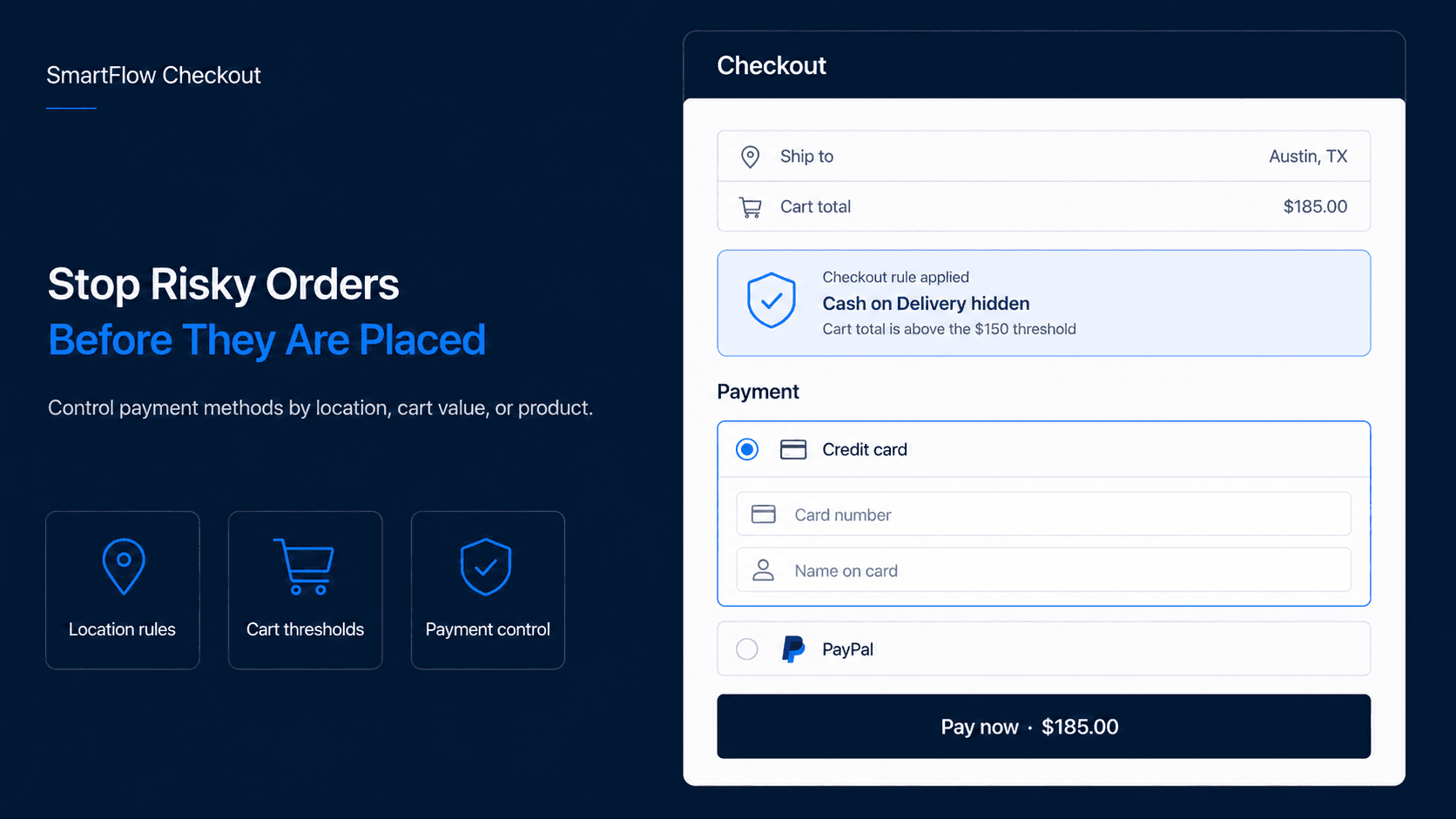
When COD Becomes Expensive
Imagine you sell a product for $60.
The customer chooses Cash on Delivery.
You send the order to your supplier.
The product ships.
The carrier reaches the customer.
Then the customer refuses the package.
You never collect the $60.
But several costs have already happened: product handling, shipping, fulfillment, return processing, and support time.
Inside Shopify, the order looked successful.
Financially, it was not.
That is why COD-heavy stores should not look only at:
How many orders did we receive?
A better question is:
Which orders actually turn into collected, profitable revenue?
That is where conditional payment rules become useful.
COD Risk Is Not Fraud
Cash on Delivery risk and payment fraud are not the same problem.
Payment fraud can involve stolen payment credentials, unauthorized transactions, identity misuse, or other deceptive activity.
A COD customer may place a completely legitimate order and later refuse the delivery, become unreachable, change their mind, provide an unusable address, or simply not have payment available when the carrier arrives.
That may create a financial loss.
It does not automatically make the customer fraudulent.
SmartFlow Checkout should therefore be viewed as a tool for checkout policy and payment eligibility, not a complete fraud-detection system.
Its role is to help merchants decide when specific payment methods make sense for a particular order.
One Rule Does Not Fit All
Suppose your store accepts both prepaid payments and COD.
Should COD be available for a $20 phone case?
Possibly.
What about a $700 electronics order?
The financial exposure is very different.
The same question applies across markets, products, cart values, and customer situations.
A merchant may be comfortable offering COD for low-value everyday products but not for expensive electronics with high shipping and return costs.
Another merchant may find that COD performs well in one market but poorly in another.
The problem is not COD itself.
The problem is assuming one payment policy should apply to every order.
A better model is:
Order context → Check payment rules → Show eligible methods
Build Rules Around Exposure
With SmartFlow Checkout, merchants can configure payment rules around their own fulfillment and financial policies.
For example:
"Hide Cash on Delivery when the order value is above $150."
Or:
"Only offer COD in the markets where we currently support it."
Or:
"If the cart contains products from our high-value electronics collection, require a prepaid payment method."
The checkout can evaluate the configured conditions before the order is submitted.
That allows the merchant to control exposure without manually reviewing every order afterward.
A simple rule might be:
Cart below $100 → COD available
Cart $100 or above → Prepaid methods only
But the threshold should come from the merchant's actual economics.
Do not copy another store's $100 or $150 rule without understanding your own margins, shipping costs, refusal rates, and product exposure.
Calculate the Real Cost
A refused COD order is not simply a lost sale.
Imagine:
Selling price: $120
Product cost: $55
Outbound shipping: $12
Return shipping: $10
Payment collected: $0
The merchant did not merely miss $120 of revenue.
The business also incurred costs before discovering that payment would never be collected.
That is the real reason cart value and product type matter.
A low-cost product with inexpensive fulfillment may still be reasonable to offer through COD.
A high-cost product with expensive outbound and return logistics creates a different risk profile.
The useful question is:
How much money is exposed before payment is actually collected?
That figure can help the merchant decide where COD still makes sense.
Adapt by Product and Market
Not every product or market needs the same payment policy.
Imagine your store sells:
Phone case - $18
and:
Portable projector - $320
A refused COD order on the projector can create much more financial exposure.
A merchant could therefore define:
High-value electronics in cart → Hide COD
while continuing to offer COD for lower-cost products.
Market conditions can matter too.
A store may have reliable COD delivery in one country or region but poor collection economics in another.
That does not mean customers from the second region are fraudulent.
Other factors may be responsible, including carrier reliability, shipping time, address quality, customer expectations, or product-market fit.
A better way to frame the rule internally is:
COD is currently not economical for us in this market.
That keeps the decision tied to fulfillment performance rather than labeling groups of customers.
Restrict Only What Matters
Hiding COD does not mean every other payment method should disappear.
If the business problem is refused COD orders, the rule should target COD.
For example:
High-value order → Hide COD
should not automatically become:
High-value order → Hide wallets, cards, Shop Pay, PayPal, and other prepaid methods
Those alternatives may actually reduce the merchant's exposure because payment is collected earlier.
The same principle applies to returning and first-time customers.
A repeat customer with several successfully completed COD orders may represent a different business situation from a first-time shopper placing an unusually large order.
If the necessary customer context is available to the rule, merchants may choose to incorporate it.
But a first-time customer should not automatically be treated as suspicious.
The purpose is to control the amount of financial exposure the merchant is willing to accept.
Expect a Conversion Tradeoff
When COD disappears, not every customer will simply select another payment method.
Some shoppers will pay online.
Some will choose another available option.
Some may leave checkout.
That means payment restrictions always involve a tradeoff.
The wrong question is:
Did checkout conversion go down?
The better question is:
Did profitable order completion improve?
Imagine this simplified example:
Before the rule
100 COD orders placed
75 successfully delivered and paid
After the rule
85 orders placed
78 successfully delivered and paid
The number of orders decreased.
But the number of successfully completed and collected orders increased.
That is why COD policies should be judged on business outcome rather than raw checkout conversion alone.
Measure Collected Revenue
Useful COD metrics can include:
- COD orders placed
- COD orders delivered and paid
- COD refusal rate
- Return-to-sender rate
- Shipping loss from refused orders
- Checkout abandonment after COD restrictions
You can also compare margin and payment-method usage before and after introducing a rule.
Suppose removing COD from expensive products increases prepaid purchases but causes some customers to leave.
That may still be a good change if the orders that remain create better contribution margin and fewer return costs.
Or it may be a poor change if profitable customers strongly prefer COD and the restriction eliminates too many good purchases.
There is no universal answer.
The merchant needs to compare the economics.
Optimize for what becomes collected revenue, not simply what creates an order record.
Combine Checkout Controls Carefully
Payment rules solve only one part of operational risk.
A prepaid customer can still enter an unusable address.
A low-value order can still contain a product that cannot ship to a specific destination.
A customer can still provide information that conflicts with fulfillment requirements.
That is why a merchant may combine:
- Payment eligibility rules
- Address validation
- Shipping restrictions
- Cart validation
- Order review processes
For example:
High-value product → Prepaid payment required
combined with:
Unsupported destination → Checkout validation
These rules solve different problems.
The goal is not to build the largest possible collection of checkout restrictions.
It is to place each control where it addresses a real operational issue.
Too many overlapping rules can create confusion and unnecessary abandonment.
Test Before You Enforce
A merchant might begin with:
"Keep COD available for orders under $100. Hide COD when the cart exceeds $100 or contains products from our High Value collection. Also hide COD in markets where we do not currently support COD fulfillment."
Before enabling the rules broadly, test the important paths.
Check carts below the threshold, exactly at the threshold, and above it.
Test what happens when a high-value product is added and then removed.
Make sure discounts that change the cart value do not create unexpected payment behavior.
Verify that prepaid methods remain available where intended.
Also test across mobile, different markets, repeat customers, and carts containing several products.
The rule should continue to make sense as the cart changes.
A payment control that reduces COD exposure but prevents legitimate customers from completing checkout has simply created a different problem.
Frequently Asked Questions
Can Shopify hide COD based on cart value?
Shopify supports payment customization capabilities that allow eligible payment methods to be adjusted based on checkout conditions. SmartFlow Checkout can help merchants configure supported COD rules around conditions such as order value.
Can COD availability change by market?
Yes, where the merchant's Shopify setup and supported payment customization conditions allow it. This can help stores apply different COD policies across markets.
Does hiding COD prevent fraud?
No. COD restrictions can reduce exposure to refused or unpaid COD orders, but fraud prevention is a broader problem involving other systems and risk signals.
Should I disable COD completely?
Not necessarily. If COD performs well for your customers, targeted rules based on order value, products, or markets may be more appropriate than disabling it everywhere.
Will restricting COD reduce conversion?
It can. Some customers strongly prefer COD. Merchants should compare any conversion change with delivery success, collected revenue, shipping losses, and margin.
Should first-time customers automatically lose COD?
Not necessarily. Being a new customer does not make someone risky. Any customer-based rule should reflect real store data and the level of exposure the merchant is comfortable accepting.
Can SmartFlow Checkout control COD availability?
Yes. SmartFlow Checkout can help merchants configure conditional payment rules so supported payment methods appear according to defined checkout conditions.
Optimize for Profitable Orders
An order appearing in Shopify does not automatically make it a successful order.
If the customer refuses delivery and the merchant absorbs the fulfillment and return costs, the checkout conversion did not produce the expected business outcome.
That is why payment rules should reflect the economics behind the purchase.
For one merchant, COD may work across almost every order.
For another, it may make sense only below a particular cart value.
Another may offer it in selected markets while requiring prepaid payment for expensive products.
There is no universal COD rule.
Understand exposure → Define eligibility → Keep alternatives available → Measure collected revenue
SmartFlow Checkout helps merchants turn those decisions into checkout conditions so payment options reflect the order being placed instead of treating every cart exactly the same.