The Customer Is Buying Polarized Sunglasses. Don't Give Every Shopper the First-Order Discount.
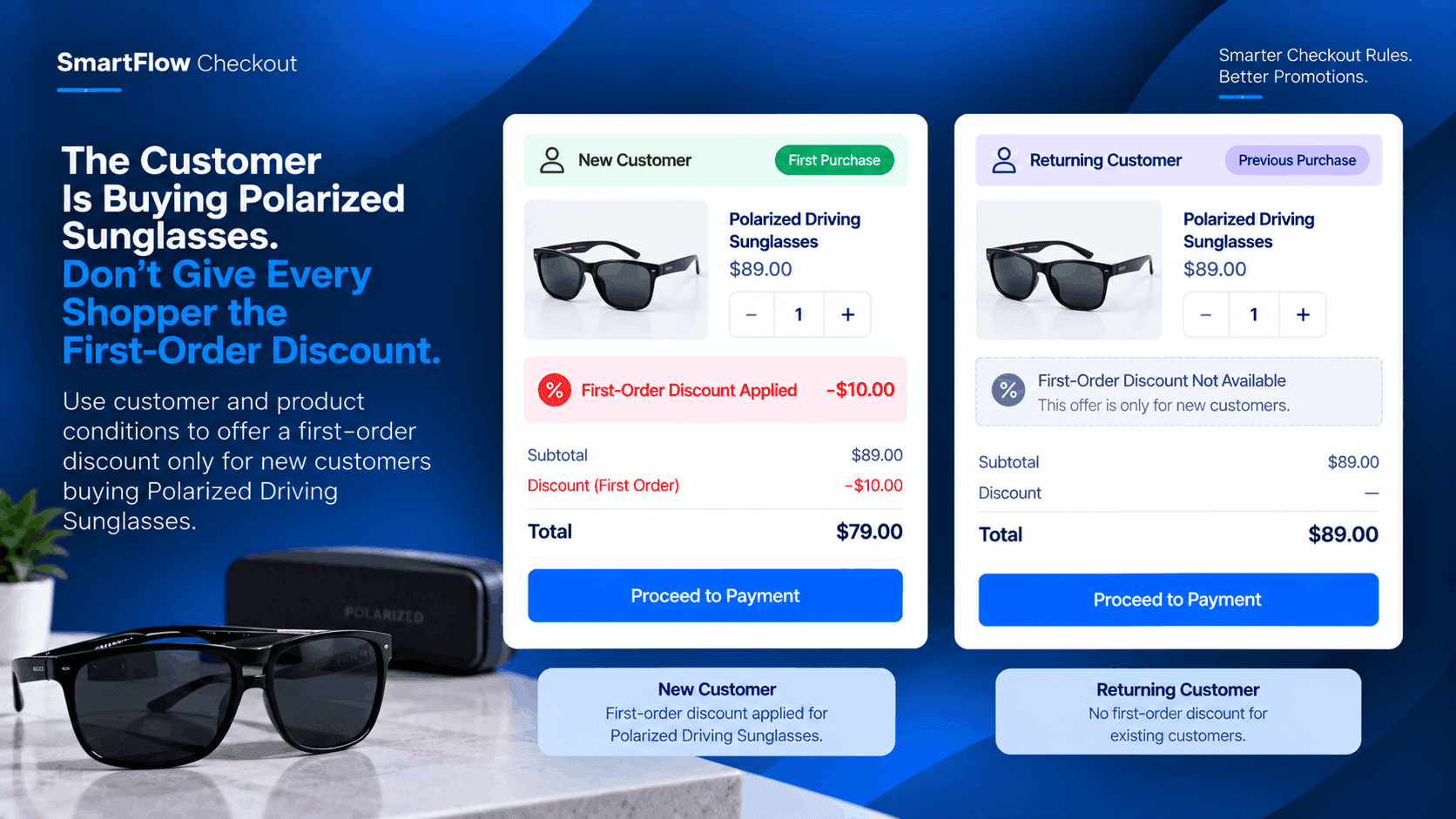
A customer finds a pair of Polarized Driving Sunglasses.
They like the frame.
They check the product details.
They add the sunglasses to their cart.
Now the store wants to offer something special.
It has a first-order promotion for new customers buying this particular product.
But there is a catch.
The store does not want the discount going to everyone.
A returning customer should not receive the first-order offer.
And someone buying a completely different product should not automatically qualify either.
The store needs the checkout to understand both parts of the promotion.
The Promotion Has Two Conditions
The sunglasses store has a simple idea:
New customer + Polarized Driving Sunglasses = first-order discount.
That sounds straightforward.
But a normal discount can easily become broader than the store intended.
If the customer has already purchased from the store, they shouldn't qualify.
If the customer is buying a different pair of sunglasses, the offer may not apply.
The store needs to connect the discount to the actual shopping situation.
A Customer Can Be New Or Returning
The store may have thousands of customers.
Some are visiting for the first time.
Others have already purchased sunglasses, accessories, or other products.
A first-order promotion is meant for the first group.
That means customer information matters.
The checkout needs to distinguish between an eligible first-time customer and someone who has already purchased from the store.
That is one part of the rule.
The Product Matters Too
The store also wants the promotion tied to the Polarized Driving Sunglasses.
This isn't a store-wide welcome discount.
The promotion is being used to encourage new customers to purchase a specific product.
That means the cart matters too.
The checkout needs to know what the customer is buying.
Now the promotion has two pieces of logic:
Who is the customer?
What is in the cart?
Combine The Conditions
SmartFlow Checkout supports discount customization with conditions involving customer and cart information. Its supported conditions can include customer details, cart products, order information, quantity, location, shipping, and other checkout factors. :contentReference[oaicite:0]{index=0}
That allows the store to create a more targeted rule.
The workflow can be thought of as:
Customer adds Polarized Driving Sunglasses → customer eligibility is checked → product condition is checked → eligible customer receives the configured discount.
If the conditions aren't satisfied, the promotion does not need to apply.
The store keeps control over who receives the offer.
The Returning Customer Sees Something Different
Imagine a customer who bought from the store six months ago.
They come back and add the same Polarized Driving Sunglasses to their cart.
They meet the product condition.
But they are not a first-time customer.
The promotion can therefore remain unavailable to them.
That is exactly what the store intended.
The offer isn't about giving everyone a lower price.
It is about creating a specific incentive for a specific customer situation.
The First-Time Customer Gets The Offer
Now imagine another shopper.
They have never purchased from the store.
They find the Polarized Driving Sunglasses.
They add them to the cart.
The customer condition is satisfied.
The product condition is satisfied.
The configured first-order discount can apply.
The customer gets the promotion the store designed for them.
The difference happens automatically at checkout.
No Manual Coupon Decisions
Without a conditional rule, the store might have to rely on coupon codes or manual instructions.
That creates questions.
Does this customer qualify?
Is this product included?
Has the customer purchased before?
Should the discount be removed?
The more customers the store gets, the more difficult those manual checks become.
A checkout rule can handle the conditions consistently.
The customer sees the appropriate checkout experience without asking the store team to make the decision manually.
Keep The Offer Focused
The store doesn't need to turn the entire catalog into a first-order promotion.
The Polarized Driving Sunglasses can have their own campaign.
That makes the promotion easier to understand.
The store knows what it is trying to achieve.
The customer knows what product the offer applies to.
And the discount is not unnecessarily spread across unrelated products.
This is especially useful when a store has different promotional strategies for different products.
The Rule Supports The Marketing Idea
A promotion often starts with a simple business idea.
In this case:
“We want new customers to try our Polarized Driving Sunglasses.”
The difficult part is turning that idea into checkout logic.
The store needs to connect:
New customer
with:
Specific product
with:
Specific discount.
SmartFlow Checkout provides the conditions needed to turn that business rule into a checkout workflow. :contentReference[oaicite:1]{index=1}
One Customer, One Product, One Offer
The workflow stays focused.
New customer enters checkout.
They have the Polarized Driving Sunglasses in their cart.
SmartFlow checks the configured conditions.
The customer is eligible and the required product is present.
The first-order discount applies.
If the customer is not eligible or the required product isn't present, the promotion doesn't need to apply.
No complicated customer journey.
Just a targeted checkout rule.
Why Targeted Discounts Matter
Discounts are useful, but giving the same discount to everyone can reduce the value of a promotion.
A first-order offer has a specific purpose.
It is designed to encourage a new customer to make their first purchase.
A product-specific condition makes that offer even more focused.
The store can use its promotion where it actually matters instead of automatically reducing the price for customers who don't need the incentive.
Let Checkout Handle The Decision
The store already knows the promotion rules.
It knows which customer should qualify.
It knows which product should trigger the offer.
The checkout simply needs to apply those rules consistently.
SmartFlow can check the configured customer and product conditions while the customer is completing the purchase.
That means the store doesn't have to manually inspect every order to determine whether the promotion was appropriate.
Frequently Asked Questions
Can SmartFlow use customer conditions for discounts?
Yes. SmartFlow supports discount customization with customer-related conditions as well as cart, order, quantity, location, shipping, and other conditions. :contentReference[oaicite:2]{index=2}
Can a discount depend on the product in the cart?
Yes. Cart-product conditions can be used as part of SmartFlow's discount customization. :contentReference[oaicite:3]{index=3}
Can customer and product conditions be combined?
SmartFlow supports multiple condition types for discount rules, allowing merchants to build more targeted promotions around the circumstances of an order. :contentReference[oaicite:4]{index=4}
Does the discount have to apply to every sunglasses product?
No. The store can configure the promotion around the specific product condition relevant to its campaign.
Does SmartFlow require custom code for this type of checkout rule?
SmartFlow Checkout is designed to provide supported checkout customization without requiring custom code. :contentReference[oaicite:5]{index=5}
Give The Right Customer The Right Offer
The store doesn't want to discount every pair of sunglasses.
It doesn't want returning customers receiving a first-order promotion.
It wants something much more specific:
A new customer buying the Polarized Driving Sunglasses should receive the offer.
That is a simple business rule.
SmartFlow Checkout can turn that rule into a checkout condition by combining customer and product information.
The customer gets the promotion when they qualify.
The store keeps the offer targeted.
And the team doesn't have to manually check every order.
A discount becomes more useful when the checkout knows exactly when it should apply.