Stop Profit Leaks: How to Dynamically Hide Payment Methods at Checkout
The Limitations of a Static Checkout
Shopify's native checkout is optimized for speed and conversion, operating under the assumption that all revenue is equal and all payment methods carry the same inherent risk. For merchants operating at scale, this assumption is structurally flawed.
Offering a "one-size-fits-all" checkout experience—where every customer sees the exact same payment gateways and shipping options regardless of their cart contents, geographic location, or customer history—leads to significant profit leakage.
Consider the economics of a static checkout in complex scenarios:
- The High-Risk Transaction: A first-time customer in a historically high-return postal code orders $800 worth of merchandise and selects Cash on Delivery (COD). If they refuse the package at the door (Return to Sender), the merchant absorbs the outbound shipping, the return shipping, and the opportunity cost of tied-up inventory.
- The Margin Killer: A customer purchases a highly discounted clearance item where the net margin is only 4%. They select a "Buy Now, Pay Later" (BNPL) gateway that charges the merchant a 6% processing fee. The merchant actually loses money on the transaction.
- The Heavy Freight Dilemma: A retail customer accidentally selects an expedited, subsidized shipping rate that was intended only for lightweight items, forcing the merchant to absorb a massive shipping loss on a 50lb package.
To protect bottom-line profitability, merchants require a programmable checkout that adapts in real-time to the context of the transaction. Static rule sets cost high volume stores thousands of dollars every week in unnecessary processing fees.
Intelligent Checkout Customization with SmartFlow
The solution is not to turn off COD or BNPL entirely—those payment methods are crucial for conversion rates in many markets. The solution is conditional visibility. SmartFlow Checkout empowers merchants to deploy dynamic, rule-based logic to govern their payment and shipping gateways, all without writing complex Shopify Functions or hiring a specialized Liquid developer.
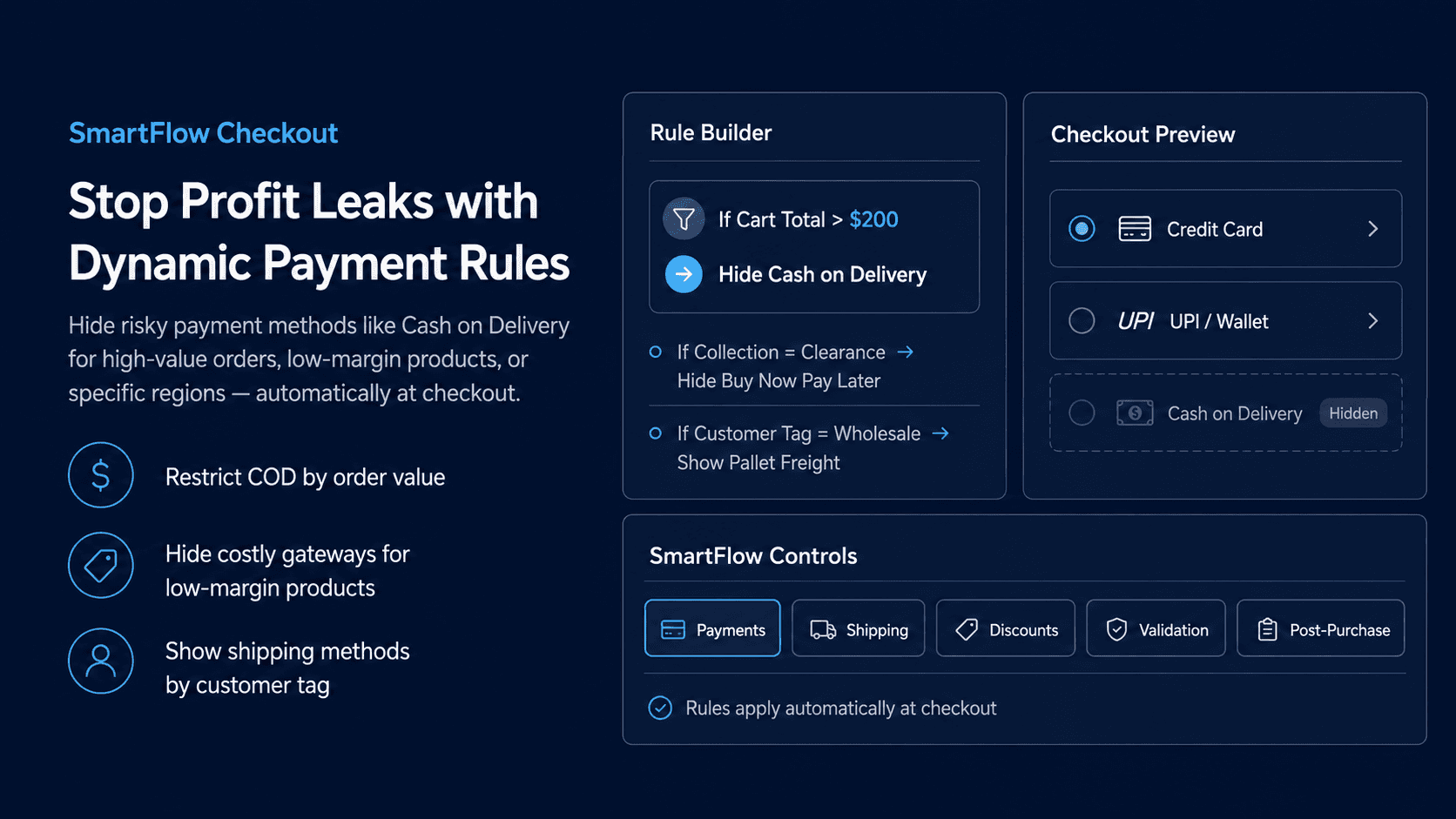
Check out the interactive demo below to see exactly how these rules are configured:
The Mechanics of Dynamic Rules
SmartFlow Checkout integrates natively into Shopify's backend architecture. When a customer enters the checkout flow, SmartFlow evaluates the cart payload and the customer object against a predefined ruleset before rendering the available payment methods.
This allows for highly sophisticated, operational gatekeeping:
1. Managing Cash on Delivery (COD) Risk
COD remains a dominant payment method in many international markets, but it carries the highest risk of non-delivery. SmartFlow allows you to constrain this risk precisely.
- Cart Thresholds: You can create a rule that states: If Cart Subtotal > $200, Hide 'Cash on Delivery'. This ensures that your financial exposure on uncaptured revenue is capped.
- Geographic Restrictions: If Shipping Postal Code matches [List of High-Risk Zones], Hide 'Cash on Delivery'. This prevents fraudulent or historically unreliable regions from utilizing the service.
2. Protecting Margins from Gateway Fees
Different payment providers charge vastly different rates. While a standard credit card processor might charge 2.9%, a BNPL provider might charge upwards of 6%. SmartFlow allows you to optimize your net margin per transaction.
- Product-Specific Rules: If Cart contains items from the 'Clearance' or 'Low Margin' collections, Hide all BNPL gateways. This forces the customer to use a standard credit card, preserving the fragile profit margin on discounted goods.
3. B2B and Wholesale Logistics
Running a hybrid D2C/B2B store often results in shipping nightmares. Retail customers should not see wholesale freight options, and wholesale buyers should not be subsidized with free ePacket shipping.
- Tag-Based Routing: If Customer is tagged with 'Wholesale', Hide 'Standard Retail Shipping' and Show 'LTL Pallet Freight'. This ensures the checkout experience automatically adapts to the customer's account type, reducing friction for B2B buyers and preventing expensive shipping errors.
Implementation Without the Developer Overhead
In the past, implementing these types of dynamic restrictions required a Plus merchant to hire an agency to write custom scripts within the checkout.liquid file (which is now deprecated) or deploy custom Shopify Functions apps.
SmartFlow Checkout abstracts this complexity into an intuitive, visual rules engine. You define the condition (e.g., Cart Total, Shipping Address, Customer Tag) and you define the action (e.g., Hide Payment Method, Rename Shipping Method). The platform handles the backend evaluation instantly, ensuring a lightning-fast checkout experience that never bottlenecks the customer.
By deploying dynamic checkout rules, merchants gain granular control over their operational costs, considerably reducing return-to-sender rates and protecting margins on every single transaction. Stop treating all orders equally and start treating your checkout like the intelligent financial gateway it should be.
Frequently Asked Questions (FAQ)
Q: Will hiding BNPL options hurt my overall conversion rate? A: Data shows that hiding BNPL strictly for low-margin clearance items prevents profit loss. High-intent buyers will pivot to a credit card to secure the heavy discount. For full-priced items, you should keep BNPL visible.
Q: Do these rules work with Shop Pay and Apple Pay express buttons? A: Yes, SmartFlow integrates at the checkout infrastructure level. Even if a user attempts to bypass the flow using an express checkout button, the backend logic evaluates the cart and applies the restrictions before confirming the payment.
Q: How many geographic zones can I block for COD? A: SmartFlow allows you to upload unlimited arrays of postal codes, states, or country codes to create robust block lists for high-risk payment methods.