Protecting Dropshipping Margins: Automating Fraud Prevention at Checkout
The Vulnerability of High-Volume Dropshipping
Operating a dropshipping business is an exercise in extreme financial efficiency. The model is built on capturing volume while running on incredibly thin margins. Because dropshippers do not hold inventory, they rely heavily on paid acquisition channels—primarily Meta and TikTok ads—to drive traffic.
When your Cost of Goods Sold (COGS) and Customer Acquisition Cost (CAC) consume 80% of your gross revenue, the remaining 20% margin is highly fragile. In this environment, a single fraudulent order or a refused package doesn't just result in a lost sale; it actively drains your capital.
Consider the math of a Cash on Delivery (COD) refusal. A customer in a high-risk geographic zone orders a $50 product. You pay the factory $20 for the item and $15 for expedited international shipping. When the package arrives, the customer refuses to pay or is nowhere to be found. The carrier flags the package as "Return to Sender" or simply destroys it. You have now lost $35 in hard cash. To recover from that single $35 loss, assuming a 10% net margin, you must successfully generate $350 in new sales.
The Problem with Post-Purchase Fraud Apps
The Shopify app ecosystem is filled with "Fraud Prevention" tools. However, almost all of these tools share a structural flaw: they operate after the purchase has been made.
A standard fraud app analyzes the order payload, checks the IP address against the shipping address, and assigns a risk score (e.g., "High Risk of Fraud"). It then flags the order in the Shopify Admin.
This creates a massive operational bottleneck. A human operator must manually review the flagged order, reach out to the customer for verification (which they rarely respond to), and eventually manually cancel and refund the order. Even worse, if you are running automated dropshipping fulfillment via tools like DSers or AutoDS, the order might be sent to the factory and shipped before the human operator even sees the fraud warning.
Furthermore, post-purchase apps cannot stop COD refusals. A customer placing a valid COD order is not committing technical fraud, they are simply exhibiting high-risk behavior that your store shouldn't subsidize.
Proactive Defense with SmartFlow Checkout
The only way to truly protect dropshipping margins is to shift your defense mechanism to the very front of the funnel. You must prevent the high-risk order from being placed in the first place.
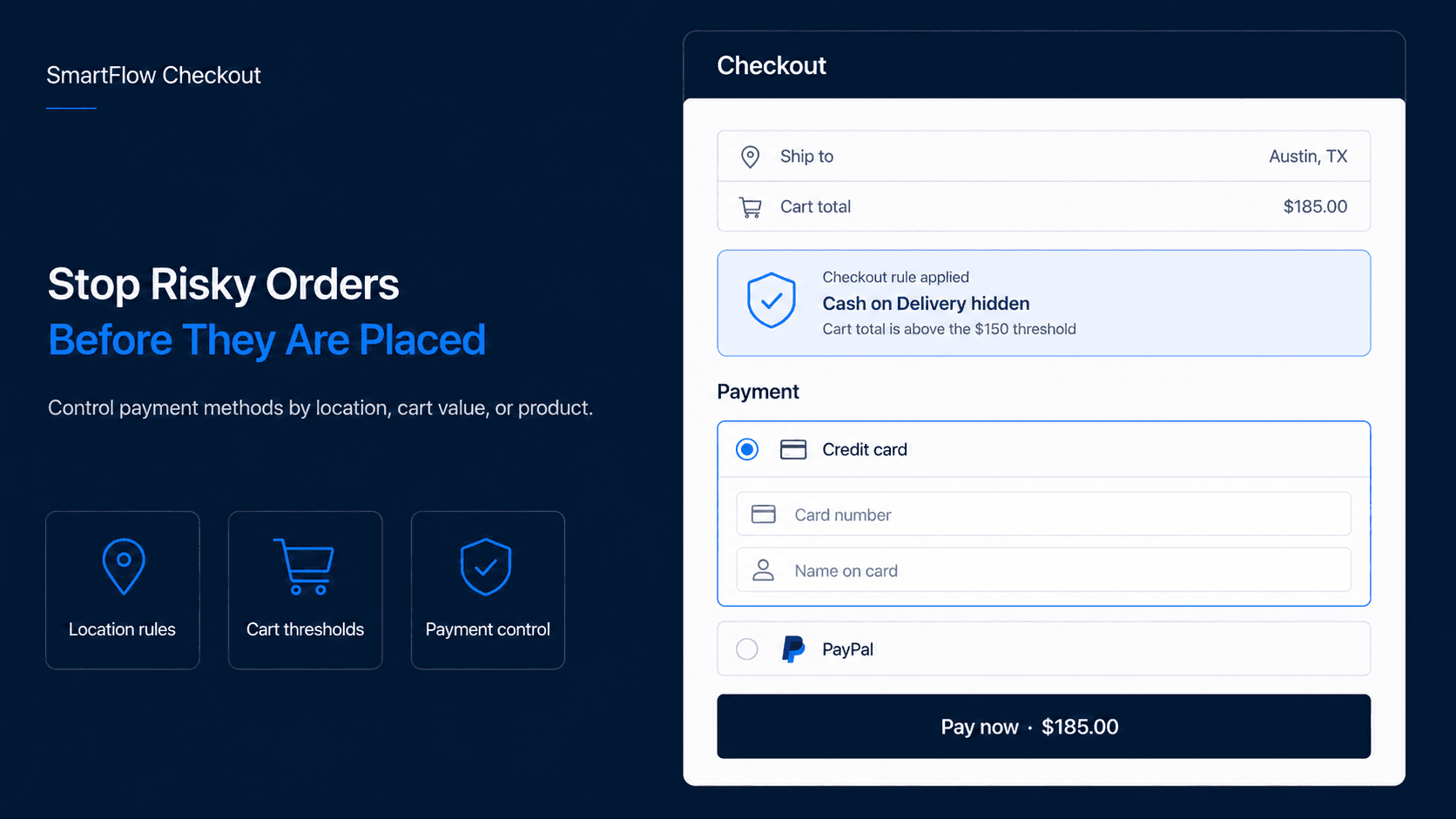
SmartFlow Checkout transforms your payment page into an active financial shield. By leveraging Shopify's Checkout Extensibility framework, SmartFlow allows you to create dynamic, conditional rules that govern which payment methods are visible to which customers in real-time.
Building Your Financial Shield
You do not need to hire a developer to manipulate complex backend logic. SmartFlow provides a visual interface to build precise gatekeeping rules.
1. Geographic Payment Fencing
If your data indicates that specific postal codes, states, or entire countries have an unacceptably high rate of COD refusals, you can lock them out instantly. You simply set a rule: If Shipping Country equals [High-Risk Country], hide 'Cash on Delivery' and hide 'Buy Now, Pay Later'. When a customer from that region reaches the payment step, those options simply do not exist on their screen. They are forced to use a standard, upfront credit card payment. If they are a legitimate buyer, they will pay. If they are a malicious actor, they will abandon the cart, saving you the cost of a failed shipment.
2. Cart Value Thresholds
Dropshippers often test high-ticket items to boost Average Order Value (AOV). However, exposing high-ticket items to COD or unverified payment gateways is incredibly dangerous. With SmartFlow, you can implement strict financial thresholds. You can set a rule: If Cart Subtotal is greater than $150, hide all alternative payment methods and only display 'Credit Card via Stripe'. This ensures your largest, most expensive orders are fully captured and verified before fulfillment begins.
3. Category-Specific Restrictions
Different products carry different risk profiles. If you are dropshipping a highly targeted electronics item (which has a notoriously high fraud rate), you need stricter rules than if you are selling a basic $15 phone case. SmartFlow can read the contents of the cart. If Cart contains items from the 'High-Risk Electronics' collection, hide Apple Pay and Google Pay (if your gateway struggles to verify them). By restricting the checkout flow based on the actual items being purchased, you maintain high conversion rates on safe products while locking down risky ones.
The Math of Prevention
Deploying proactive checkout rules is the highest-leverage activity a dropshipper can perform. By stopping just five fraudulent or refused COD orders a week, a store can recover thousands of dollars in pure net profit over a fiscal quarter.
Stop relying on manual reviews and post-purchase cancellations. Secure your checkout flow natively and protect the margins you work so hard to generate.
Frequently Asked Questions (FAQ)
Q: Will hiding COD hurt my conversion rate in countries that rely on it? A: Hiding COD will lower your raw conversion rate in those specific regions, but it will dramatically increase your profitable conversion rate. Revenue that you can't collect is not real revenue.
Q: Does SmartFlow work with third-party gateways like PayPal? A: Yes. SmartFlow can dynamically hide any payment gateway that is configured within your Shopify Payments settings, including PayPal, Klarna, Sezzle, and custom manual payment methods.
Q: Can I block specific IP addresses from checking out entirely? A: SmartFlow focuses on routing and payment visibility based on shipping data and cart contents. For hard IP blocking, you would utilize Shopify's native fraud filters in conjunction with SmartFlow's payment rules.