Profit from Protection: Adding a Shipping Insurance Toggle at Checkout
The Escalating Porch Piracy Problem
The explosion of direct-to-consumer e-commerce over the last decade has created a massive, rapidly growing problem: package theft. According to recent industry surveys, over 49 million Americans have had at least one package stolen from their doorstep. For e-commerce merchants, the financial and reputational impact is highly damaging.
When a customer contacts your support team claiming their package was stolen from their porch or arrived heavily damaged in transit, the merchant is immediately faced with an impossible choice:
- Absorb the Financial Loss: You choose to reship the item for free to preserve the relationship. The merchant pays for the original product cost, the original shipping fee, the replacement product cost, and the replacement shipping fee. On a $50 average order value, this can easily result in a $70 total loss.
- Deny the Claim: You tell the customer that the package was marked "Delivered" and instruct them to file a claim with UPS or FedEx. This process is incredibly slow, highly adversarial, and almost always results in a furious customer who leaves a 1-star review, initiates a credit card chargeback, and never returns to your store.
Neither option is good for business. Much like abandoned cart issues caused by poor UX, a negative post-purchase experience destroys customer lifetime value (LTV).
The Third-Party Insurance Trap
To combat this widespread issue, a wave of third-party shipping protection applications (like Route, Navidium, and Guide) emerged. These apps inject a checkbox at the cart stage offering customers the option to "protect" their package for a small fee (typically $1 to $3). If the package is lost, stolen, or damaged, the third-party company handles the claims process and pays for the reshipment.
This sounds great in theory. The problem lies entirely in the economics. These third-party providers take a massive commission (often 50% or more) of the insurance premium collected from your customers. The merchant is essentially paying a middleman to handle a process that, statistically, has an extremely low claim rate.
Consider the underlying math: If you sell 1,000 orders per month and 70% of customers opt-in to a $2.00 shipping protection fee, you collect $1,400. If your actual claim rate is 3% (30 claims), and the average reshipment cost is $25, your total claims cost is $750.
If you used a third-party app that took a 50% cut, you would only receive $700 of the $1,400 collected. You effectively broke even, or worse, lost money on the deal. But if you self-insured the process, you would pocket the full $1,400 minus the $750 in claims, netting $650 in pure, incremental profit.
Self-Insured Shipping Protection with SmartFlow Checkout
The smartest, most profitable merchants are eliminating the middleman entirely. By using SmartFlow Checkout to inject a native, branded shipping protection toggle directly into the secure checkout flow, the merchant collects 100% of the premium revenue and self-insures the claims.
Building a Profit Center from Risk
SmartFlow Checkout uses Shopify's modern Checkout Extensibility framework to inject a clean, on-brand UI component directly into the payment step. Here is a technical breakdown of how the architecture works:
1. Native Checkout Integration
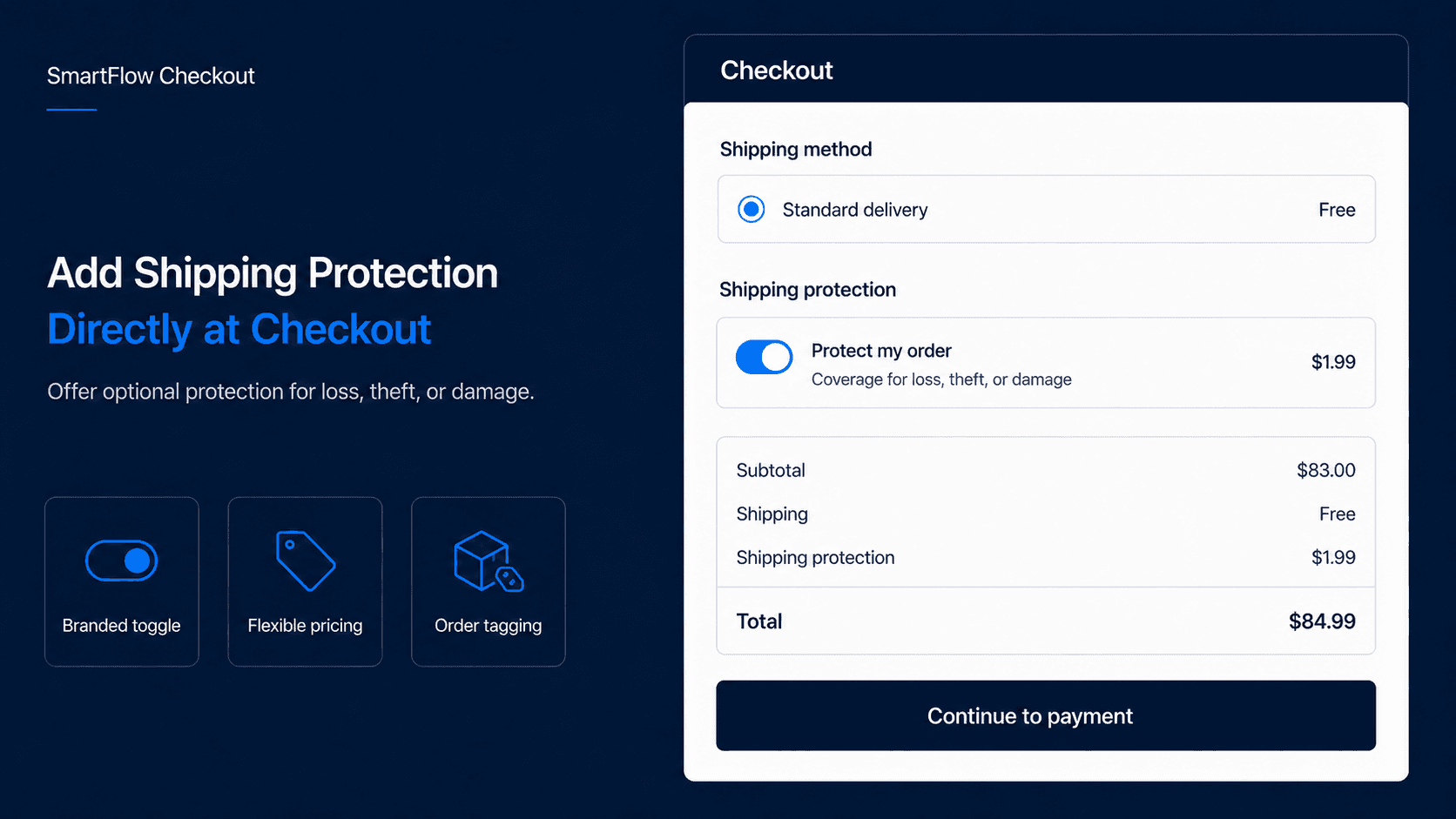
SmartFlow injects a visually appealing toggle switch or checkbox directly below the shipping method selection. It displays a clear, concise message: "Protect your order against loss, theft, or damage for just $1.99." Because this element lives natively within the secure checkout DOM (not a clunky pop-up or external cart-page widget), it feels like a built-in Shopify feature. This deep integration builds trust and achieves significantly higher opt-in conversion rates.
2. Dynamic Premium Pricing Rules
SmartFlow does not force a flat-rate premium across all orders. You can configure highly intelligent pricing rules based on cart value. For example:
- Orders under $50: Protection costs $1.49.
- Orders between $50 and $150: Protection costs $2.49.
- Orders over $150: Protection costs $3.99.
The premium dynamically adjusts based on the cart total in real-time, ensuring the price always feels proportional and fair to the customer, maximizing the attach rate.
3. Automatic Line Item Injection
When the customer toggles the protection on, SmartFlow does not just add a hidden note to the order payload. It dynamically adds a new, explicit line item to the checkout—"Shipping Protection"—with the calculated premium as the price. This ensures the revenue is cleanly tracked in your Shopify analytics and accounting software as a distinct revenue stream, completely separate from your core product sales.
4. Automated Order Tagging for Claims Workflow
Once the order is placed, SmartFlow automatically tags the order in the Shopify Admin with "Shipping-Protected." When a customer contacts your support team about a lost or damaged package, the agent simply checks the order for the tag. If it is present, the merchant immediately approves the reshipment with zero friction. If the tag is absent, the merchant follows their standard (and typically less generous) claims policy.
The Mathematics of Self-Insurance
The key insight that third-party apps do not want you to realize is that the vast majority of packages are delivered successfully. Industry data suggests that the average claim rate for shipping protection is between 2% and 5%. This means that for every 100 customers who pay $2.00 for protection, you collect $200, but you only need to reship 2 to 5 orders.
Even at a generous 5% claim rate with an average reshipment cost of $30, your cost is $150 against $200 collected. That is a 25% profit margin on a service that costs you absolutely nothing to provide. At scale, this adds up to tens of thousands of dollars in pure, incremental annual revenue that flows straight to the bottom line.
Stop giving your insurance profits away to third-party applications. Own the entire shipping protection workflow and turn risk into revenue with SmartFlow Checkout.