Read the Fine Print: Autonomous Contract Review & Red Flag Detection
The Contract Blindspot in SMBs
Every business, regardless of its size or industry, is bound by contracts. From the sprawling SaaS agreement for your email marketing platform, to the commercial lease on your office space, to the master services agreement with your third-party fulfillment warehouse—contracts govern the financial health and legal obligations of your entire operation.
For large enterprises, every single contract passes through a dedicated legal department before a signature is ever applied. A team of paralegals and specialized attorneys thoroughly reviews every clause, flags unusual terms, negotiates amendments, and protects the company's liability. This is the standard operating procedure for the Fortune 500.
For small and mid-size businesses (SMBs), however, the reality is starkly different. The founder or operations manager receives a dense, 40-page PDF from a new vendor. They know they should read it carefully. But they also know that hiring outside counsel to review a single commercial contract can cost anywhere from $500 to $2,000 per document, taking days to turn around.
So what do they do? They skim the first page, scroll to the last page, and sign it via DocuSign, hoping for the best.
The Real Cost of Not Reading
This "sign and hope" approach exposes businesses to massive, often invisible, financial risk. The most dangerous clauses in commercial agreements are explicitly designed to be buried deep within dense, unreadable legal language:
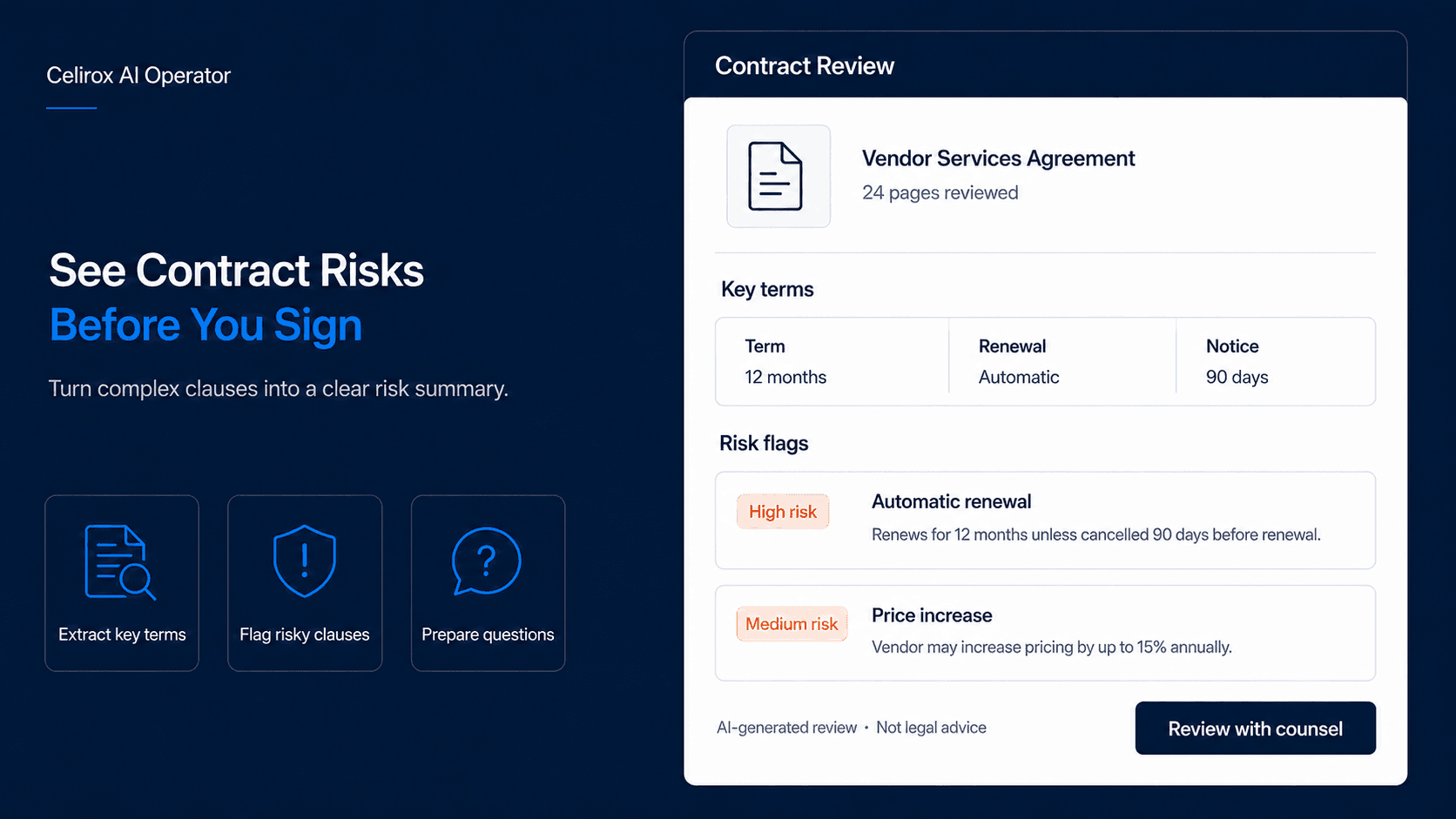
- Automatic Renewal Clauses (Evergreen Contracts): The contract states that it auto-renews for another 12 months unless written cancellation is submitted exactly 90 days before the renewal date. Most business owners miss this narrow window and are locked into paying for another year of software they no longer use.
- Unilateral Price Escalation: A clause buried on page 27 states that the vendor reserves the right to increase pricing by up to 15% annually with only 30 days notice. The business owner only discovers this when their monthly ACH debit suddenly jumps.
- Broad Indemnification: The contract shifts liability for third-party claims entirely onto your business. This means if the vendor's product causes harm to a customer, your company is legally and financially responsible for all damages and legal fees.
- Non-Compete and Exclusivity: A supplier contract quietly includes a clause preventing you from sourcing similar products from any competitor for 24 months after the termination of the agreement.
Any single one of these clauses, if missed, can cost a business tens of thousands of dollars or trap them in an highly unfavorable relationship for years. This is the legal equivalent of the errors caused by manual invoice processing, but with far more severe consequences.
Deploying an AI-Powered Legal Analyst
Reading contracts is fundamentally a pattern-recognition task. Identifying risky clauses requires comparing the specific language in a document against a vast corpus of known legal patterns, precedents, and industry standards. This is precisely the type of analytical work that Large Language Models (LLMs) excel at.
The Celirox AI Operator can be deployed as an autonomous contract analyst. It is capable of ingesting any legal document and producing a comprehensive, plain-English risk assessment in seconds, acting as your first line of legal defense.
From 40 Pages to a One-Page Summary
You do not need a law degree or a $500-per-hour attorney to perform routine contract reviews. You simply upload the PDF to the Celirox AI Operator and issue a clear directive:
"Read this commercial lease agreement in its entirety. Produce a structured summary that includes: (1) The key commercial terms (contract duration, total cost, payment schedule). (2) A list of every clause that could be considered a risk or disadvantage to my company, specifically including auto-renewal terms, price escalation rights, indemnification obligations, termination penalties, and non-compete restrictions. (3) For each flagged clause, provide a plain-English explanation of the risk and a suggested negotiation point."
Once deployed, the AI Operator executes a highly thorough, multi-pass analysis:
1. Full Document Ingestion and Parsing
The AI Operator accepts the contract in any common format: PDF, DOCX, or even a pasted block of text. Using advanced document parsing, it processes the entire document, correctly handling headers, footers, section numbering, and cross-references between clauses. Unlike simple keyword-matching tools from a decade ago, the LLM understands the semantic meaning of legal language within its full context.
2. Commercial Term Extraction
The first pass extracts the core business terms that the signer cares about most: What is the total contract value? What is the payment schedule (Net 30, Net 60)? What is the initial term length? What are the specific conditions for early termination? This information is formatted into a clean, scannable table for immediate review.
3. Risk Clause Identification
The second pass is the critical one. The AI systematically evaluates every clause in the document against a comprehensive framework of known contractual risk patterns. It does not rely on simple keyword matching (like merely searching for the word "indemnify"). Instead, it understands the intent and implication of each clause.
For example, if Section 8.3 states: "Client agrees to hold harmless and indemnify Provider against any and all claims arising from Client's use of the Services," the AI flags this immediately: "HIGH RISK: This is a broad indemnification clause. It shifts liability for any third-party claims onto your company, even if the claim arises from a defect in the Provider's own service. Suggested Negotiation: Request mutual indemnification language, limiting your obligation to claims arising solely from your own gross negligence."
4. Plain-English Risk Report
The final output is a structured, executive-friendly report. It is not written in confusing legalese; it is written for a business operator. Each flagged clause includes: the exact section number, a direct quote of the problematic language, a plain-English explanation of why it is financially risky, and a concrete suggestion for how to negotiate a better term with the vendor.
The Democratization of Legal Diligence
Deploying an AI Operator for contract review does not replace the need for an attorney in complex, high-stakes negotiations or M&A activity. What it does is democratize access to basic legal diligence for the hundreds of routine contracts that SMBs sign every single year without any review at all.
The 10-page SaaS agreement, the updated terms from your payment processor, the new lease addendum from your landlord—these documents no longer need to be signed blindly. Let the Celirox AI Operator read the fine print so you can operate and negotiate from a position of absolute knowledge.