effortless Internationalization: Adapting Checkout for Global Buyers
The Complexity of Cross-Border E-commerce
Expanding an e-commerce brand internationally is often viewed as the ultimate growth lever. The internet is borderless, and tapping into the European or Asian markets can double your total addressable market (TAM) overnight.
However, driving international traffic to your site is only the first step. The true bottleneck lies in the checkout experience. If a customer from Germany navigates to your US-based Shopify store, adds an item to their cart, and proceeds to checkout, they are typically met with a highly localized, high-friction wall.
They see shipping options via USPS (a carrier they aren't familiar with). They don't see their preferred local payment method (like Giropay or iDEAL). Most destructively, they have no idea if they will be slapped with massive import duties and VAT (Value Added Tax) when the package arrives at their local customs office.
Faced with this uncertainty, the international buyer will simply close the tab.
The Standard (and Flawed) Approach
Before this, merchants attempted to solve this by spinning up entirely separate Shopify "expansion stores" (e.g., brand.co.uk, brand.de, brand.au). This required massive operational overhead: syncing inventory across multiple backends, managing different product catalogs, and paying for duplicate apps.
With the advent of Shopify Markets, managing global sales from a single backend became possible. However, the standard checkout UI still remains remarkably static and confusing for the end-user.
Dynamic Localization with SmartFlow Checkout
To achieve true global scale, your checkout must act like a chameleon, instantly adapting to the cultural and financial expectations of the buyer.
SmartFlow Checkout leverages the Checkout Extensibility framework to inject dynamic, location-based rules that transform the checkout into a native experience for any customer, anywhere in the world.
The Mechanics of Algorithmic Adaptation
SmartFlow utilizes the customer's IP address (during the cart phase) and their verified shipping address (during the checkout phase) to execute a series of instantaneous UI modifications.
Here is how the automated localization architecture functions:
1. Dynamic Payment Gateway Pruning
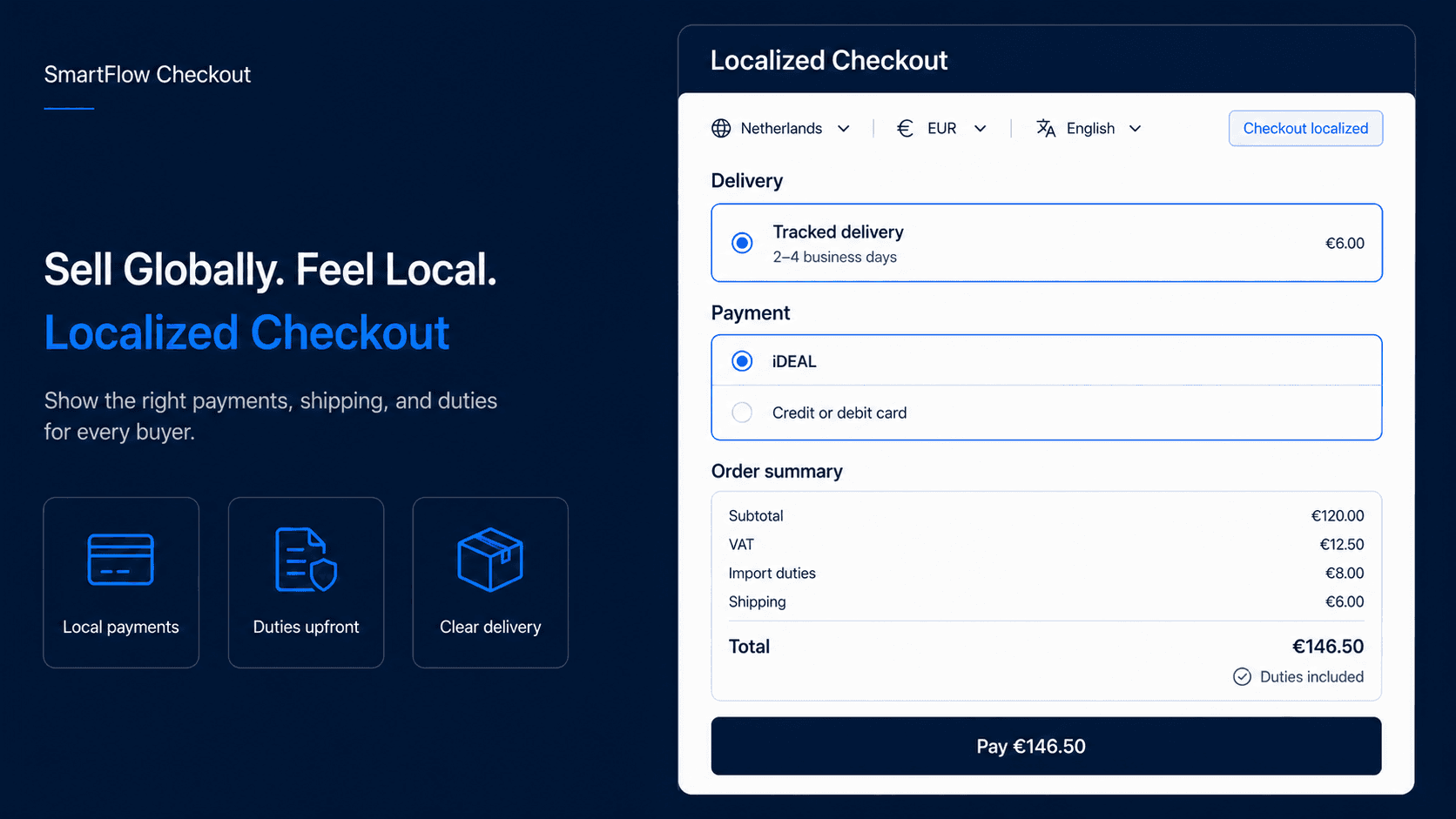
A cluttered checkout reduces conversion. If you offer 15 different payment methods to accommodate every global market, the UI becomes a chaotic mess of buttons. SmartFlow solves this through dynamic pruning. If the customer's shipping address is in the Netherlands, the checkout automatically hides "Afterpay" and prominently displays "iDEAL" (the dominant Dutch payment method). If the customer is in the US, "Klarna" and "iDEAL" are completely hidden, keeping the interface clean and focused solely on Shop Pay, Apple Pay, and standard credit cards.
2. DDP (Delivered Duty Paid) Transparency
The number one reason for international cart abandonment is "unexpected costs." If a customer buys a $100 jacket but gets hit with a $40 customs bill upon delivery, they will likely refuse the package (resulting in a costly RTS) and leave a scathing review. SmartFlow integrates deeply with Shopify Markets Pro or third-party tax APIs to provide absolute transparency. It dynamically injects a clear breakdown into the order summary: "Includes $12.50 VAT and $8.00 Import Duties." By collecting these fees upfront (DDP), the package sails through customs without delay, and the customer has total financial clarity.
3. Contextual Shipping Translation
International shipping nomenclature is confusing. A customer in London doesn't care about "USPS Priority Mail International." They want to know when it will arrive and who is delivering it. SmartFlow allows you to dynamically rename shipping methods based on the destination country. You can set a rule: If Country = UK, rename "Standard International" to "Evri Standard Tracked (3-5 Days)." This sharply increases buyer confidence.
4. Address Formatting Enforcement
Address formats vary wildly by country. Forcing a Japanese buyer into a standard US address form (Street, City, State, Zip) causes massive friction. SmartFlow detects the selected country and dynamically rearranges and re-labels the input fields to match local postal conventions, preventing validation errors and failed deliveries.
Competing on a Global Stage
To win internationally, your brand must feel local. By deploying dynamic, automated localization rules via SmartFlow Checkout, you eliminate the cognitive load and financial uncertainty that plague cross-border transactions.
Merchants utilizing dynamic checkout adaptation routinely see their international conversion rates jump by 30% to 50%. Stop losing global customers to a rigid UI. Adapt your checkout and conquer the global market.