Zero to SEO: Automating Bulk Product Meta Titles, Descriptions & Alt Text
The Invisible Store
You could have the most beautifully designed e-commerce storefront on the internet, with flawless product photography, aggressive pricing strategies, and a lightning-fast checkout flow. But if your product pages have empty meta titles, generic meta descriptions, and missing image alt text, Google's crawler algorithms essentially treat your store as invisible.
Search Engine Optimization (SEO) remains the single most cost-effective customer acquisition channel in e-commerce. Unlike paid advertising on Meta or Google Ads, where your traffic stops the moment you stop paying, organic traffic from Google is free and compounds over time. However, earning that organic traffic requires a foundational commitment: every single product page on your store must be properly optimized with unique, descriptive metadata that tells search engines exactly what the page is about.
The Problem of Scale in E-commerce SEO
For a small boutique store with 20 distinct products, writing unique SEO metadata is a manageable afternoon task for a founder. But for a growing brand with 500, 1,000, or even 5,000 active SKUs, the mathematical reality of manual SEO becomes brutal.
Each product page requires, at minimum:
- A unique Meta Title (under 60 characters) that includes the primary search keyword.
- A unique Meta Description (under 155 characters) that compels a click from the search results page.
- Image Alt Text for every product photo (critical for Google Image Search and ADA accessibility compliance).
If a store has 1,000 products with an average of 4 images each, that equates to 1,000 meta titles, 1,000 meta descriptions, and 4,000 alt text entries. Writing these manually takes roughly 2 to 3 minutes per product. That is over 50 hours of pure, focused copywriting labor. Most merchants simply never do it, leaving massive amounts of free organic traffic on the table. This is as financially inefficient as failing to dynamically adjust product prices against competitors.
The Hidden Cost of Default Metadata
When a merchant leaves the meta title blank, Shopify defaults to using the basic product title. When the meta description is blank, Google attempts to pull a random snippet of text from the first paragraph of the product description.
The result is a search listing that looks generic, uncompelling, and virtually identical to every other dropshipping store selling the same item. A customer searching Google for "organic lavender face serum" will click on the result with a tailored, benefit-driven meta description, not the one that simply says "Lavender Serum - My Store - Buy Now."
Deploying AI-Powered Bulk SEO with Store Operator
Writing thousands of unique, high-quality, constraint-based SEO entries is the exact type of repetitive, pattern-based task that artificial intelligence excels at.
The Celirox Store Operator can be deployed to independently audit and optimize the SEO metadata for your entire product catalog in a single, autonomous operation.
The Autonomous SEO Audit
You do not need to export massive CSV files or hire an expensive freelance copywriter to tackle your backlog. You simply issue a conversational directive to the Celirox Store Operator:
"Scan my entire Shopify product catalog. For every product that has a blank or default meta title, generate a unique, keyword-rich meta title under 60 characters. For every product with a blank meta description, write a compelling, benefit-focused description under 155 characters. For every product image missing alt text, generate descriptive alt text based on the product title and visual context. Apply all changes directly via the Shopify Admin API."
Once deployed, the Store Operator executes a systematic, catalog-wide optimization in four distinct phases:
1. Full Catalog Audit
The Store Operator queries the Shopify Admin API to pull the complete product catalog. It programmatically inspects every product for three core conditions: Is the meta title blank or identical to the product title? Is the meta description blank? Does any associated image have an empty alt text field? It compiles a prioritized list of every deficient product.
2. Contextual Content Generation
For each flagged product, the AI does not generate generic filler text. It reads the existing product title, product description, tags, and collection associations to deeply understand the item. It then crafts a meta title that naturally incorporates the most likely search query a customer would use.
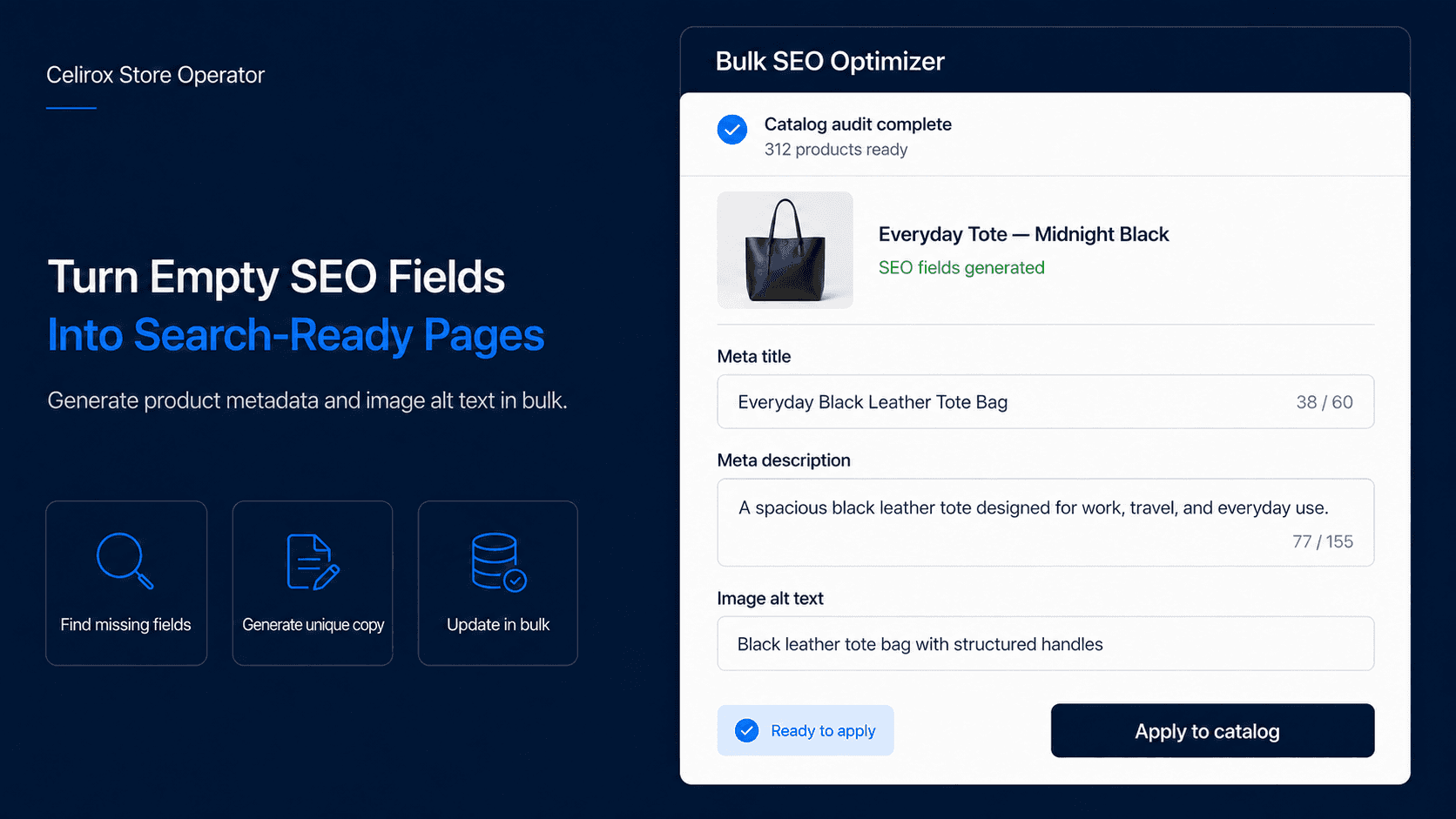
For example, for a product titled "The Everyday Tote - Midnight Black," the AI might generate:
- Meta Title: "Everyday Leather Tote Bag in Black | Free Shipping"
- Meta Description: "Crafted from full-grain leather, the Everyday Tote in Midnight Black fits a 15-inch laptop. Water-resistant lining. Shop now with free express shipping."
3. Image Alt Text Generation
For product images, the AI combines the product context with deep visual understanding. If the product is "Organic Lavender Face Serum" and the image shows a bottle on a wooden table with lavender sprigs, the generated alt text might be: "30ml bottle of organic lavender face serum on a wooden surface with dried lavender flowers." This is invaluable for both Google Image Search rankings and website accessibility compliance (WCAG/ADA), protecting merchants from legal liability.
4. Bulk API Application
The Store Operator does not require the merchant to review and manually copy-paste thousands of entries. It applies all generated metadata directly to the Shopify product records via the Admin API. The changes are live within minutes, not weeks.
The Compound Effect of Automated SEO
The beauty of SEO is that it compounds over time. Every product page you optimize is a new, permanent entry point for organic traffic. Within 30 to 90 days of deploying the Store Operator's bulk SEO audit, merchants consistently see a measurable increase in organic impressions and click-through rates from Google Search Console.
Stop leaving free traffic on the table. Let the Celirox Store Operator write the SEO copy your catalog has been missing since day one.