The Psychology of Quantity Breaks: Automating Volume Discounts
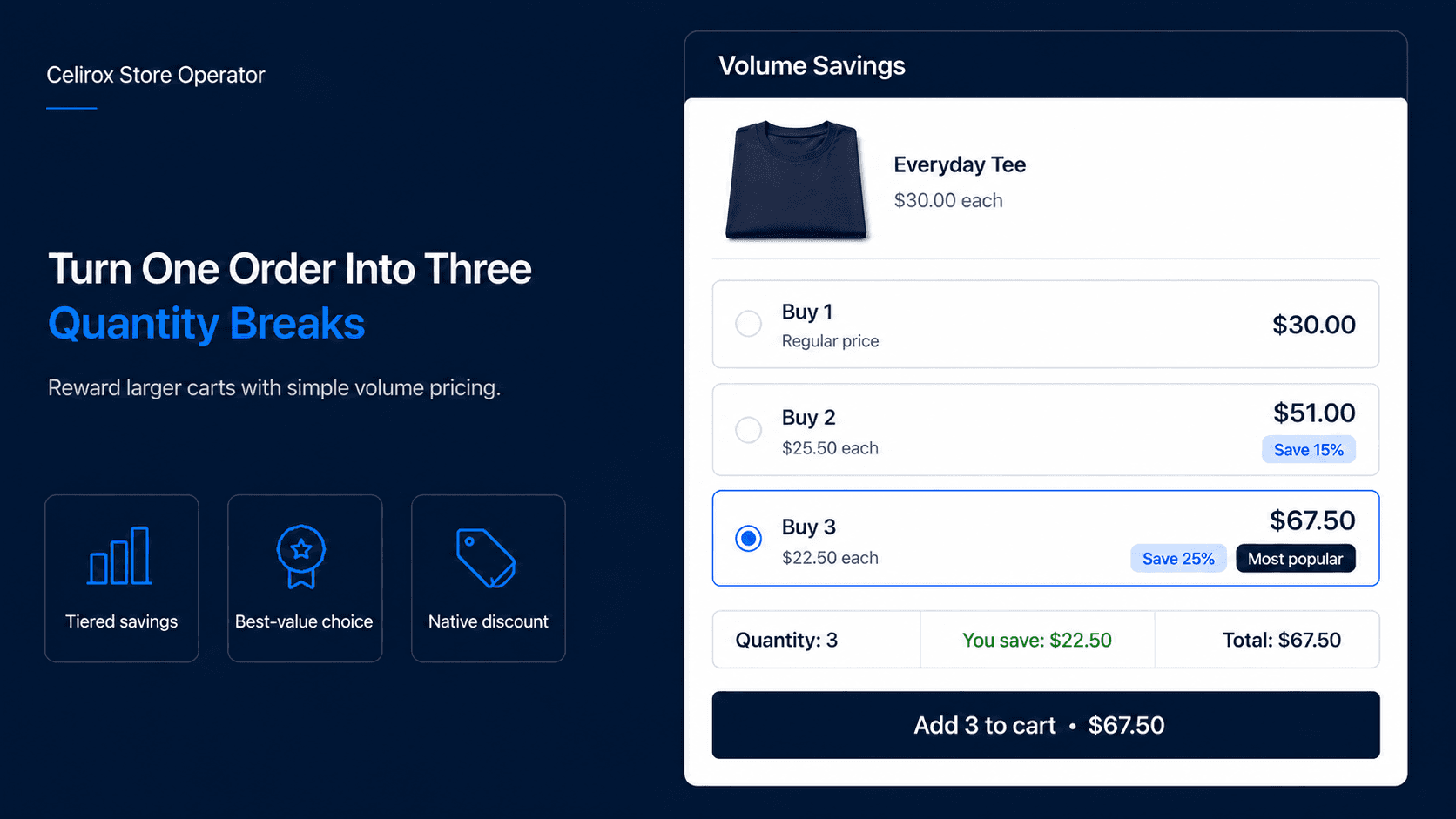
The Economics of High-Volume Carts
In direct-to-consumer (D2C) e-commerce, the single most destructive expense is the Customer Acquisition Cost (CAC). If you spend $30 on Meta Ads to acquire a customer who buys a $40 t-shirt, your margins are effectively nonexistent after accounting for Cost of Goods Sold (COGS) and pick-and-pack fulfillment fees.
The mathematical reality is simple: selling three t-shirts to one customer is infinitely more profitable than selling one t-shirt to three separate customers. You pay the CAC only once, and the dimensional weight of shipping three shirts in a single polymailer is marginally different than shipping one.
To scale profitability, merchants must incentivize customers to increase their cart size before they click the "Add to Cart" button. The most effective psychological mechanism for this is the Quantity Break (or Volume Discount).
The Technical Debt of Third-Party Apps
A Quantity Break strategy seems simple in theory: Buy 1 for $30, Buy 2 for $50 (Save $10), Buy 3 for $65 (Save $25).
However, implementing this UI on Shopify natively is incredibly complex. Because Shopify historically did not support tiered pricing out-of-the-box, an entire ecosystem of third-party "Quantity Break" apps emerged. Unfortunately, these apps are essentially flawed in their execution.
Most legacy bundling apps rely on "Draft Orders." When a customer selects the "Buy 3" tier, the app intercepts the checkout flow, creates a hidden draft order, applies a manual discount, and redirects the user. This causes several massive issues:
- Performance Drag: These apps inject massive Javascript payloads onto your product pages, causing the UI to flicker and dramatically lowering your Google Core Web Vitals score.
- Checkout Conflicts: Because they rely on Draft Orders, they often break compatibility with standard Shopify discount codes, subscription apps (like Recharge), and post-purchase upsell funnels.
- Inventory Errors: They often struggle to correctly decrement the inventory of the underlying SKUs.
Native Architecture with Celirox Store Operator
To maximize Average Order Value (AOV) without sacrificing site performance, the volume discount logic must be handled natively. Celirox Store Operator utilizes an LLM to instantly generate and deploy native, zero-friction Quantity Breaks using Shopify's newest Checkout Extensibility and Functions APIs.
The Conversational Deployment
You do not need to wrestle with complex app settings or hire a front-end developer. You simply instruct the AI:
"Create a Quantity Break widget for all products in the 'Basics' collection. Set up three tiers: Buy 1 at regular price, Buy 2 for 15% off, and Buy 3 for 25% off. Design the widget to look exactly like the active theme's variant selector buttons. Highlight the 'Buy 3' option as the 'Most Popular' choice."
Upon receiving this command, the Celirox AI executes a flawlessly integrated technical sequence:
1. Zero-Bloat DOM Injection
Celirox performs semantic analysis on your active Shopify theme (whether it is Dawn, Impact, or a custom build). It reads your CSS variables, border radiuses, font families, and button hover states. It then dynamically generates the HTML for the Quantity Break widget and smoothly injects it directly into the product page DOM, right above the "Add to Cart" button. Because the code is native HTML/CSS rendered server-side, there is absolutely zero Javascript bloat or "flickering" when the page loads.
2. Shopify Functions (Backend Logic)
Instead of relying on fragile Draft Orders, Celirox writes the tiered discounting logic directly into Shopify's backend using Shopify Functions. This means the discount calculation happens on Shopify's servers in milliseconds. When the customer proceeds to checkout, the 25% discount is cleanly applied as an item-level discount.
3. Seamless App Compatibility
Because the logic uses Shopify Functions, the checkout remains completely native. The customer can still use their Shop Pay installment plans, they can still apply an additional standard discount code (if you allow stacking), and your post-purchase upsell flows will trigger perfectly.
4. Behavioral Nudges (The "Most Popular" Badge)
Conversion Rate Optimization (CRO) is highly dependent on visual hierarchy. The AI automatically injects a subtle, visually distinct "Most Popular" or "Best Value" badge on the highest volume tier. This creates a psychological anchor, pushing the customer to view the "Buy 1" option as a mathematically poor decision compared to the heavily discounted bundle.
The AOV Transformation
By removing the technical friction and presenting a clear, financially compelling offer at the exact moment of purchase intent, merchants utilizing native Quantity Breaks consistently increase their AOV by 20% to 35%.
Stop paying expensive monthly fees for bloated apps that slow down your store. Let the Celirox AI Operator build elegant, high-converting volume discounts natively.