They Bought the French Press. What Happens If the Glass Breaks?
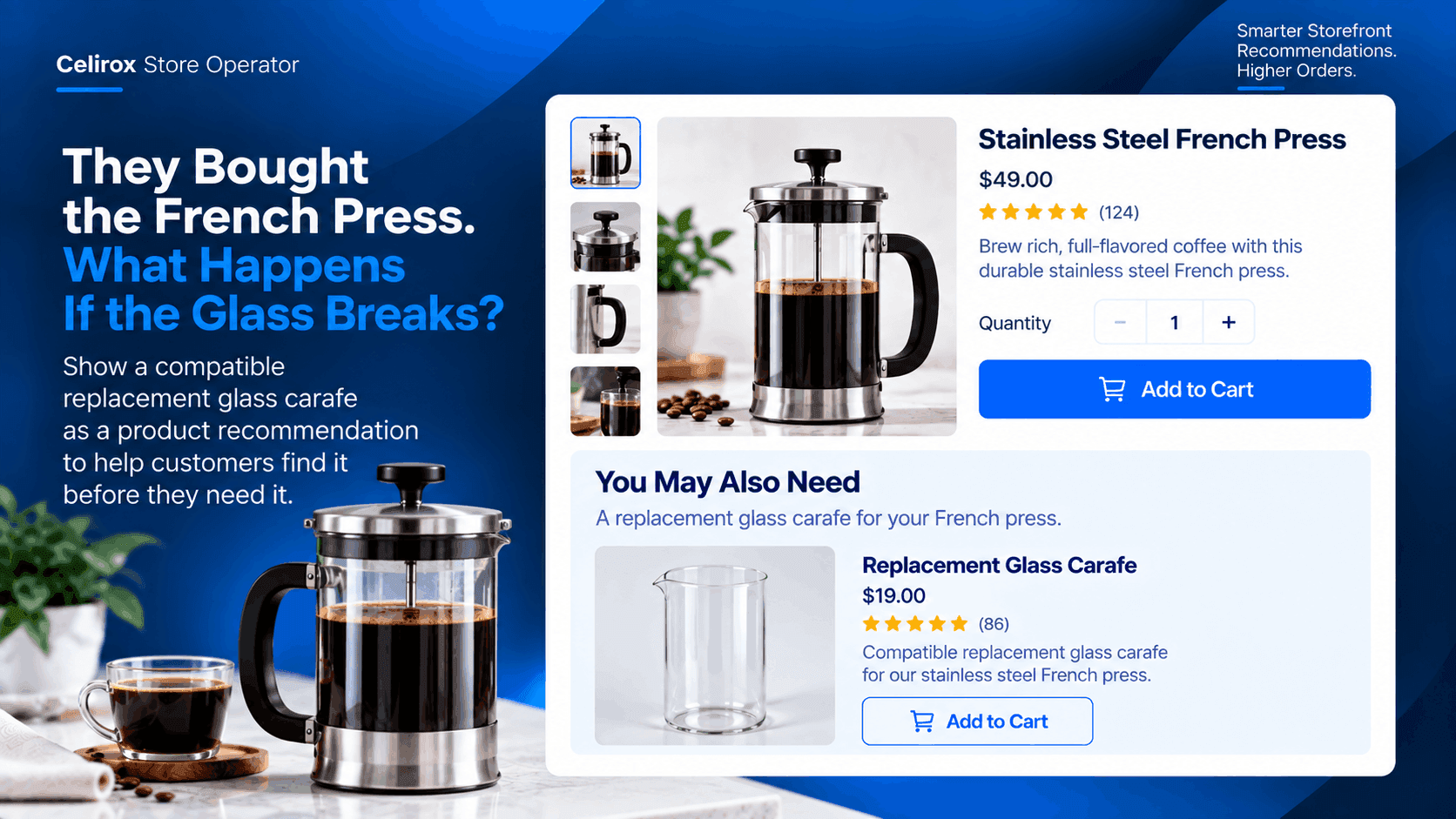
A customer is shopping for a new French press.
They find a Stainless Steel French Press, check the size, look at the design, and add it to their cart.
The purchase makes sense.
But there is another product the customer may not be thinking about yet.
A replacement glass carafe.
Glass can eventually crack or break. When that happens, the customer may start searching for a replacement from scratch.
The merchant already sells one.
The problem is that the customer may never know it exists.
The Useful Product Is Easy To Miss
Coffee equipment stores often sell products that naturally belong together.
A French press and its replacement carafe are one example.
But customers don't always browse a store with future problems in mind.
Someone shopping for a French press is thinking about today's purchase.
They are not necessarily searching for replacement parts.
That makes the storefront an important place to introduce relevant products.
Show The Recommendation At The Right Moment
Imagine the customer opens the product page for the Stainless Steel French Press.
Instead of showing an unrelated coffee accessory, the store can surface the replacement glass carafe that belongs with it.
The recommendation has context.
The customer is already looking at the French press.
The additional product solves a specific problem connected to that purchase.
That is much more useful than simply displaying another random product.
The Merchant Knows The Connection
The store owner already understands the relationship between the products.
The French press is the primary product.
The replacement carafe is the supporting product.
The challenge is making that relationship visible to shoppers.
Store Operator is designed to help merchants manage storefront workflows and recommendations through plain-English instructions rather than requiring them to build everything manually.
That means the merchant can describe the storefront change they want and configure the relevant product relationship.
A Simple Storefront Instruction
The merchant could define the recommendation around the French Press:
Recommend the compatible replacement glass carafe with the Stainless Steel French Press.
The goal isn't to redesign the whole store.
It isn't to recommend every coffee accessory.
It is one specific relationship between two products.
That keeps the storefront experience focused.
The Customer Sees A Useful Option
The customer may not need the replacement immediately.
But now they know it exists.
They can understand that the store sells a replacement for an important component of the French press.
For some shoppers, that extra information can make the original purchase feel easier to maintain.
The recommendation becomes useful even when the customer doesn't buy the additional product today.
Recommendations Should Have A Reason
A product recommendation works better when there is an obvious reason behind it.
Consider these two experiences.
French Press → Replacement Glass Carafe
The connection is immediately understandable.
Compare that with showing a completely unrelated coffee product simply because it happens to be popular.
The first recommendation answers a question the customer may eventually have.
“What do I do if I need to replace the glass?”
That makes the recommendation part of the product experience rather than just another promotion.
It Helps The Store Think Beyond One Sale
The merchant's relationship with the customer doesn't have to end with the first purchase.
A replacement product gives the store another useful product connection.
The customer discovers a maintenance option.
The merchant makes an existing product easier to find.
And the storefront becomes more informative.
This is especially useful for products that have replaceable components, accessories, or compatible add-ons.
Keep Product Relationships Organized
As a store grows, these relationships become harder to manage manually.
There may be dozens of primary products.
Each may have its own compatible accessory or replacement component.
The merchant doesn't want to create confusing recommendations across the catalog.
A focused storefront workflow can keep each relationship tied to the product where it makes sense.
For this coffee equipment store, the rule can remain simple:
Stainless Steel French Press → Compatible Replacement Glass Carafe.
The Recommendation Solves A Future Problem
The interesting part of this use case is that the customer may not need the replacement today.
That's okay.
The purpose of the recommendation is discovery.
If the carafe breaks months later, the customer already knows where to look.
Instead of searching the wider internet for a compatible replacement, they may remember that the original store carries one.
A small storefront recommendation can therefore support the customer beyond the initial purchase.
Store Operator Keeps The Setup Practical
Store Operator provides zero-code storefront setup through the Shopify theme editor and App Embed, while its chat-based interface lets merchants give instructions in plain English.
That makes this kind of storefront change practical for a merchant who doesn't want to build a custom recommendation system.
The merchant can focus on the business relationship:
Which product should recommend which related product?
The storefront configuration can then be handled through the available Store Operator workflow.
One Product, One Relevant Recommendation
The store doesn't need a complicated recommendation strategy.
Start with one product.
Find the product that naturally belongs with it.
Make that connection visible.
For this store, the workflow is:
Customer views the Stainless Steel French Press.
The storefront presents the compatible replacement glass carafe.
The customer discovers an option they may need later.
That is a small change, but it has a clear purpose.
Frequently Asked Questions
What product is being recommended?
The use case connects a Stainless Steel French Press with its compatible replacement glass carafe.
Why recommend a replacement product?
Customers may not think about replacement parts when making their initial purchase. Showing the relevant replacement gives them useful information before they need it.
Is this the same as recommending random accessories?
No. The recommendation is based on a direct product relationship: the replacement carafe is connected to the French Press.
Does Store Operator support storefront setup?
Yes. Store Operator supports zero-code storefront setup through Shopify's theme editor and App Embed workflow.
Can merchants give Store Operator instructions in plain English?
Yes. Store Operator includes a chat-based interface designed around natural-language instructions.
Make Useful Products Easier To Find
The customer came to buy a French press.
They didn't come looking for a replacement carafe.
But that doesn't mean the replacement isn't useful.
When the store connects the two products at the right moment, the customer gets information they may otherwise miss.
The merchant also gets a clearer product relationship on the storefront without turning the entire shopping experience into a wall of recommendations.
Good product recommendations don't have to be complicated. Sometimes they simply help customers discover the thing they'll need next.