A Customer Is Ready to Buy. But What If They Don't Want to Pay the Full Amount Today?
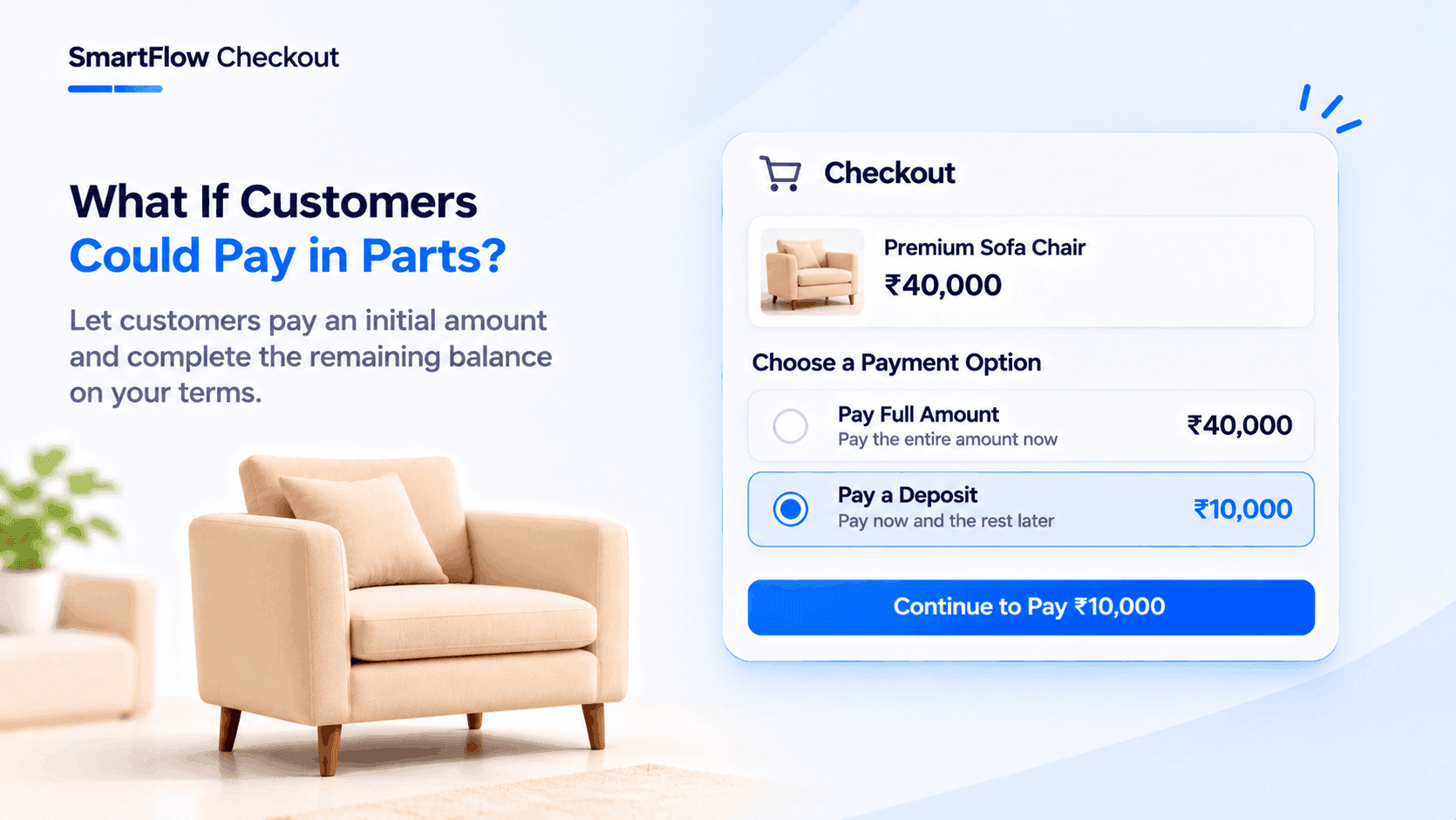
Imagine a customer visiting an online furniture store.
They find a premium sofa priced at ₹40,000. They like the design, check the dimensions, review the delivery information, and decide they want to purchase it.
But there is one hesitation: paying ₹40,000 in a single transaction doesn't suit their budget right now.
They close the checkout page and decide to think about it later.
The merchant had a customer who was interested and ready to purchase, but the full upfront payment became a barrier.
Now imagine the store offered another option: pay ₹10,000 initially and complete the remaining ₹30,000 according to the merchant's payment terms.
For customers who prefer spreading their payment commitment, that option could make the purchase easier to consider.
This is where partial payments can become useful.
Why Full Upfront Payment Isn't Always Ideal
Many online purchases are straightforward. A customer selects a product, pays the full amount, and receives an order confirmation.
However, not every purchase fits this pattern.
Consider products such as:
- Premium furniture.
- Expensive electronics.
- Custom-made products.
- Large equipment.
- High-value orders that require advance commitment.
For these purchases, customers may be interested in the product but hesitant to pay the entire amount immediately.
A partial payment arrangement gives merchants another way to structure the purchase. Instead of requiring the complete order value at the initial payment stage, the merchant can collect an agreed amount first and arrange the remaining balance separately.
It is not suitable for every store or every product, but it can be useful when the business model supports deposits or staged payments.
What Is a Partial Payment on Shopify?
A partial payment allows a customer to pay only a portion of the order amount initially rather than paying the full amount at once.
For example, consider an order worth ₹40,000:
| Payment detail | Amount |
|---|---|
| Total order value | ₹40,000 |
| Initial payment | ₹10,000 |
| Remaining balance | ₹30,000 |
The customer pays ₹10,000 initially. The remaining ₹30,000 is handled according to the merchant's payment arrangement.
The important distinction is that collecting a deposit does not automatically mean the remaining amount has been collected. Merchants need a clear process for communicating, tracking, and collecting the outstanding balance.
Deposit Payments vs Full Payments
A full payment requires the customer to pay the complete order amount during checkout.
A deposit arrangement collects an agreed portion initially, with the remaining balance due later under the merchant's stated terms.
Both approaches can serve different customer needs.
For example, a customer purchasing a low-cost kitchen accessory may prefer paying the full amount immediately. Someone ordering a custom dining table may prefer paying a deposit first.
The merchant should decide which products qualify, how much the initial payment should be, and when the remaining balance becomes due.
What Merchants Should Decide Before Offering Partial Payments
Partial payments need clear rules. Simply allowing customers to pay less without explaining the remaining obligation can create confusion.
Before enabling a deposit option, merchants should consider:
- Initial payment amount: Decide whether the customer pays a fixed deposit or a percentage of the order value.
- Remaining balance: Clearly communicate how much is still outstanding.
- Payment deadline: Specify when the remaining amount must be paid.
- Order handling: Explain whether processing or fulfilment begins after the deposit or after the full balance is received.
- Refund and cancellation terms: Make the applicable policies clear before customers place an order.
Clear communication helps customers understand their commitment and helps merchants manage orders more consistently.
How SmartFlow Checkout Fits In
SmartFlow Checkout includes partial payment functionality for merchants who want to offer an alternative to collecting the entire order amount upfront.
For example, a store selling premium furniture could configure a partial payment arrangement so eligible customers can pay an initial amount rather than the full order value at the beginning.
This gives merchants another way to structure the payment experience around their products and business requirements.
The merchant still needs to define the payment terms and establish how the outstanding balance will be handled. The exact payment setup should be checked against the store's payment provider, Shopify configuration, and applicable platform requirements.
The objective is straightforward: give customers a suitable payment arrangement while keeping the merchant's payment expectations clear.
Frequently Asked Questions
Can Shopify customers pay a deposit instead of the full amount?
Partial payment arrangements can be offered through suitable Shopify-compatible functionality and payment setups. The available options depend on the merchant's configuration and payment provider.
What is the difference between a deposit and a partial payment?
A deposit is an initial amount paid toward a purchase. Partial payment describes paying less than the full amount initially, with the outstanding balance handled later. In many ecommerce arrangements, a deposit is a form of partial payment.
Can merchants choose how much customers pay initially?
The available deposit amounts and configuration options depend on the partial payment solution being used. Merchants should check the supported settings before deciding on their payment structure.
When should customers pay the remaining balance?
That depends on the merchant's payment terms. The due date or payment schedule should be communicated clearly before the customer completes the initial payment.
Are partial payments suitable for every Shopify store?
Not necessarily. They are most relevant to businesses selling higher-value, custom, made-to-order, or other products where a deposit arrangement makes commercial sense.
Give Customers Another Way to Complete Their Purchase
A customer who hesitates at checkout isn't always rejecting the product. Sometimes, the payment arrangement simply doesn't fit their immediate needs.
For suitable products, partial payments can provide another way to move forward. Customers can make an initial commitment, while merchants establish clear terms for collecting the outstanding balance.
Start by identifying products where deposits make sense, defining the payment conditions, and explaining those conditions before checkout.
Explore SmartFlow Checkout to learn more about checkout customization and partial payment functionality.