When Products Ship Differently, Your Checkout Should Know
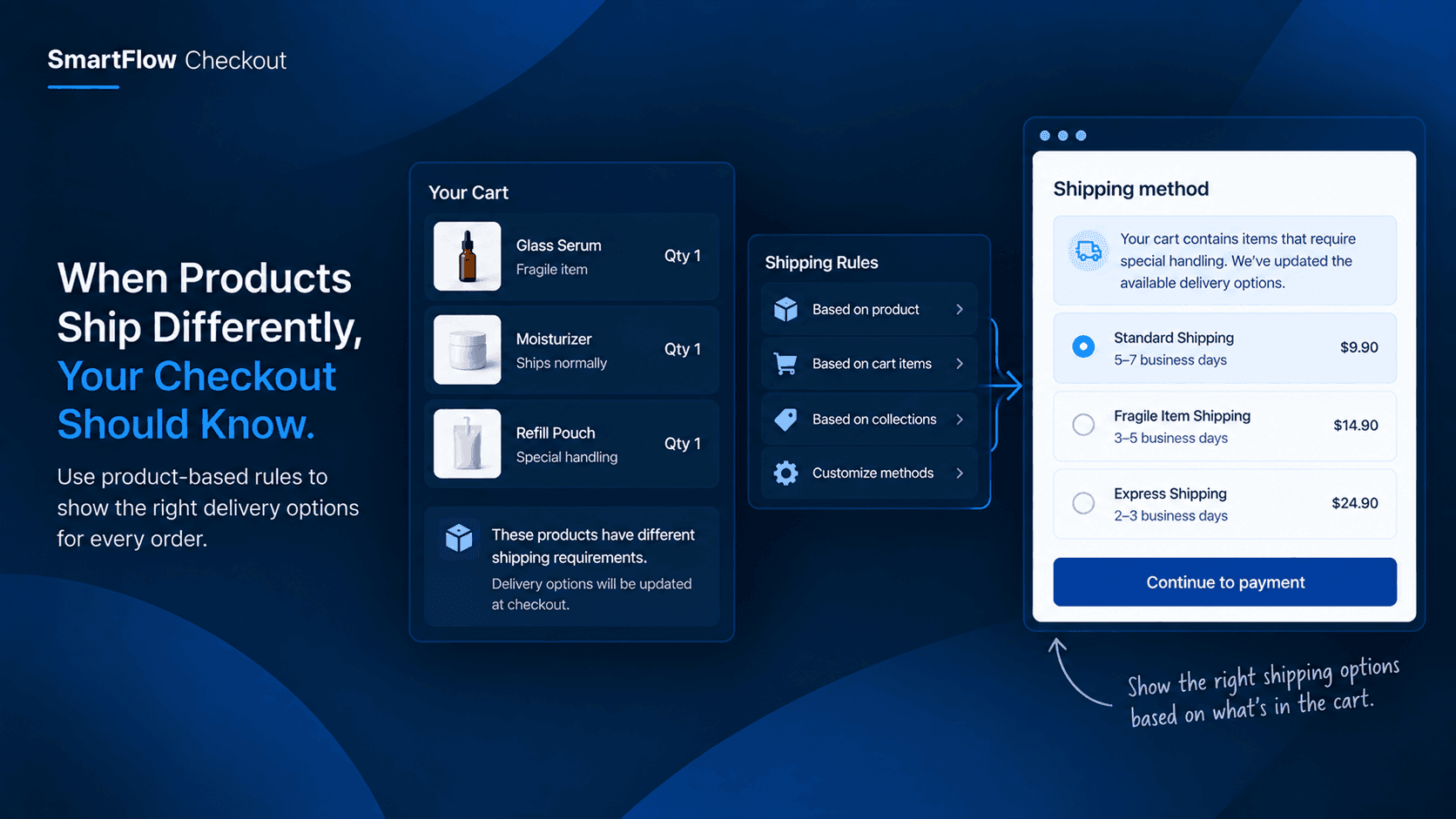
A customer adds three products to the cart.
A glass serum bottle.
A moisturizer.
And a large refill pouch.
From the customer's perspective, it is one order.
They expect to choose a delivery option and move on.
But the fulfillment team sees something different.
The serum needs careful handling.
The moisturizer can ship normally.
The refill pouch has completely different packaging requirements.
The customer does not need to understand any of that.
The fulfillment team does.
And if checkout treats every cart the same way, the problem may only become visible after the order has already been placed.
That is when someone has to figure out how to fulfill an order that was allowed to choose a delivery method that does not really fit what is inside the box.
One Cart Can Have Different Needs
Many Shopify stores sell products that do not all behave the same way during fulfillment.
A clothing store may sell standard garments alongside oversized products.
A skincare business may sell glass bottles alongside liquids.
A food merchant may sell products with different handling requirements.
A furniture store may sell small accessories alongside products that require a completely different delivery process.
The customer sees these products together in one shopping cart.
The warehouse does not.
For the warehouse, the products determine how the order needs to be packed, handled, and delivered.
That difference is easy to overlook when building a checkout experience.
The merchant thinks about individual products.
The customer thinks about the complete order.
The delivery method needs to make sense for both.
The Problem Appears After Checkout
Imagine a merchant has a special delivery arrangement for fragile products.
When a customer buys the fragile product by itself, the fulfillment team knows exactly how to handle it.
But customers can also purchase that product together with regular products.
The checkout still shows the normal shipping choices.
The customer selects the cheapest option and completes the order.
Now the fulfillment team opens the order.
They see the fragile product.
They see the selected shipping method.
And someone realizes that the selected method is not the one the business normally uses for that product.
The order is already paid.
The customer expects it to be delivered.
The team now has to solve a problem that could have been addressed while the customer was still checking out.
This is where product-based checkout logic becomes useful.
Products Can Change Delivery
A shipping method that works for one product may not work for another.
That does not necessarily mean the merchant needs a completely different shipping strategy for the entire store.
The rule may only need to apply when a particular product is present.
For example:
If the cart contains a fragile glass product → show suitable delivery methods.
Or:
If the cart contains an oversized product → remove delivery methods that cannot handle the order.
Or:
If the cart contains a product from a special handling collection → show only the delivery options appropriate for that product.
The important part is that the checkout responds to what the customer is actually buying.
The customer should not have to understand the merchant's fulfillment process.
The checkout should simply present the options that make sense for the order.
When Two Products Change Everything
Product combinations can make this even more important.
Consider a merchant selling specialty food products.
One product can be shipped normally.
Another product requires special handling.
Customers can purchase either product separately, but they can also put both into the same cart.
Now the delivery requirement is determined by the combination.
If the customer buys Product A, normal delivery works.
If the customer buys Product B, a different delivery method is required.
If the customer buys A and B together, the merchant needs a delivery option that works for the complete order.
This is not really a customer-service problem.
It is a checkout logic problem.
The customer is simply buying two products together.
The merchant needs the checkout to recognize that the combination changes the fulfillment requirement.
Tell Checkout About The Products
SmartFlow Checkout allows merchants to customize delivery methods using conditions based on products and cart information, along with other supported order and shipping conditions. :contentReference[oaicite:0]{index=0}
That means a merchant can build a rule around an actual store requirement.
For example:
"When the cart contains products from our fragile collection, hide delivery methods that are not suitable for those products."
The merchant can then decide which delivery methods should remain available.
This is different from showing the same shipping choices to everyone.
The customer sees delivery options based on what is actually in the cart.
The business gets more control over how orders with special products move into fulfillment.
Think About The Fulfillment Team
A good checkout rule should start with the people handling orders after payment.
Ask what happens when a particular product appears in an order.
Does the warehouse need special packaging?
Does the product require a particular carrier?
Does it need a specific delivery service?
Is there a shipping method the team should never use for it?
Does combining it with another product change the way the entire order should be shipped?
These questions are more useful than starting with:
"Which shipping option should we hide?"
The shipping method is only the final part of the decision.
The real question is:
What does our fulfillment team need in order to handle this order correctly?
Once that requirement is clear, the checkout rule becomes much easier to design.
Don't Make Customers Figure It Out
Customers should not have to understand your warehouse.
They should not see a confusing list of delivery options and wonder which one is safe for a particular product.
They also should not have to contact support because the checkout offered an option that the store cannot actually use.
Suppose a customer buys a fragile item and sees three delivery choices.
If only one of those choices is appropriate, showing all three does not give the customer more freedom.
It creates uncertainty.
The customer may simply choose the cheapest option.
Later, the merchant has to explain why that choice cannot be used.
A better experience is to make the appropriate option available at checkout and remove unnecessary choices that create problems later.
Good checkout customization is often less about showing more options and more about showing the right options.
Build Rules Around Real Products
Product-based rules work best when they represent something the merchant already understands.
For example:
Fragile products → Special delivery
Oversized products → Freight-capable delivery
Special handling products → Appropriate carrier
Specific product combination → Compatible delivery method
The rule should be easy for the team to explain.
If the fulfillment manager can say:
"Whenever this product is in the order, we need this type of delivery,"
there is a strong foundation for a checkout rule.
SmartFlow Checkout can then help turn that business requirement into delivery customization without requiring the merchant to manually manage the shipping options for every individual order. :contentReference[oaicite:1]{index=1}
The goal is not to make the checkout complicated.
It is to make the checkout reflect the way the business actually fulfills orders.
Test The Complete Cart
Product-based delivery rules should be tested with real shopping situations.
Do not test only the special product by itself.
Test the combinations customers are likely to create.
For example:
- Special product alone
- Standard product alone
- Special + standard product
- Two special products together
- Multiple quantities of the special product
- Different destinations
- Different customer types
- Carts with other delivery conditions
The important question is always:
Does the available delivery choice still make sense for the complete cart?
A rule that works perfectly for one product may behave differently when another product is added.
Testing those combinations before the rule goes live can prevent the fulfillment team from discovering the problem later.
Prevent The Handoff Problem
The best time to solve a delivery mismatch is before the order becomes a fulfillment task.
Once the order reaches the warehouse, the customer has already paid and expects the business to deliver what was promised.
That leaves the merchant with fewer options.
Someone may need to contact the customer.
Someone may need to change the order.
The fulfillment team may need to find another carrier.
The merchant may have to absorb an unexpected cost.
Or the order may simply take longer to process.
A product-aware checkout can prevent many of these situations by making the delivery options reflect the products before payment is completed.
The checkout becomes the point where the business requirement is handled, rather than pushing the problem downstream.
Frequently Asked Questions
Why would a product affect shipping options?
Some products have different handling, packaging, carrier, size, or fulfillment requirements. A delivery method that works for one product may not be suitable for another.
Can shipping rules depend on products in the cart?
Yes. SmartFlow Checkout supports delivery customization using product and cart conditions, allowing merchants to control available shipping methods based on what customers are purchasing. :contentReference[oaicite:2]{index=2}
Can a product combination affect delivery?
Yes, a merchant can design rules around cart conditions so that the available delivery methods reflect the products being purchased together, subject to the supported conditions configured in SmartFlow Checkout.
Do customers need to know why a shipping option is unavailable?
Not necessarily. The objective is to present the delivery options that make sense for the order rather than exposing customers to internal fulfillment complexity.
Can this be useful for fragile products?
Yes. A merchant can use product-based delivery conditions when certain products require specific shipping or handling arrangements.
Can this work for oversized products?
Product-based conditions can be useful when certain products require different delivery methods because of their size or fulfillment requirements.
Should merchants create a rule for every product?
Usually, no. Start with products or product groups that genuinely create different fulfillment requirements. The goal is to solve real operational problems without making the checkout unnecessarily complicated.
What happens if customers combine special and normal products?
That combination should be part of the rule design and testing process. The merchant should determine which delivery method works for the complete order and configure the checkout accordingly.
Why test product combinations?
Because the correct delivery method for one product may not be correct when another product is added. Testing realistic carts helps make sure the checkout behaves correctly before customers place orders.
Does SmartFlow Checkout require custom code for this?
SmartFlow Checkout is designed to provide checkout and delivery customization without requiring merchants to build custom code for these supported configurations. :contentReference[oaicite:3]{index=3}
Make Checkout Match Fulfillment
Customers think about what they want to buy.
Your fulfillment team has to think about how those products can actually be delivered.
Those two perspectives meet at checkout.
When every product in the catalog can follow the same delivery process, a simple shipping setup may be enough.
But when certain products need different handling, treating every cart the same can create problems after the order is already placed.
A better approach is to let the products in the cart influence the delivery choices the customer sees.
The right products → The right delivery options → A cleaner handoff to fulfillment
SmartFlow Checkout gives Shopify merchants the ability to build delivery rules around product and cart conditions, helping the checkout reflect real fulfillment requirements before an order reaches the operations team. :contentReference[oaicite:4]{index=4}
The customer gets a simpler decision.
The fulfillment team gets an order that makes more sense.
And the merchant spends less time fixing a problem that could have been prevented at checkout.