How Did You Hear About Us? A Better Shopify Attribution Signal
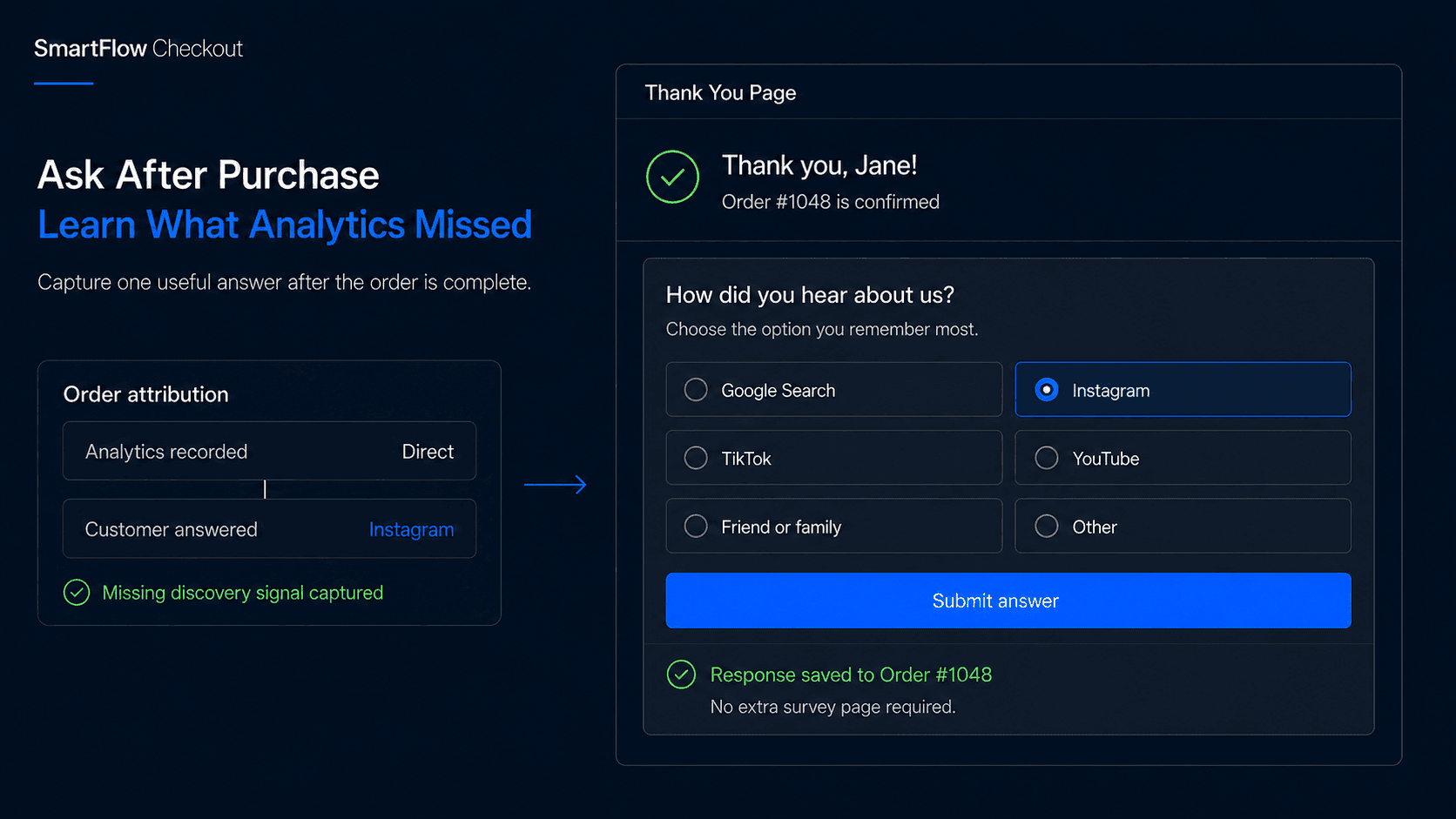
When Analytics Miss the Story
Imagine you run a Shopify store and 40 orders arrive over the weekend.
Your analytics dashboard says several customers came through direct traffic.
Instagram reports some conversions.
Google claims others.
Then you speak to one customer and hear:
"I first saw your product in a creator's Instagram Reel, searched your brand on Google two days later, and finally bought after my friend sent me the link."
Which channel deserves the sale?
The honest answer is that the customer journey was more complicated than a single attribution label.
That is why one simple question after purchase can reveal information your tracking stack may not capture clearly:
How did you hear about us?
It does not replace analytics.
It gives the merchant another perspective directly from the customer.
Why Attribution Gets Messy
Customers rarely discover a brand and purchase in one clean session.
Someone might first see a TikTok video, hear the brand mentioned on a podcast later, search it on Google a few days afterward, receive a link from a friend, and finally return directly to purchase.
Analytics tools can observe parts of that journey.
They may not reconstruct the entire sequence or explain which interaction the customer personally remembers as most influential.
Privacy changes, device switching, private messaging, offline conversations, and different attribution models make the picture even harder to interpret.
That does not mean advertising analytics are useless.
Platforms still use first-party data, modeled conversions, consented tracking, server-side integrations, and other measurement approaches.
The important point is simpler:
No single dashboard should automatically be treated as a perfect explanation of why someone purchased.
What Zero-Party Data Means
Zero-party data is information a customer intentionally provides directly to a business.
Instead of the merchant inferring something from browsing behavior, the customer tells the business themselves.
That can include:
- Product preferences
- Survey responses
- Communication preferences
- Purchase intentions
- Attribution answers
For marketing attribution, a question such as:
How did you hear about us?
creates what is often called self-reported attribution.
The customer is telling you which source they remember as part of discovering the brand.
That answer may not reconstruct every touchpoint.
But it can reveal influence that click-based analytics struggle to see.
Ask After the Purchase
Timing matters.
Ask too early and the survey becomes another decision between the shopper and payment.
Ask several days later by email and many customers may never answer.
The Thank You or Order Status experience provides a useful middle ground.
The purchase is already complete.
The customer is still engaged with the order.
That makes it a natural moment for one short question.
With SmartFlow Checkout, merchants can add post-purchase survey components to supported Shopify experiences and collect the answer without forcing customers into a separate survey flow.
The question can remain simple:
How did you hear about us?
Possible answers might include:
- Google
- Instagram
- TikTok
- YouTube
- Friend or family
- Podcast
- Influencer or creator
- Other
The exact choices should reflect how the store actually acquires customers.
A podcast-heavy brand should include podcasts.
A creator-led business may want individual creator names.
A local business may care about events or local recommendations.
The survey should match the marketing decisions the merchant needs to make.
Keep the Survey Focused
A simple attribution question can quickly turn into a long questionnaire.
The merchant starts with:
How did you hear about us?
Then adds:
Why did you purchase?
Which products interest you?
How would you rate your experience?
Would you recommend us?
What is your age?
Now the customer is doing homework.
If the current goal is acquisition attribution, keep the interaction focused.
One useful answer is often more valuable than six unanswered questions.
Other customer research can happen elsewhere in the journey.
The post-purchase experience does not need to collect everything the marketing team may eventually want to know.
Compare Both Attribution Stories
Self-reported attribution becomes most useful when it is compared with analytics instead of replacing it.
Imagine an order shows:
Analytics attribution: Google Search
but the customer answers:
YouTube
That is not necessarily a contradiction.
The journey may have looked like:
YouTube review → Customer remembers brand → Google search days later → Purchase
Google may represent the measurable visit that led to the transaction.
YouTube may represent where the customer believes their interest began.
Both signals tell the merchant something useful.
One describes the measurable path.
The other describes remembered influence.
That difference is especially important when evaluating channels that often create awareness before the final click.
Find Hard-to-Track Influence
Some discovery channels naturally leave weak or incomplete click trails.
Imagine a customer sees your product inside a private WhatsApp group.
They do not click.
The next morning, they search your brand on Google and purchase.
Analytics may correctly attribute the measurable website visit to Google.
But they may never reveal the WhatsApp recommendation that created the original interest.
The same thing can happen with:
- Word-of-mouth recommendations
- Podcasts
- Private communities
- Group chats
- Offline conversations
- Creator mentions without links
- Cross-device discovery
A post-purchase survey gives customers a chance to surface those influences directly.
This can be particularly useful for marketing activities where the merchant knows attention is being generated but traditional attribution consistently shows weak direct conversion.
That does not prove the channel deserves all the credit.
It gives the merchant another signal worth investigating.
Treat Answers as Signals
Self-reported attribution has limitations too.
Customers may remember the most recent interaction rather than the first one.
They may select the channel they remember most clearly even when several touchpoints influenced them.
Some may choose the easiest answer.
Others may interpret How did you hear about us? differently.
That is why the survey should not become the only attribution system.
A stronger approach combines:
- Advertising platform data
- Web analytics
- First-party purchase data
- Self-reported responses
Each source describes a different part of the customer journey.
When several signals consistently point in the same direction, the merchant has a stronger basis for investigation and budget decisions.
The goal is not to replace one imperfect attribution model with another.
It is to build a more complete view.
Use Responses for Decisions
Suppose a merchant spends:
$8,000 on Meta
$5,000 on Google
$3,000 on creators
Analytics strongly credit Meta and Google.
Creator campaigns appear weak.
After collecting post-purchase responses for several weeks, the merchant notices that many customers repeatedly name specific creators when asked how they first heard about the brand.
That does not mean the business should immediately move its entire advertising budget.
It means there is something worth investigating.
The merchant can compare the responses with discount codes, landing pages, customer cohorts, branded search activity, repeat purchases, and revenue.
The survey becomes a discovery tool rather than another dashboard claiming to know the entire customer journey.
Useful questions include:
- Which channels are mentioned most often?
- Which sources appear among higher-value customers?
- Are customers naming channels analytics underrepresent?
- Do answers change after a new campaign?
- Which creators or communities appear repeatedly?
Over time, those patterns can help explain how customers actually remember discovering the brand.
Frequently Asked Questions
What is a "How did you hear about us?" survey?
It is a short survey asking customers where they remember discovering the brand. Merchants commonly use it as a form of self-reported attribution.
Is a post-purchase survey zero-party data?
Yes. The customer intentionally provides the information directly to the business rather than the merchant inferring it from tracked behavior.
Does self-reported attribution replace analytics?
No. It works best as an additional signal alongside advertising attribution, web analytics, and first-party purchase data.
Why ask the question after purchase?
The order is already complete, so the survey does not add another step before payment. The customer's purchase journey is also still relatively fresh.
What answers should I include?
Use options that reflect how customers genuinely discover your business, such as Google, Instagram, TikTok, YouTube, creators, podcasts, referrals, communities, events, or other relevant sources.
Should I include individual creator names?
If creator marketing is important enough that you need to compare individual partnerships, more specific options can make the responses more actionable.
Can SmartFlow Checkout collect these responses?
Yes. SmartFlow Checkout can be used to add supported post-purchase survey components so merchants can collect customer-provided information after the order is completed.
Ask the Customer Too
Marketing teams can spend hours trying to reconstruct a customer's journey from several dashboards.
Sometimes it is also worth asking the person who actually made the purchase.
Not:
Which attribution model should receive conversion credit?
Just:
How did you hear about us?
The answer will not solve attribution by itself.
But when collected consistently and compared with other data, it can reveal creators, referrals, communities, podcasts, and conversations that are easy to overlook.
Analytics tells you what was measured → Customers tell you what they remember → Compare both
SmartFlow Checkout gives Shopify merchants a way to capture that additional signal as part of the post-purchase experience while the purchase is still fresh.