Build Shopify Product Bundles Faster with Celirox Store Operator
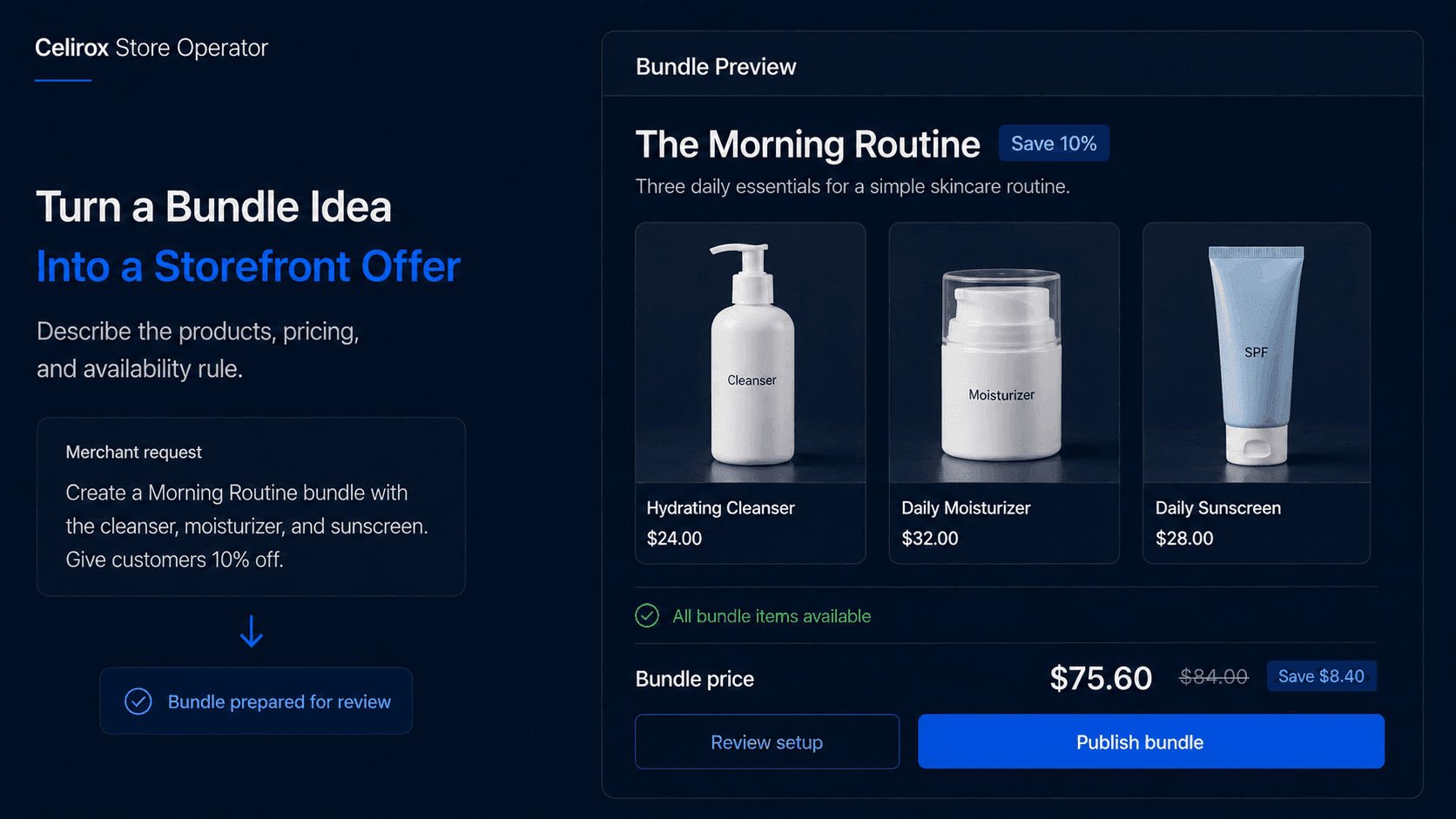
You Know What Belongs Together
Imagine you run a skincare store. Customers regularly buy your cleanser, moisturizer, and sunscreen separately. You already know those products make sense as a routine, and selling them together could make the buying decision easier while increasing the value of the order.
The idea itself takes a few seconds:
"Create a skincare starter bundle with the cleanser, moisturizer, and sunscreen and give customers 10% off when they buy all three."
The work usually starts after the idea. You need to choose the right products and variants, decide how the bundle should be priced, think about inventory, configure the offer, make sure it looks right on the storefront, and test what happens when someone actually buys it.
That gap between having a merchandising idea and getting it live correctly is where Celirox Store Operator can help.
What Makes a Bundle Work
A Shopify product bundle combines products or variants into one purchasing offer. A merchant might pair shampoo with conditioner, a camera with a memory card, a coffee machine with a starter coffee pack, or cleanser with moisturizer and sunscreen.
But simply putting products together does not make a good bundle.
The strongest bundles usually answer an obvious customer need. If someone buys their first espresso machine, they may also need coffee beans, a milk pitcher, or cleaning tablets. Instead of making the shopper discover each accessory separately, the merchant can present one clear offer:
Everything you need to start making coffee at home.
The bundle becomes useful because it reduces decision-making. The discount may help, but the discount is not the entire reason the products belong together.
This is an important distinction. Merchants often begin with:
"How much should we discount?"
A better first question is:
"Why would the customer want these products together?"
If that answer is weak, increasing the discount usually does not fix the underlying offer.
Start With Customer Need
The easiest bundle ideas often come directly from existing customer behavior.
Suppose customers frequently buy a cleanser and moisturizer together. Adding sunscreen creates a complete daily skincare routine. A photography store may notice that new camera buyers frequently need a memory card and spare battery. A fashion merchant may see customers repeatedly purchasing a particular hoodie and pair of joggers together.
These relationships give the bundle a clear purpose.
A useful test is simple:
Can the customer understand why these products belong together without needing a paragraph of explanation?
Compare a travel bundle containing a backpack, packing cubes, and a travel bottle with another bundle containing a backpack, T-shirt, notebook, socks, keychain, and water bottle simply because those products were available.
The first tells a story.
The second feels like a collection of products looking for a discount.
A bundle should reduce the customer's decision-making effort, not create another complicated decision.
Build Bundles Through Chat
With Celirox Store Operator, the merchant can begin by describing the merchandising outcome instead of translating it into a series of configuration steps.
For example:
"Create a bundle with the Classic Hoodie and Joggers. Give customers 15% off when they buy both and call it the Weekend Set."
Store Operator can interpret the request, identify the relevant store resources, prepare the required setup, and give the merchant an opportunity to review what will be created.
The workflow becomes:
Describe the offer → Identify products and rules → Prepare the setup → Review → Publish
The merchant can then refine the request conversationally.
For example:
"Change the discount to 10%, include only black and navy variants, and don't offer the bundle when either product is unavailable."
This is the useful part of the interaction. The merchant can think in terms of the offer they want to create instead of first figuring out which settings, conditions, products, and storefront components need to be configured.
Human judgment still matters. Store Operator can reduce configuration work, but it should not decide which products make commercial sense to bundle without the merchant's direction.
Choose the Right Bundle Type
Not every bundle should work the same way.
A fixed bundle works well when the merchant already knows exactly what belongs together. A Morning Routine Kit, for example, might contain one cleanser, one moisturizer, and one sunscreen. The customer purchases the set as defined.
A mix-and-match bundle makes more sense when choice is part of the offer. A candle store might let customers choose any three fragrances from a selected collection. A clothing merchant could allow the customer to choose a shirt color while keeping the rest of the outfit fixed.
Quantity-based offers solve another problem. A merchant selling protein bars might offer one box at the standard price, two boxes at a better per-box price, and three boxes at the best per-box price.
The correct structure depends on what the customer needs to decide.
If the products naturally belong together and require little customization, a fixed bundle keeps things simple. If personal preference matters, giving the shopper controlled choices may create a better experience.
The structure should follow the buying decision rather than forcing every product combination into the same template.
Protect Margin and Inventory
A bundle does not automatically need a large discount.
Suppose a main product costs $40 and the relevant accessory costs $15. Selling both together for $52 still gives the customer a visible saving while preserving more margin than an aggressive storewide promotion.
Convenience can also be part of the value. A camera buyer may appreciate being shown the correct memory card even without a large discount because the recommendation prevents them from forgetting something they need.
Before choosing the price, consider the product margin, existing promotions, whether customers already buy the products together, and whether the offer increases order value without making the final order less profitable.
Inventory deserves the same attention.
Imagine a Weekend Set containing one hoodie and one pair of joggers. If the joggers become unavailable, the merchant needs a clear rule for what happens to the bundle. A bundle is more than a visual product card because its availability depends on the products and variants underneath it.
This becomes especially important when several bundles share the same products. A popular component can affect multiple offers at once.
The merchant should therefore think about pricing and inventory before publishing, not after customers begin placing orders.
Know When Not to Bundle
Not every product relationship needs to become a bundle.
Sometimes a smaller recommendation is better.
A customer buying running shoes may appreciate an optional shoe-care product, but they may not want to commit to a complete outfit containing shoes, socks, shorts, a shirt, and a jacket.
Similarly, a bundle becomes weaker when the products have little relationship, one component is constantly unavailable, customers usually want different variants, or the discount removes too much margin.
The question is not:
"Can these products technically be bundled?"
It is:
"Does buying these products together make the customer's decision easier?"
If the answer is no, consider a product recommendation, cart upsell, checkout offer, or another merchandising approach instead.
The objective is not to create the maximum number of bundles. It is to create a small number of offers customers immediately understand.
Test Before You Publish
A merchant using Store Operator could start with:
"Create a bundle called Summer Essentials using the Linen Shirt, Chino Shorts, and Sunglasses. Give customers 12% off when they buy the complete set."
Before publishing, the merchant should review the important parts of the offer: whether the correct products and variants are included, whether the pricing preserves enough margin, what happens when a component becomes unavailable, and whether the offer is clear on desktop and mobile.
Then test the actual buying journey.
Open the bundle as a customer. Select the available options. Add it to the cart. Change quantities where relevant. Remove an item. Confirm the expected pricing. Check what happens when one of the underlying products becomes unavailable.
The configuration is not finished because the bundle appears on the storefront.
It is finished when the complete purchase works the way the merchant intended.
Measure What Customers Actually Want
Publishing the bundle is only the beginning.
The important question is whether customers actually find the combination useful.
Suppose 1,000 shoppers view a new bundle and almost nobody purchases it. The problem may not be technical. The products may not belong together strongly enough, the value may be unclear, or shoppers may prefer purchasing the items separately.
On the other hand, if customers repeatedly choose the bundle, that tells the merchant something useful about how those products are perceived.
Measure signals such as bundle purchases, conversion, average order value, margin, inventory movement, and whether the underlying products continue to sell separately.
Do not optimize for average order value in isolation.
A bundle that increases average order value while damaging conversion or margin may not be an improvement.
The useful question is:
Does this offer create a better and more profitable buying decision?
That keeps the analysis connected to the actual business rather than celebrating a larger cart for its own sake.
Frequently Asked Questions
What is a Shopify product bundle?
A Shopify product bundle combines multiple products or variants into one purchasing offer. Depending on the setup, the merchant may define the exact products or allow customers to choose from an approved selection.
What products should I bundle together?
Start with products that naturally solve the same customer need, complete one another, or are commonly useful together. A clear product relationship is usually more important than offering a large discount.
Do bundles need a discount?
No. Convenience, discovery, or a complete solution can provide value without a large discount. If you do offer savings, make sure the final order still makes economic sense.
What happens when a bundle item sells out?
That depends on how the bundle is configured and how its component inventory is handled. Merchants should decide what should happen when one of the required products or variants becomes unavailable and test that behavior before publishing.
Can bundles increase average order value?
They can encourage customers to purchase several relevant products together, but average order value should be evaluated alongside conversion, margin, inventory, and overall profitability.
How does Celirox Store Operator help?
Celirox Store Operator lets merchants describe the bundle they want in plain English and helps turn that request into the required store configuration. The merchant can review and refine the result before publishing.
Turn Ideas Into Storefront Offers
Most merchants already know some of the products that belong together.
They see the relationships in customer orders, support conversations, product usage, and their own knowledge of the catalog.
The harder part is often turning that merchandising idea into something customers can actually buy without spending unnecessary time translating the idea into configuration.
That is where Celirox Store Operator fits.
You describe the outcome:
"Bundle these products, use this pricing, apply these conditions, and show it this way."
Store Operator helps prepare the store setup, while you review the result and stay in control of what goes live.
The goal is not to create bundles everywhere.
It is to make it easier to launch the right bundle when you already know what your customers need together.