AI Agents vs. Zapier: When Business Workflows Need More Than Rules
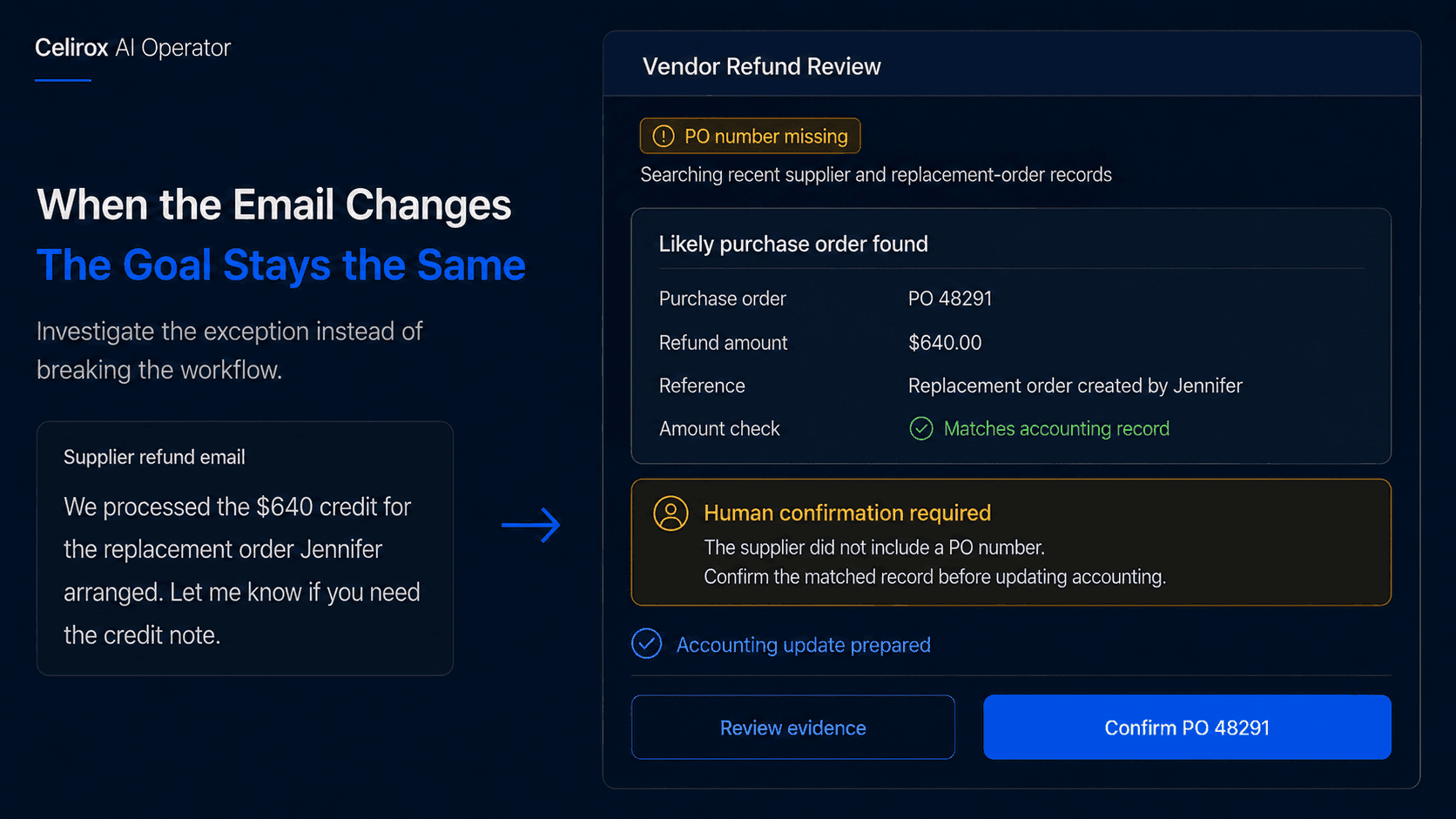
When the Workflow Stops Working
Imagine an operations team has a process for vendor refunds.
Most refund emails are predictable:
PO: 48291
Refund: $640
Reason: Damaged inventory
The workflow reads those fields, finds the purchase order, prepares the accounting update, and notifies the right person.
It works well because the input is structured and the expected path is known.
Then one supplier sends:
"We processed the credit for the damaged shipment from last Tuesday. It should be against the replacement order Jennifer arranged. The amount is $640. Let me know if you need the credit note."
There is no clearly labeled purchase order.
Now someone has to work out what "the replacement order Jennifer arranged" refers to, search previous records, find the likely transaction, compare the amount, and decide whether the evidence is strong enough to continue.
The business goal has not changed.
Process the correct vendor refund.
What changed is the path required to achieve it.
This is the difference between following a predefined workflow and handling an operational goal.
Fixed Workflows Still Matter
Zapier, Make, scripts, and other workflow systems solve an important problem extremely well.
When the process is predictable, deterministic automation is often exactly what a business should use.
Imagine a form submission that always needs to create a CRM contact and notify a salesperson. The trigger is known, the fields are known, and the actions are known.
There is little value in asking a reasoning system to decide what should happen every time.
A traditional workflow is easier to understand, test, monitor, and audit when the business logic looks like:
Event happens → Check known condition → Perform known action
Modern automation platforms have also become much more capable than simple "if this, then that" tools. They can include branching, filters, AI steps, approvals, and more sophisticated orchestration.
So the useful question is not:
Will AI agents replace traditional automation?
A better question is:
Which parts of the business are predictable enough for fixed rules, and which require interpretation before the next action can be chosen?
Complexity Changes the Problem
A workflow may start simple and become difficult only after real-world exceptions appear.
Suppose your company processes supplier invoices.
The original process might be:
Invoice arrives → Find purchase order → Compare amount → Prepare accounting entry
Then exceptions begin.
One supplier sends the invoice as a PDF attachment. Another sends only a statement. A third references the wrong purchase order. Another invoice contains a price that differs from the approved PO. One vendor has two open orders with nearly identical amounts.
You can keep adding branches to the workflow.
If the PO number is missing, search by vendor. If two records match, compare dates. If the amount differs by less than a certain threshold, continue. If the difference is larger, request approval.
There is nothing inherently wrong with this.
For predictable exceptions, explicit rules are often safer.
The problem appears when the number of branches keeps growing because the correct next step depends on understanding the situation rather than simply checking another field.
At that point, the team may spend more time maintaining the decision tree than improving the underlying operation.
What an Operator Changes
An operator-style system begins from a different starting point.
Instead of defining every possible route before work starts, the business defines the goal, available tools, constraints, and approval rules.
For example:
"Review new vendor refund notices. Identify the correct purchase order and refund amount, compare them with our records, and prepare the accounting update. If the information is ambiguous or the amount does not match, stop and ask for review."
One refund may require:
Read email → Find PO → Verify amount → Prepare update
Another may require:
Read email → Inspect attachment → Search recent orders → Compare vendor records → Detect ambiguity → Ask for review
The goal remains the same.
The route changes depending on what the system discovers.
That is the part that makes operator-style execution useful in operational work.
Where AI Operator Fits
Celirox AI Operator is designed around this kind of goal-driven business operation.
A finance team might say:
"Check incoming supplier invoices against purchase orders. If the supplier, quantities, and totals match, prepare the bill for approval. If something differs, explain the discrepancy and show me what needs attention."
A sales operations team might say:
"Review tomorrow's external meetings, find the relevant CRM records, gather the latest account context, and prepare a short briefing for each salesperson. If important CRM fields appear outdated, prepare suggested updates for review."
A support team might say:
"Review unresolved priority tickets, gather the customer and account context, identify the likely next action, and escalate anything that requires approval."
These are not just sequences of predetermined API calls.
Each instruction describes an outcome.
The Operator may need to inspect information, choose which connected system to check next, compare records, handle missing information, and decide whether it has enough confidence to continue.
A useful operating pattern is:
Understand → Investigate → Decide → Act → Verify
The exact tools used can vary with the situation.
Use Rules and Reasoning Together
AI does not need to make every decision.
In many cases, it should not.
Imagine a company has a rule:
Invoices above $25,000 require CFO approval.
There is no reason for a model to reinterpret that threshold every time.
Keep the rule deterministic.
Now imagine the invoice is $24,700, but it appears to duplicate another invoice from the same supplier and references a purchase order that was already fully billed.
That requires investigation.
This suggests a more practical architecture:
- Use fixed rules for predictable decisions.
- Use context-aware reasoning when the next step depends on what is discovered.
- Keep human approval for actions with meaningful financial, legal, security, or customer consequences.
The strongest operational systems often combine all three.
They do not replace reliable rules with AI simply because AI is available.
Know When Reasoning Helps
A process is a stronger candidate for operator-style execution when the difficulty comes from interpretation rather than the number of steps.
Several signals are especially useful.
First, information arrives in inconsistent formats. The same request may appear in an email, PDF, CRM note, support ticket, or message, and the important details are not always in the same place.
Second, the next action depends on context. "Process the refund if eligible" sounds straightforward until eligibility depends on payment status, contract terms, customer history, amount, or previous actions.
Third, missing information requires investigation. The correct response is not always "workflow failed." Sometimes the next step is checking another system, finding a related record, or asking someone for clarification.
Finally, completion needs verification. Sending an API request is not necessarily the same as completing the business task. The system may need to confirm that the downstream record actually changed.
When several of these conditions are present, a fixed workflow can become increasingly difficult to maintain.
Keep Predictable Workflows Simple
There are plenty of cases where an operator would add unnecessary complexity.
If the business process looks like:
Known event → Known condition → Known action
a deterministic workflow may still be the best solution.
Examples include:
- Copying a new lead into another database
- Sending an internal notification when a value crosses a fixed threshold
- Adding a spreadsheet row after a form submission
- Applying a known label when an exact condition is met
- Running a scheduled synchronization between structured systems
These processes benefit from predictability.
There is little value in introducing reasoning where no judgment is required.
A company should not replace a workflow that quietly performs the same reliable task thousands of times simply because agentic systems are becoming popular.
Keep what already works.
Keep Humans at Key Decisions
Giving software more freedom to choose actions also creates new risks.
An AI system can misunderstand ambiguous information. A connected application can return incomplete records. Two systems can disagree. A seemingly reasonable action may have financial or operational consequences that are difficult to reverse.
That is why autonomy needs boundaries.
A finance workflow might allow the Operator to investigate an invoice and prepare the accounting entry but require approval before creating a high-value bill.
A sales workflow might allow it to research an account and prepare CRM changes while requiring the account owner to approve changes to deal stage.
A security workflow might allow it to investigate an access mismatch but require human confirmation before removing a user's permissions.
The objective is not to remove people from operations.
It is to remove the repetitive investigation and mechanical work that happens before a meaningful human decision is required.
The Operator should make the decision easier to review, not hide the decision from the person responsible for it.
Ask the Right Question
Before rebuilding an existing Zap, Make scenario, script, or internal workflow, ask:
Is this process difficult because it contains many steps, or because the correct steps change depending on what happens?
If the process simply contains many predictable steps, traditional automation may still be ideal.
If the difficult part is interpreting incomplete information, investigating exceptions, deciding which path applies, recovering from unexpected situations, or determining whether the business goal was actually achieved, an operator-style system becomes more relevant.
That distinction helps avoid using AI where ordinary automation is already enough.
It also helps identify the workflows where more flexible execution could create real operational value.
Frequently Asked Questions
Are AI agents replacing Zapier and Make?
Not necessarily. Traditional workflow automation and operator-style systems solve overlapping but different problems. Predictable processes are often better handled with fixed rules, while more ambiguous work may benefit from contextual reasoning.
What is the main difference?
A traditional workflow normally follows predefined triggers, conditions, and actions. An AI Operator can work toward a defined goal and choose among available actions based on the context it discovers.
When should I keep a fixed workflow?
Keep it when the inputs, rules, and actions are predictable. Deterministic workflows are often easier to test, control, and audit.
When does an AI Operator help more?
It becomes more useful when work involves unstructured information, changing execution paths, investigation across systems, recurring exceptions, or the need to verify that the intended result actually happened.
Can an AI Operator make mistakes?
Yes. AI systems can misunderstand information or choose an inappropriate action. Permissions, validation, monitoring, approval rules, and verification are important for consequential operations.
Do I have to replace existing automations?
No. Existing reliable workflows can remain in place. An AI Operator is more useful for the operational work that still requires someone to interpret what happened and decide what should happen next.
Keep What Already Works
A workflow that quietly performs the same predictable task thousands of times does not need to become an AI agent.
Keep it.
The more interesting opportunity begins with the work that still makes someone stop and ask:
"Which record does this refer to?"
"Why did this fail?"
"What information am I missing?"
"What should happen next?"
"Is this safe to execute?"
"Did the task actually finish correctly?"
Those are the operational moments Celirox AI Operator is designed around.
Instead of defining every possible path before work begins, the business defines the goal, boundaries, tools, and approval rules. The Operator can investigate the situation, choose the appropriate next steps, and keep human judgment where it matters.
Fixed rules where the answer is known. Context-aware execution where the answer depends on the situation. Human approval where accountability matters.
That is a more practical way to think about AI agents and business automation than trying to replace every existing workflow.