One Cake Mold Works. But What If You're Baking All Day?
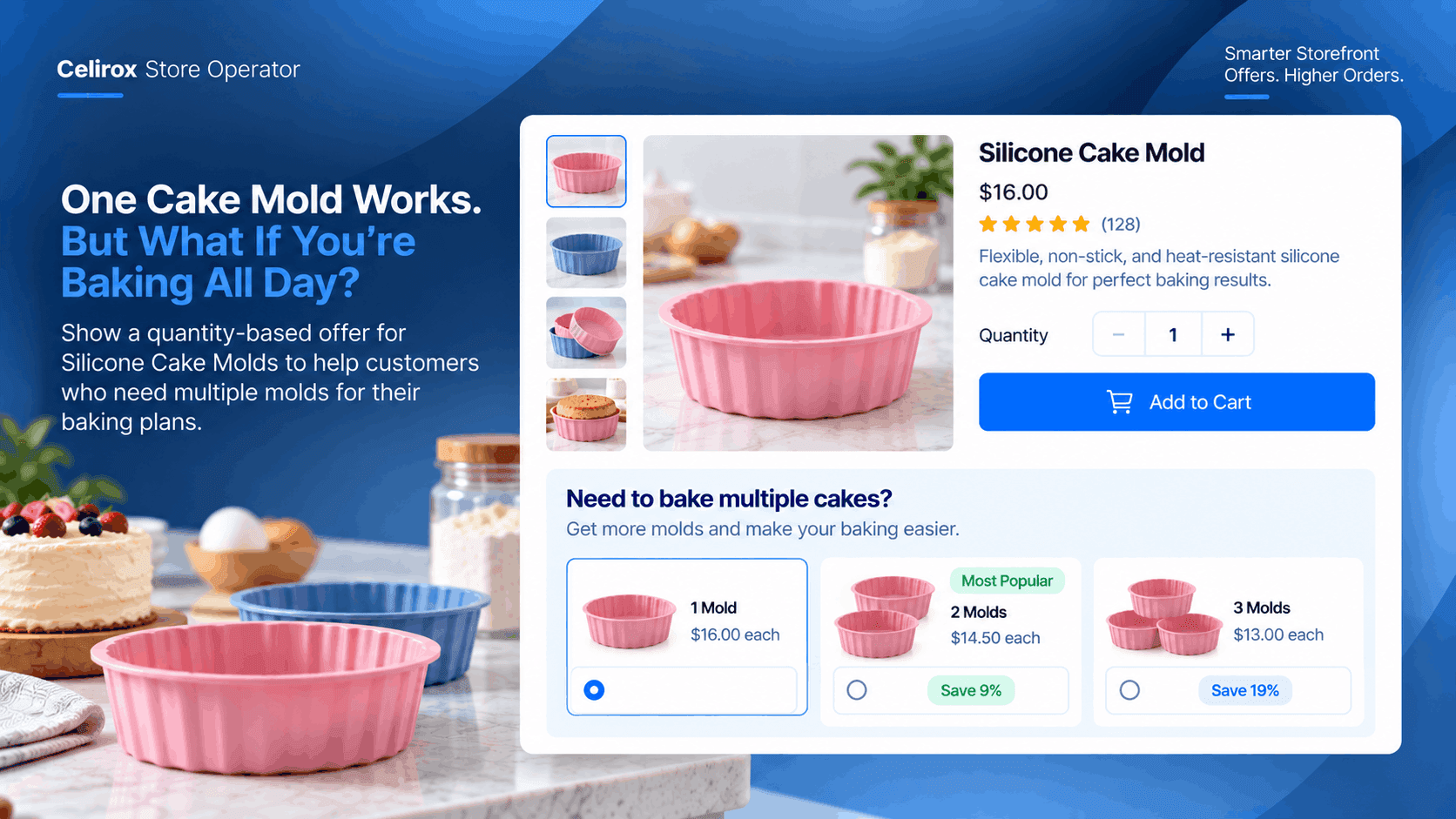
A customer is preparing for a birthday party.
They need to bake several cakes.
They visit a baking supplies store and find a Silicone Cake Mold that looks perfect.
So they add one to the cart.
Then they start thinking about the baking schedule.
One cake goes into the oven.
Then another.
Then another.
Suddenly, the customer realizes that having only one mold means washing, cooling, removing the cake, and preparing the mold again before starting the next batch.
The store sells multiple molds.
But the customer may never think to buy more than one.
The Customer Has A Bigger Need
The customer didn't necessarily come to buy multiple cake molds.
They came to solve a baking problem.
One mold technically solves it.
But if they're preparing several cakes, multiple molds can make the process easier.
This is where a relevant quantity offer can help.
Instead of waiting for the customer to figure it out themselves, the storefront can make the multi-unit option visible at the right moment.
One Product Can Need Multiple Units
Quantity offers make sense when the same product has a practical reason to be purchased more than once.
A Silicone Cake Mold is a good example.
Someone baking one cake may need one.
Someone preparing cakes for a party, bakery order, or large gathering may need several.
The customer already understands the product.
The store simply needs to make the quantity option easier to notice.
Don't Make It A Store-Wide Offer
The merchant doesn't need to create a quantity promotion for every product.
A rolling pin doesn't necessarily need the same offer.
Neither does a set of measuring spoons.
The reason for the offer is specific to the Silicone Cake Mold.
That keeps the storefront message relevant.
The customer sees an offer connected to the product they are already considering.
The Offer Appears Around The Product
Imagine the customer opens the Silicone Cake Mold product page.
They see the normal product information.
Then they see an option encouraging a larger quantity:
Need to bake multiple cakes? Consider buying 2 or more molds.
Now the customer has something to consider.
They may realize that buying multiple molds could save time during preparation.
The recommendation doesn't require the customer to search through the catalog.
It appears alongside the product that created the need.
The Merchant Can Encourage Larger Quantities
A quantity-based offer can be structured around the merchant's chosen product and offer rules.
For example:
Buy 2 Silicone Cake Molds and receive the configured offer.
Or the merchant could structure another quantity threshold that makes sense for the product and its margins.
The important point is that the offer is tied to the quantity of the specific product.
Store Operator can help merchants manage storefront workflows and offers through its available automation capabilities.
The Customer Still Makes The Choice
The purpose isn't to force the customer to buy multiple molds.
Someone baking one cake may only need one.
That's completely reasonable.
The quantity offer simply gives another option to shoppers whose situation is different.
A customer preparing ten cakes can see the value of buying multiple units.
A customer preparing one cake can continue with one.
The storefront supports both situations.
A Small Offer Can Change The Shopping Decision
The customer originally thought:
“I need a cake mold.”
The storefront introduces another possibility:
“Actually, I need several cake molds.”
That's an important difference.
The store isn't inventing a new need.
The customer already has a reason to use multiple units.
The offer simply helps them recognize that the store can fulfill that need in one purchase.
The Product Remains The Focus
This isn't about filling the page with promotional messages.
The product is still the main focus.
The quantity offer supports the product.
The customer understands what they are buying and why a larger quantity might make sense.
That makes the offer easier to understand than a generic message such as:
“Buy more products today.”
The context is clear.
Multiple cakes → multiple molds.
It Works For Event Baking
Consider a customer preparing desserts for a wedding, birthday party, or family gathering.
They may need several batches.
With one mold, each batch requires another cycle.
With multiple molds, several cakes can be prepared more efficiently.
The store may already have exactly what the customer needs.
The challenge is helping the customer see that before they complete the order.
A quantity offer provides that reminder.
The Merchant Can Keep The Rule Specific
The workflow can remain simple:
Customer views the Silicone Cake Mold.
The storefront presents the relevant quantity offer.
Customer decides whether one or multiple units make sense.
If they choose the qualifying quantity, the configured offer applies according to the merchant's setup.
There is no need to redesign the entire storefront.
There is no need to promote unrelated products.
One product gets one relevant quantity opportunity.
Why Product Context Matters
A quantity offer is much easier to understand when the customer can immediately see why it exists.
For the Silicone Cake Mold, the reason is practical.
More molds can help when more cakes need to be prepared.
That context makes the offer feel like part of the shopping experience rather than an unrelated sales message.
The customer can decide based on their actual baking plans.
Store Operator Keeps The Store Flexible
Store Operator is designed to help merchants manage Shopify storefront tasks through a chat-based interface and automation workflows.
That means a merchant can focus on the business instruction instead of manually managing every storefront adjustment.
For this baking store, the instruction is straightforward:
Create a quantity-based offer around the Silicone Cake Mold for customers who may need multiple units.
The merchant can then configure the offer according to the store's own pricing and promotion strategy.
One Mold Or Several?
The customer came looking for one cake mold.
They may still leave with one.
But another customer may realize they need three.
That difference matters.
A good storefront doesn't assume every shopper has the same need.
It gives customers relevant options based on the product they are considering.
For the baking store, the Silicone Cake Mold quantity offer does exactly that.
Frequently Asked Questions
Why would a customer buy multiple cake molds?
Customers preparing several cakes or multiple batches may find multiple molds more convenient than repeatedly waiting for one mold to become available.
Does the quantity offer need to apply to the whole store?
No. The offer can be focused on the Silicone Cake Mold rather than applying a generic quantity promotion across unrelated products.
Can customers still buy just one mold?
Yes. A quantity offer can present a larger-quantity option without requiring every customer to purchase multiple units.
Is this useful for event baking?
It can be. Customers preparing cakes for parties, gatherings, or other events may have a practical reason to purchase multiple units of the same mold.
Does Store Operator support storefront automation?
Store Operator provides storefront management and automation capabilities designed to help merchants make changes without manually handling every storefront task.
Make The Second Mold Easier To Consider
The customer already has a reason to bake.
They already found the mold they need.
The only missing thought may be:
“Do I need more than one?”
A relevant quantity offer can put that question in front of them at the right time.
For the merchant, it creates a focused opportunity around one product instead of another generic store-wide promotion.
For the customer, it makes a potentially useful option easier to discover.
Sometimes increasing the value of a product page isn't about adding another product. It's about helping customers choose the right quantity.