They Found the Journal. But Where's the Pen to Use With It?
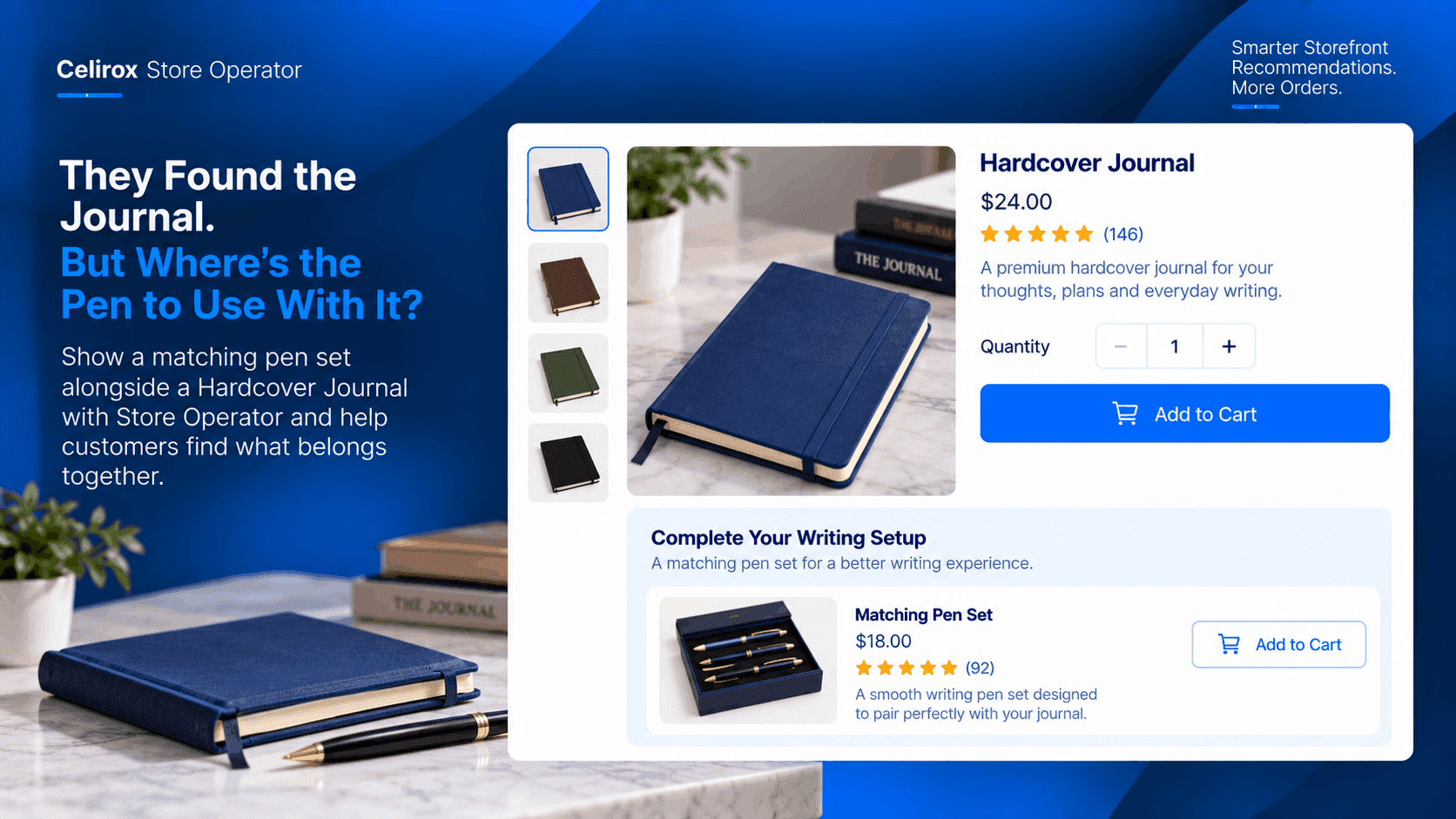
A customer walks into an online bookstore looking for a journal.
They want something substantial enough for daily writing, planning, or personal notes.
They find a Hardcover Journal that looks right.
The cover is exactly what they wanted.
The size works.
They add it to the cart.
Then they leave.
The store also sells a pen set that pairs naturally with that journal.
But the customer never sees it.
The problem isn't that the store lacks the product.
The problem is that the useful companion product is easy to miss.
The Journal Starts The Shopping Journey
A journal is already a complete product.
A customer can buy it and start writing.
But many journal shoppers also need something to write with.
The store knows this.
The customer probably knows it too.
Yet customers don't always browse related products after finding what they came for.
Once they find the journal, they may simply add it to the cart and head toward checkout.
That creates a missed discovery opportunity.
The Matching Pen Is Already There
The bookstore has a matching pen set in its catalog.
It isn't an unrelated accessory.
It has a clear connection to the journal.
Someone buying the journal may want the pen set for:
- Daily journaling
- Planning
- Note-taking
- Gifting
The store doesn't need to convince every customer to buy it.
It simply needs to make the option visible.
Put The Recommendation Where It Makes Sense
Imagine the customer is viewing the Hardcover Journal.
Under the product information, they see a simple recommendation:
Complete Your Writing Setup
Matching Pen Set
Now the customer immediately understands why the second product is being shown.
There is no need to search the bookstore for pens.
The recommendation appears at the exact point where the journal is being considered.
Relevance Matters More Than More Products
A storefront can display dozens of recommended products.
That doesn't mean all of them are useful.
Showing a bookmark, coffee mug, unrelated novel, and desk accessory alongside a journal may create more choices without creating more value.
A matching pen set is different.
The relationship is obvious.
Journal → Pen Set
The customer doesn't have to figure out why the recommendation exists.
The Merchant Can Define The Relationship
The bookstore owner already knows which products belong together.
The Hardcover Journal is the primary product.
The matching pen set is the companion.
The merchant can use Store Operator to help manage storefront changes and product recommendations through a chat-based workflow.
Instead of manually rebuilding the storefront every time a related-product relationship needs to be highlighted, the merchant can focus on the instruction:
Recommend the matching pen set with the Hardcover Journal.
The Customer Gets An Extra Option
The recommendation doesn't force a second purchase.
The customer can ignore it.
They can buy the journal alone.
Or they can decide that the pen set makes sense too.
That is important.
A useful recommendation should help the customer make a decision, not make the decision for them.
The store is simply showing something relevant at the right time.
It Can Also Help Gift Shoppers
A Hardcover Journal can also be purchased as a gift.
A customer buying it for someone else may appreciate seeing a matching pen set.
Instead of wondering whether the journal is enough, they can consider a simple combination.
The store has already done the work of identifying the companion product.
The shopper only needs to decide whether it fits their purchase.
The Recommendation Has A Clear Purpose
The strongest storefront recommendations answer a simple question:
“Why are you showing me this?”
For this use case, the answer is immediate.
The customer is buying a journal.
The store is showing a pen set that can be used with it.
There is no complicated explanation.
The product relationship does the work.
One Journal, One Companion
The store doesn't need a large recommendation engine for this particular use case.
It can start with one product relationship.
Primary product: Hardcover Journal
Recommended product: Matching Pen Set
Reason: Both products support the same writing activity.
That makes the storefront change easy for the merchant to understand and easy for the customer to understand.
Discovery Can Happen Before Checkout
Without the recommendation, the customer might never visit the pen section.
They may complete the journal purchase and leave.
The store could technically send another promotion later.
But the customer is already shopping for a writing product right now.
Showing the pen set during that shopping moment makes discovery more natural.
The recommendation becomes part of the product experience.
Store Operator Helps Keep The Storefront Useful
Store Operator is designed to help Shopify merchants manage storefront tasks through a chat-based interface and automation workflows.
For a bookstore, that can make product relationships easier to surface without requiring the merchant to manually manage every storefront adjustment.
The merchant can focus on the business logic.
Which product should be recommended?
Where should it appear?
Why is it relevant?
Once those decisions are clear, the storefront can be configured around them.
The Customer's Next Need Is Visible
The customer came looking for a journal.
They found one.
Then the storefront introduces something they may need next.
That's a small change.
But it improves product discovery without overwhelming the shopper with unrelated recommendations.
The store isn't trying to sell everything at once.
It is simply making one useful companion product easier to find.
A Simple Storefront Workflow
The complete experience can be straightforward:
Customer views the Hardcover Journal.
Store Operator's configured storefront recommendation presents the matching pen set.
Customer discovers the companion product.
They decide whether to add it.
The store keeps the shopping journey focused.
No complicated catalog-wide recommendation strategy is required for this use case.
Why Specific Recommendations Work
A recommendation becomes more useful when it reflects what the customer is already doing.
The shopper is writing.
The store shows something designed for writing.
That is the difference between relevance and noise.
The goal isn't to put more products in front of the customer.
The goal is to put the right related product in front of them.
Frequently Asked Questions
What product is being recommended?
The use case connects a Hardcover Journal with a matching pen set.
Why recommend a pen set with a journal?
The products serve the same basic activity. A customer purchasing a journal may also need a writing instrument.
Does the recommendation have to appear across the whole store?
No. The idea is to make the recommendation relevant to the Hardcover Journal rather than displaying it indiscriminately across unrelated product pages.
Can customers still purchase only the journal?
Yes. The recommendation simply presents another option. The customer remains free to purchase the journal alone.
Can Store Operator help manage storefront recommendations?
Store Operator provides storefront management and automation capabilities that can help merchants configure and maintain storefront experiences.
Is this the same as recommending random accessories?
No. The recommendation is based on a direct and understandable relationship between the journal and the pen set.
Help Customers Find What Belongs Together
The customer came looking for one thing.
They found the Hardcover Journal.
But the store had another product that naturally belonged with it.
Without a relevant recommendation, that product could remain invisible.
By connecting the journal with its matching pen set, the merchant makes the relationship obvious at the moment it matters.
The customer gets another useful option.
The store creates better product discovery.
And the recommendation doesn't need to become complicated.
Sometimes the best recommendation is simply the product that naturally belongs beside the one the customer is already buying.