The Product Is Cheap. Shipping It Alone Isn't.
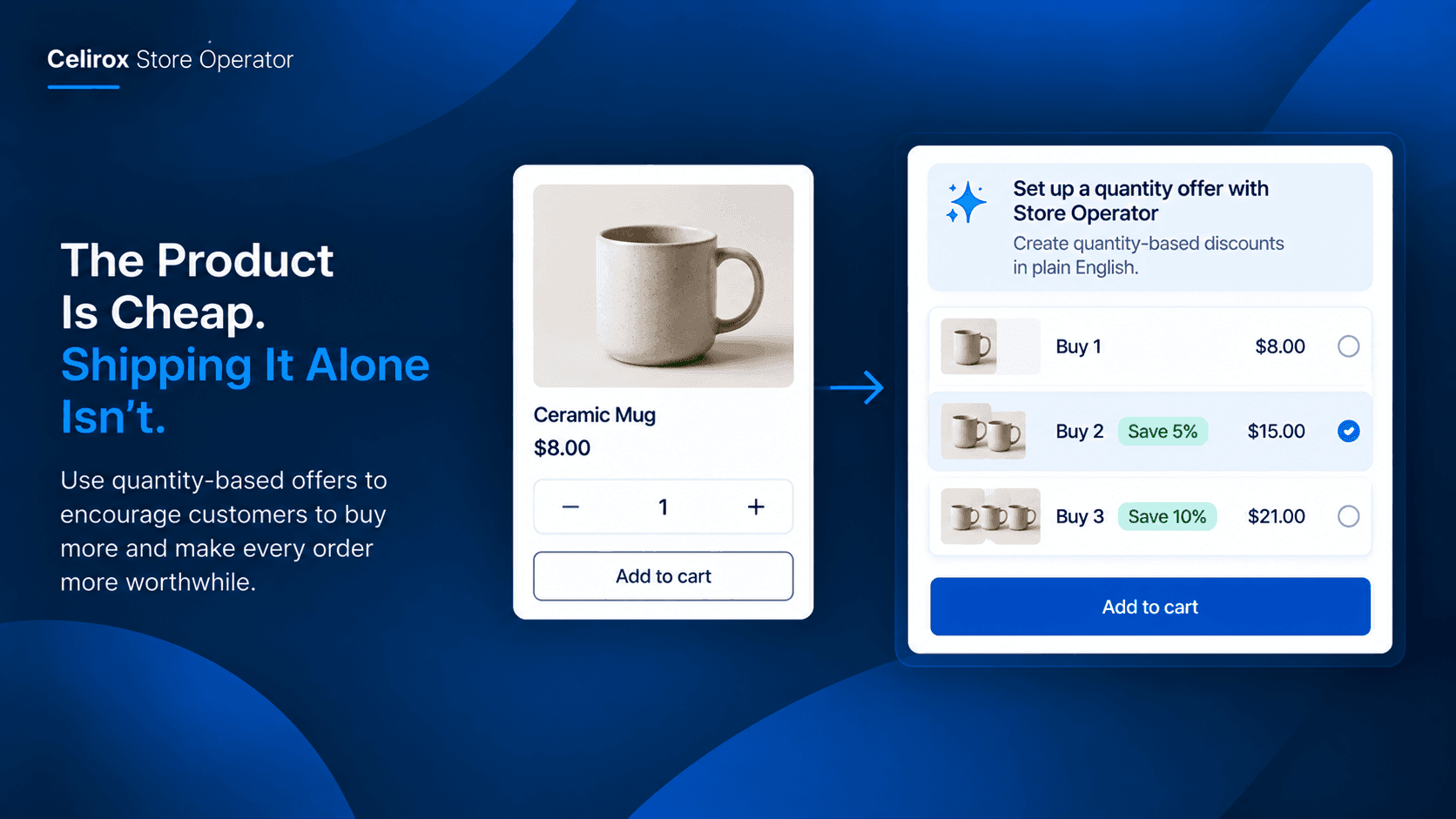
The product sells for $8.
A customer orders one.
At first, that looks like a successful sale.
Then the merchant looks at the numbers.
Shipping costs $5.
Packaging costs another amount.
Payment processing takes its share.
Someone still has to pick the product, pack it, label it, and get it out the door.
Suddenly, that $8 order does not look nearly as attractive.
The product is not the problem.
The quantity is.
One Product Can Create A Bad Order
Some products naturally make sense when customers buy several at once.
Think about candles, socks, notebooks, skincare products, snacks, craft supplies, or other small items people may use regularly.
Yet customers often start with one.
They may want to try the product first.
They may not realize that buying two or three would be better value.
Or they may simply see the individual price and stop there.
For the merchant, the problem is that the cost of processing the order does not necessarily fall just because the customer buys only one unit.
The store still has to process the order.
The warehouse still has to handle it.
The package still has to travel.
That is why quantity can matter just as much as product price.
The Merchant Does Not Want To Raise The Price
There is an obvious response.
Increase the price.
But that can create a different problem.
The merchant may already be happy with the product's individual price.
Customers may compare it with competitors.
The product may be positioned as an affordable entry point.
Raising the price simply because shipping makes small orders difficult could reduce demand without solving the underlying problem.
There is another option.
Keep the individual product attractive, but give customers a reason to purchase more than one.
That changes the economics of the order without necessarily changing the product itself.
Give Customers A Reason To Buy More
The customer needs a reason.
"Buy three" is not much of a reason on its own.
But:
"Buy 2 and save 5%"
or:
"Buy 3 and save 10%"
is different.
Now the customer can see the benefit of increasing the quantity.
The offer does not have to feel like a forced minimum.
It can simply make the larger purchase more attractive.
For products people naturally use repeatedly, this can be a much more natural proposition.
The customer gets better value.
The merchant gets a larger order.
And the cost of fulfilling the order is spread across more units.
Make The Quantity Benefit Obvious
A quantity offer should be easy to understand.
Imagine a customer looking at a product priced at $8.
They see:
Buy 1 — $8
Buy 2 — $15
Buy 3 — $21
The customer can immediately see that purchasing more changes the value of the order.
There is no complicated calculation.
No need to search through a promotion page.
No need to enter a coupon code and wonder whether it worked.
The quantity itself creates the benefit.
That is particularly useful for products where buying multiple units already makes sense.
Pick Products That Naturally Fit
Not every product should have a quantity offer.
A customer probably does not need three laptops.
They may not want three pairs of the same premium shoes.
The best opportunities are products where multiple units are genuinely useful.
For example, a customer might reasonably buy:
- Several candles for different rooms
- Multiple pairs of everyday socks
- A few skincare products for regular use
- Several notebooks for work or school
- Multiple consumable household products
The important question is simple:
"Would a customer naturally use more than one?"
If the answer is yes, a quantity offer can feel helpful rather than artificial.
The Store Operator Can Set The Offer
This is where the repetitive work usually starts for the merchant.
They know which product should have a quantity offer.
They know the quantities they want to encourage.
They know the discount they are comfortable giving.
But someone still has to go into Shopify and configure the promotion.
Then another product needs a similar setup.
Then the next collection.
Then the promotion needs to be adjusted later.
The business decision is easy.
The configuration is the tedious part.
Celirox Store Operator is designed to let merchants describe store changes and promotional workflows in plain English rather than manually working through every administrative step. :contentReference[oaicite:0]{index=0}
That makes a quantity-based offer a practical candidate for automation.
Start With One Product
You do not need to turn the entire catalog into a quantity-promotion system.
Start with one product where the economics are obvious.
Maybe customers frequently buy it individually even though two units would be more useful.
Maybe the product has a relatively low selling price.
Maybe fulfillment costs make single-unit orders less attractive.
Test a simple offer.
For example:
Buy 1 → regular price
Buy 2 → small saving
Buy 3 → better saving
Then watch what customers actually do.
The goal is not to force every shopper into a larger order.
It is to make the larger quantity attractive enough that customers who were already open to buying more have a reason to do so.
Do Not Give Away Too Much Margin
Quantity discounts can increase order size.
But the discount still has to make commercial sense.
A merchant should know what happens to the margin at each quantity.
Suppose one unit sells for $10.
If buying three reduces the effective price too aggressively, the store may increase order volume while making less money on each order.
That defeats the purpose.
The better approach is to create a quantity ladder that balances customer value with the economics of the product.
The merchant might offer a modest saving for two units and a slightly stronger saving for three.
The exact numbers depend on the product.
There is no universal discount that works for every store.
Think Beyond The Discount
A quantity offer does not always have to be a percentage discount.
The value could also come from the structure of the offer.
For example:
Buy 2 → Save $3
Buy 3 → Save $6
Or:
Buy 3 → Get a better per-unit price
The important thing is that the customer can understand why increasing the quantity benefits them.
That makes the offer easier to evaluate.
And when the benefit is clear, the customer does not need to spend time hunting for a coupon or wondering which promotion applies.
Turn Small Orders Into Better Orders
This is not about making every customer spend more.
Some customers genuinely only need one.
That is fine.
The opportunity is with customers who are already considering multiple units or who would benefit from buying them together.
A quantity offer gives those customers a reason to make the larger purchase now.
Instead of:
"I'll buy one today and come back later."
the customer may decide:
"I'll take three because the price is better."
For the merchant, that can mean fewer very small orders and a healthier average order value.
For the customer, it can mean better value on something they were likely to purchase again anyway.
Make The Offer Part Of The Buying Decision
Timing matters.
If the customer only discovers the quantity discount after completing checkout, it is too late.
The offer needs to be visible while the customer is deciding how many units to buy.
That is when the customer can compare the options and decide whether buying more makes sense.
The goal is not to interrupt them.
It is to answer a question they may already have:
"Should I buy one, or should I get a few?"
A clear quantity offer gives them the answer immediately.
Use It Where The Numbers Support It
Quantity-based offers are most useful when the economics and customer behavior point in the same direction.
The product should have a realistic multi-unit use case.
The fulfillment cost should make larger orders attractive.
The discount should still leave acceptable margin.
And the customer should be able to understand the offer without explanation.
When those pieces line up, the promotion becomes more than a marketing trick.
It becomes a better way to structure the order.
FAQ
What is a quantity-based offer?
A quantity-based offer gives customers a better price or benefit when they purchase multiple units of a product. For example, buying two or three units can unlock a lower effective price.
Is this the same as a product bundle?
Not necessarily. A bundle usually combines different products or predefined items. A quantity offer can focus on buying multiple units of the same product.
Which products work best for quantity offers?
Products that customers naturally use or purchase in multiples are strong candidates. Consumables, household products, accessories, stationery, and similar items can be good examples.
Does a quantity offer always need a discount?
No. The exact incentive can vary. What matters is that the customer has a clear reason to increase the quantity.
Can quantity offers increase average order value?
They can. When customers respond by purchasing two or three units instead of one, the total order value increases.
Should every product have a quantity offer?
No. It is better to use this strategy selectively on products where multiple units genuinely make sense and where the store's economics support the offer.
Can Celirox Store Operator help set up promotional workflows?
Celirox Store Operator is built around plain-English store automation and can handle repetitive promotional and backend tasks based on merchant instructions. :contentReference[oaicite:1]{index=1}
Make The Bigger Order Make Sense
A low-priced product can be a great product and still create an unattractive single-item order.
The merchant has to pay the costs of processing and delivering the order regardless of whether the customer buys one unit or several.
That does not automatically mean the product needs a higher price.
Sometimes the better answer is to give customers a compelling reason to buy a larger quantity.
A simple quantity-based offer can turn:
"One for $8"
into:
"Two for $15 or three for $21."
The customer gets better value.
The merchant gets a larger order.
And the fixed effort involved in processing that order becomes easier to justify.
The key is choosing the right products, setting sensible quantities, and making the benefit clear while the customer is deciding what to buy.
With Celirox Store Operator, merchants can turn those decisions into practical store workflows without making every promotional setup another manual Shopify admin task.
If your customers already have a reason to buy more than one, make the better quantity easy to choose.