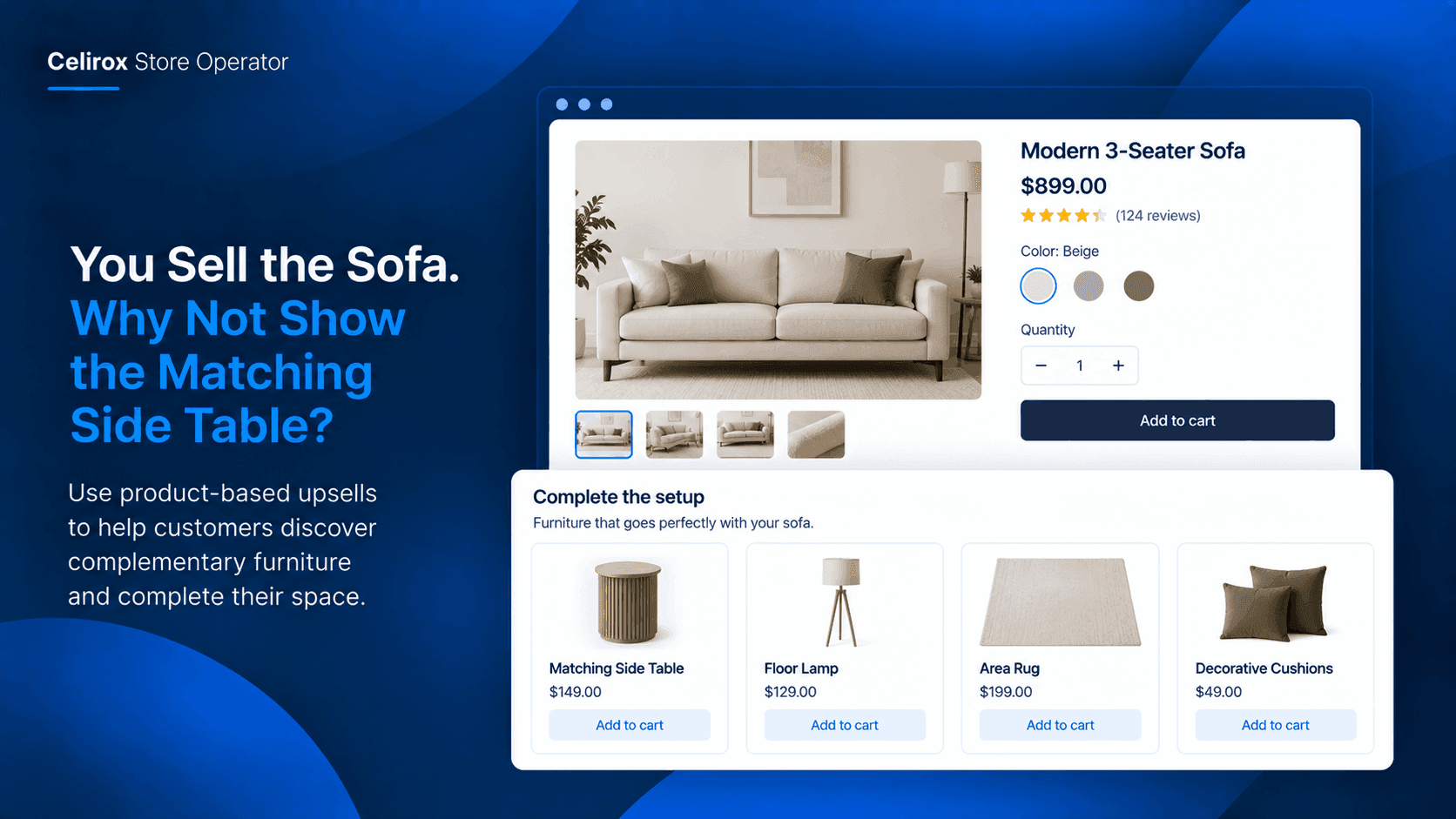
You Sell the Sofa. Why Not Show the Matching Side Table?
A customer finds the sofa they have been looking for.
The color works.
The size works.
The price works.
They are ready to buy.
But there is something else sitting in the same furniture collection that they might also want.
A matching side table.
Or a floor lamp.
Or a small coffee table that completes the setup.
The merchant already sells those products.
The customer simply did not think to look for them.
That is where a product-based upsell can make a difference.
The Customer Is Already Shopping
When someone is looking at a sofa, they have already given the store useful context.
They are not browsing completely at random.
They are interested in furnishing a particular space.
That makes the sofa a natural starting point for recommending products that work with it.
A matching side table makes sense.
A coordinating lamp might make sense.
A rug could make sense too.
The recommendation does not need to feel like another advertisement.
It can simply help the customer finish the room they are already trying to create.
The Missing Product Is Often Nearby
Furniture stores commonly sell products that belong together.
A sofa can go with:
- A side table
- A coffee table
- A floor lamp
- A rug
- Decorative cushions
But customers do not necessarily discover all of them.
They may search for “sofa,” find the product they like, and leave after purchasing it.
The merchant has another opportunity sitting inside the catalog.
The challenge is making that connection visible.
Show The Product That Belongs
Imagine a customer is viewing a modern three-seat sofa.
Under the main product information, they see:
Complete the setup
Matching Side Table — $149
Add to your room
That recommendation feels different from showing a completely unrelated product.
The customer already understands why the side table is there.
It belongs with the sofa.
The recommendation is based on the product they are already considering.
Product-Based Upselling Feels More Natural
Not every upsell needs to be:
“Buy more and save.”
Sometimes the strongest recommendation is simply:
“This goes well with what you're already buying.”
That is particularly useful for products where customers naturally create combinations.
Furniture is a good example.
A customer rarely thinks about a sofa entirely in isolation.
They are imagining the room around it.
If the store can help them discover those related products, the buying experience becomes more useful.
Start With One Product
A merchant does not need to create dozens of complicated recommendations immediately.
Start with a product that naturally has complementary items.
For example:
Main product:
Modern 3-Seater Sofa
Recommended product:
Matching Side Table
The relationship is obvious.
Then the merchant can build other product relationships:
Dining Table → Dining Chairs
Bed → Bedside Tables
Desk → Desk Chair
TV Unit → Storage Cabinet
The important part is that the recommendation has a reason.
Make The Recommendation Relevant
The customer should be able to understand why a product is being shown.
Compare these two experiences.
Random recommendation
You may also like:
A completely unrelated kitchen appliance.
Relevant recommendation
Complete your living room:
Matching side table.
The second recommendation requires almost no explanation.
Relevance is what makes a product-based upsell useful.
Give Customers Ideas They Did Not Have
Sometimes customers know exactly what they want.
Other times, they know the main product but have not thought through everything around it.
A customer might search for a sofa because they need somewhere to sit.
They may not have considered the side table.
Seeing the side table at the right moment can create a useful discovery:
“Oh, that would actually work perfectly with this.”
That is not necessarily a hard sell.
It is product discovery based on what the customer is already considering.
The Merchant Already Has The Products
This is important.
The merchant does not need to create a new product.
They do not need to launch another campaign.
They already have the side table.
They already have the lamp.
They already have the matching coffee table.
The opportunity is simply connecting those products in a way customers can see.
That turns the existing catalog into a more useful shopping experience.
Build Relationships Between Products
A furniture catalog can contain hundreds of products.
Customers cannot be expected to know which ones belong together.
Merchants, however, usually know those relationships.
They know:
“This sofa was designed to work with this table.”
“This bed matches this bedside cabinet.”
“This desk works well with this chair.”
That product knowledge can become part of the storefront experience.
Store Operator can help merchants create product-focused workflows around those relationships instead of leaving customers to discover every complementary product themselves.
Don't Recommend Everything
More recommendations do not automatically create a better experience.
If a sofa page displays ten unrelated products, the customer has to filter through them.
A focused recommendation can be more useful.
For a sofa, one or two highly relevant complementary products may be enough.
For example:
Matching Side Table
Coordinating Floor Lamp
That gives the customer a clear next step without overwhelming the original purchase.
Use The Product Story
The strongest product recommendations tell a small story.
The story here is:
You found the sofa. Now complete the space.
For a bedroom:
You found the bed. Now complete the bedside setup.
For a home office:
You found the desk. Now build the workspace.
For a dining room:
You found the table. Now choose the chairs.
The product relationship becomes part of the shopping journey.
Make Discovery Part Of The Purchase
A customer does not always want another promotion.
Sometimes they simply want help making a decision.
Showing a complementary product can do exactly that.
The merchant is saying:
“If you're considering this, you may also want to see this.”
That is a much more natural way to introduce another product than interrupting the customer with an unrelated offer.
A Simple Furniture Example
Consider a Shopify furniture store with this catalog:
Oslo Three-Seat Sofa — $899
Oslo Side Table — $149
Oslo Floor Lamp — $199
Oslo Coffee Table — $299
A customer lands on the sofa page.
Without product relationships, they may purchase only the sofa.
With a relevant product-based recommendation, the store can surface:
Complete the Oslo Collection
Side Table — $149
Floor Lamp — $199
The customer now knows that matching products exist.
They can decide whether those products belong in their purchase.
The merchant has made discovery easier without forcing the customer to search the catalog.
The Goal Is A Better Product Journey
Product upselling works best when it feels connected to the customer's intention.
A customer shopping for a sofa is already telling the store something.
They are furnishing a room.
Use that context.
Show them products that help complete the same goal.
That can make the store feel less like a giant product catalog and more like a helpful shopping experience.
Frequently Asked Questions
What is a product-based upsell?
A product-based upsell recommends a relevant product based on the product a customer is already viewing or considering.
What products work well with furniture upsells?
Examples include side tables with sofas, chairs with dining tables, bedside tables with beds, lamps with desks, and rugs with living-room furniture.
Should I recommend several products at once?
Not necessarily. A small number of highly relevant products can be easier for customers to understand than a large collection of unrelated recommendations.
Does an upsell always need a discount?
No. A product recommendation can simply help customers discover something complementary. The value comes from relevance, not necessarily from reducing the price.
Can this work outside furniture?
Yes. The same product relationship can work across many categories.
A camera can be paired with a memory card.
A coffee machine can be paired with filters.
A phone can be paired with a case.
A dress can be paired with accessories.
The important part is understanding which products naturally belong together.
Your Product Catalog Already Knows The Answer
The merchant often knows which products belong together.
The sofa has a matching table.
The bed has a matching bedside cabinet.
The desk has a coordinating chair.
The problem is that customers may never discover those relationships on their own.
Product-based upselling gives the merchant a way to surface those connections during the buying journey.
Instead of asking the customer to explore the entire catalog, show them the product that makes sense next.
Help Customers Complete What They Started
The customer came for a sofa.
Maybe the sofa is all they need.
But maybe they also need the side table.
They just did not know where to find it.
That is where a relevant product recommendation becomes useful.
It does not have to feel like another sales pitch.
It can simply be the store helping the customer complete the room they already came to create.
Celirox Store Operator can help merchants turn these product relationships into practical merchandising workflows, so complementary products are easier for customers to discover.