A Customer Asked for a Quote. Why Are You Still Building It Manually?
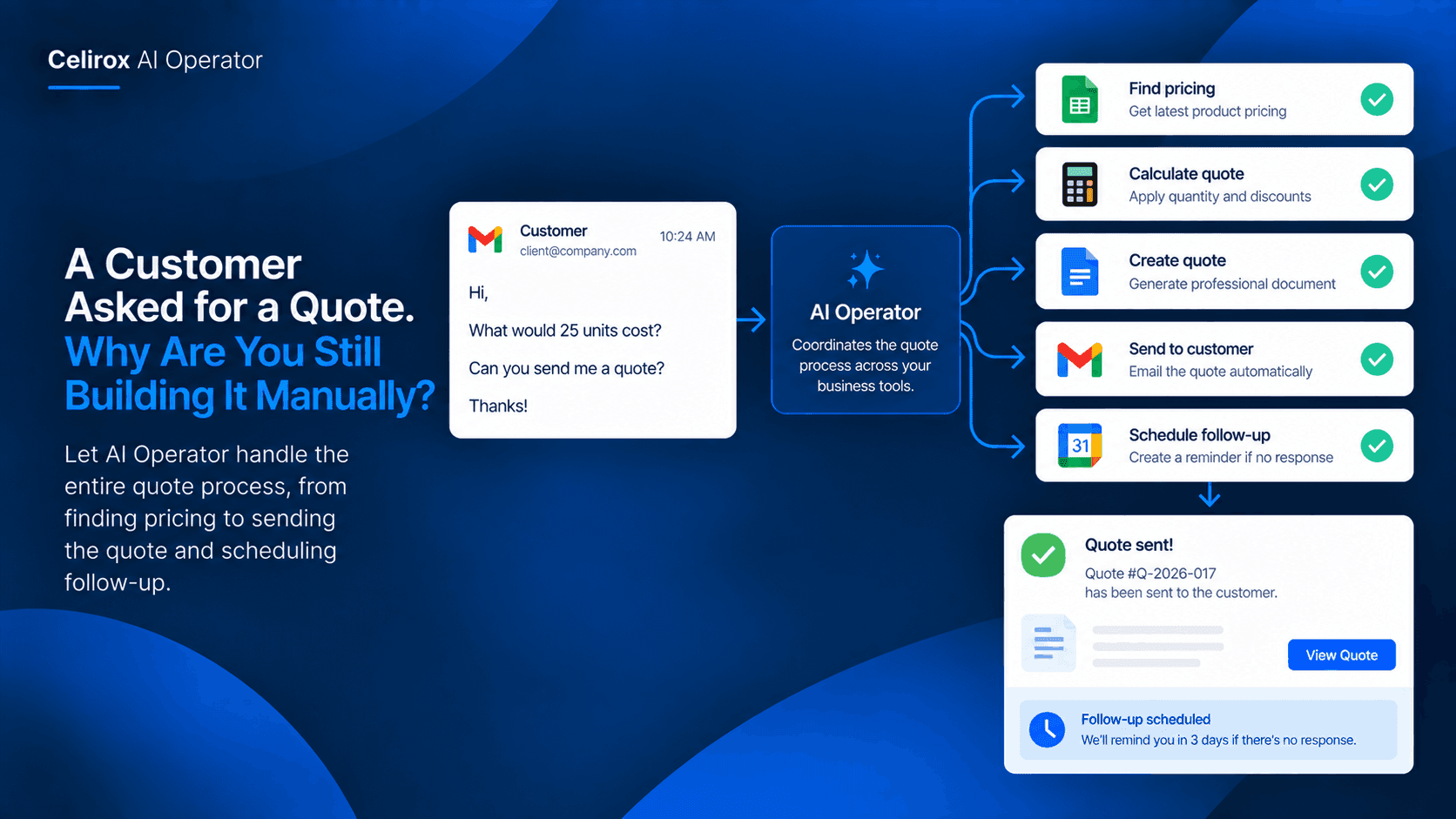
The message looks simple.
“Hi, what would 25 units cost?”
For a customer, it is one question.
For a small business owner, it can become a 20-minute task.
First, they need to find the current price.
Then they calculate the quantity.
Maybe there is a bulk price.
Maybe there is a different rate for that customer.
Then they open a document and create the quote.
Then they email it.
And finally, they have to remember to follow up if the customer does not respond.
The customer asked one question.
The business owner now has a small workflow to complete.
For a business handling several quote requests every week, those small workflows add up quickly.
The Quote Request Is Not The Work
The customer sees:
“Can you send me a quote?”
The business sees:
Find pricing → calculate → create document → send → follow up.
That difference is important.
The request itself is simple.
The work is everything that needs to happen after it.
For a small business, that work often falls on the owner or one employee who is already handling sales, customer service, operations, and administration.
There is no separate quoting department.
There is just one person trying to get back to the customer quickly.
A Typical Small Business Example
Imagine a small packaging supplier.
A customer sends an email:
“We need 500 custom boxes. Can you send us pricing?”
The owner already has the product information and pricing somewhere in the business.
But finding it is not always immediate.
They may need to check a spreadsheet.
They may need to look at a previous quote.
They may need to calculate the quantity.
They may need to prepare a formal document.
Then the quote needs to reach the customer.
And if there is no response, someone has to remember to follow up.
None of these tasks is particularly difficult.
The problem is that they are scattered.
Small Tasks Create Big Interruptions
A small business owner might receive five quote requests during a busy day.
Each request interrupts whatever they were doing.
One quote takes 15 minutes.
Another takes 10.
Another requires checking an old customer record.
Another needs a document created from scratch.
By the end of the day, the owner may have spent more time preparing quotes than actually talking to customers.
The work is necessary.
But much of it is repetitive.
That makes it a good candidate for workflow automation.
Turn The Request Into A Workflow
Instead of treating the customer's message as something that simply needs a reply, treat it as the beginning of a business process.
The workflow can look like this:
Customer requests a quote
↓
Relevant product and pricing information is found
↓
Requested quantity or package is calculated
↓
Quote is prepared
↓
Quote is saved
↓
Quote is sent to the customer
↓
Follow-up is created
The customer still gets the same quote.
The difference is that the business owner does not have to manually coordinate every step.
AI Operator Can Coordinate The Process
Celirox AI Operator is designed around connected business workflows rather than isolated actions.
That makes a quote request an interesting automation opportunity.
The incoming request can provide the starting context.
The workflow can then work with connected business tools to retrieve information, create the required output, communicate with the customer, and keep the follow-up from being forgotten.
The important part is coordination.
The owner does not have to remember which application should be opened next.
The workflow connects the steps.
Finding The Right Price
Pricing is often the first manual step.
A customer might ask for:
10 units
while another asks for:
100 units
and another asks for:
500 units.
The answer may depend on quantity, customer type, product, package, or current pricing information.
Instead of making the owner search through different places every time, an AI-driven workflow can use connected business information as part of the quote process.
The goal is to get the relevant information before preparing the quote.
From Numbers To A Proper Quote
A customer asking:
“How much for 25 units?”
usually expects more than a number in a chat reply.
They may need a proper quote containing:
- Product or service
- Quantity
- Unit price
- Total price
- Customer information
- Quote date
- Additional terms or notes
For a small business, creating that document manually can be another interruption.
An automated workflow can turn the information into a structured quote document and save it where the business keeps its files.
That makes the quote easier to find later too.
Send It Without Another Manual Step
Once the quote is ready, the next job is sending it.
The owner may normally download the document, open Gmail, find the customer email, attach the file, write the message, and send it.
Again, none of this is difficult.
But it is repetitive.
A connected workflow can make sending the completed quote part of the same process.
The customer gets the response.
The business gets one less administrative task.
Don't Forget The Follow-Up
This is where many quote processes break down.
The quote gets sent.
Then the owner gets busy.
Two days pass.
The customer is interested but waiting.
The business owner remembers the quote only when they happen to see the email again.
A quote workflow should not end when the email is sent.
The next business event matters too:
Did the customer respond?
If not, there may need to be a follow-up.
AI Operator can make the follow-up part of the workflow instead of relying entirely on someone's memory.
That means the quote process has a beginning and an ending.
One Customer Request, Several Business Tools
The power of this workflow comes from connecting the tools the business already uses.
For example:
Customer sends the quote request.
Spreadsheet or business data
Pricing information is retrieved.
Document storage
The quote is created and saved.
The completed quote is sent.
Task or calendar
A follow-up is scheduled.
Each tool has a different job.
The customer does not care which application performs each step.
They care about receiving an accurate quote quickly.
The business owner cares about not having to manually coordinate all five steps.
AI Is Useful When The Process Has Context
A simple automation might say:
When email arrives → create task.
That can be useful.
But a quote request often requires more context.
The workflow needs to understand what the customer is asking for.
It may need to identify the product.
It may need to understand the quantity.
It may need to find the relevant pricing information.
It may need to create an appropriate document.
That is why this type of workflow can benefit from an AI agent rather than a simple one-step automation.
The request is not just a trigger.
It contains information that determines what should happen next.
Make The Workflow Fit The Business
Every business quotes differently.
A freelancer may quote a project.
A wholesaler may quote quantities.
A manufacturer may quote custom orders.
A local service business may quote a job.
The underlying workflow is similar:
Request → information → calculation → quote → delivery → follow-up
The specific data and documents can change.
That makes the workflow adaptable without forcing every business into the exact same process.
The Owner Still Controls The Important Parts
Automation does not mean the business should blindly send every quote.
Some requests may require human review.
A large custom order may need negotiation.
A new customer may require special pricing.
A complex project may need clarification.
The workflow can handle the repetitive preparation while leaving important decisions with the business owner.
For example:
Small standard request
→ prepare and send the quote.
Large custom request
→ prepare the information and send it for review.
That distinction keeps automation useful without removing human judgment from the process.
What Changes For The Customer?
From the customer's perspective, the improvement is simple.
They ask for a quote.
They receive a clear response.
They do not need to wait while the owner searches through files or remembers how to format the document.
A faster response can also make the business feel more organized.
The customer does not need to know that several applications worked behind the scenes.
They simply see that the business responded.
What Changes For The Owner?
The owner gets something equally valuable:
fewer interruptions.
Instead of stopping work every time a quote request arrives, the owner can let the workflow handle the repetitive steps.
They can spend more time on:
- Customer conversations
- Sales
- Delivering current work
- Managing suppliers
- Running the business
The quote still gets done.
The owner simply does not have to manually move it through every stage.
A Quote Should Not Depend On Memory
The most fragile part of a manual quote process is often the follow-up.
The owner knows they need to follow up.
They just have ten other things happening.
That is how potential customers disappear.
A connected workflow gives the process a structure.
The request comes in.
The quote is prepared.
The quote is sent.
The follow-up is created.
Nothing depends on someone remembering the final step after a busy day.
Frequently Asked Questions
Can AI Operator automate customer quote requests?
AI Operator can be used to coordinate connected business workflows around a quote request, including retrieving relevant information, preparing documents, communicating with customers, and creating follow-up actions where the required applications are connected.
Is this useful for small businesses?
Yes. Small businesses often have one person handling sales, customer communication, administration, and operations. Automating repetitive quote preparation can reduce the amount of manual coordination that falls on that person.
Does every quote need to be sent automatically?
No. Businesses can design workflows around their own approval needs. A simple standard quote may follow an automated path, while a complex or high-value request can be routed for review.
Can the quote be saved as a document?
A workflow can include creating and saving quote documents in a connected document-storage system when that capability is configured.
What happens after the quote is sent?
A follow-up step can be included so the business does not have to rely on memory to check whether the customer responded.
Stop Rebuilding The Same Quote Process
A customer asking for a quote should not require the owner to mentally reconstruct the same workflow every time.
The information already exists.
The customer request already contains the basic requirements.
The business already has tools for documents, communication, pricing, and follow-up.
The problem is the gap between them.
AI Operator can help connect those steps into one workflow.
Request comes in.
Information is gathered.
Quote is prepared.
Customer receives it.
Follow-up is not forgotten.
That is the kind of repetitive coordination AI can take off a small business owner's plate.
Let The Business Respond Without Stopping Everything
Small businesses do not need more complicated processes.
They need the processes they already repeat to require less manual effort.
A quote request is a good example.
It starts with a simple customer question but can turn into several administrative tasks.
With a connected AI workflow, those tasks can work together instead of depending on the owner to move information from one application to another.
The customer gets a quote.
The business keeps the process organized.
And the owner gets back some of the time that would otherwise disappear into small administrative jobs.