The Dentist Finished the Treatment. But Who Schedules the Next Visit?
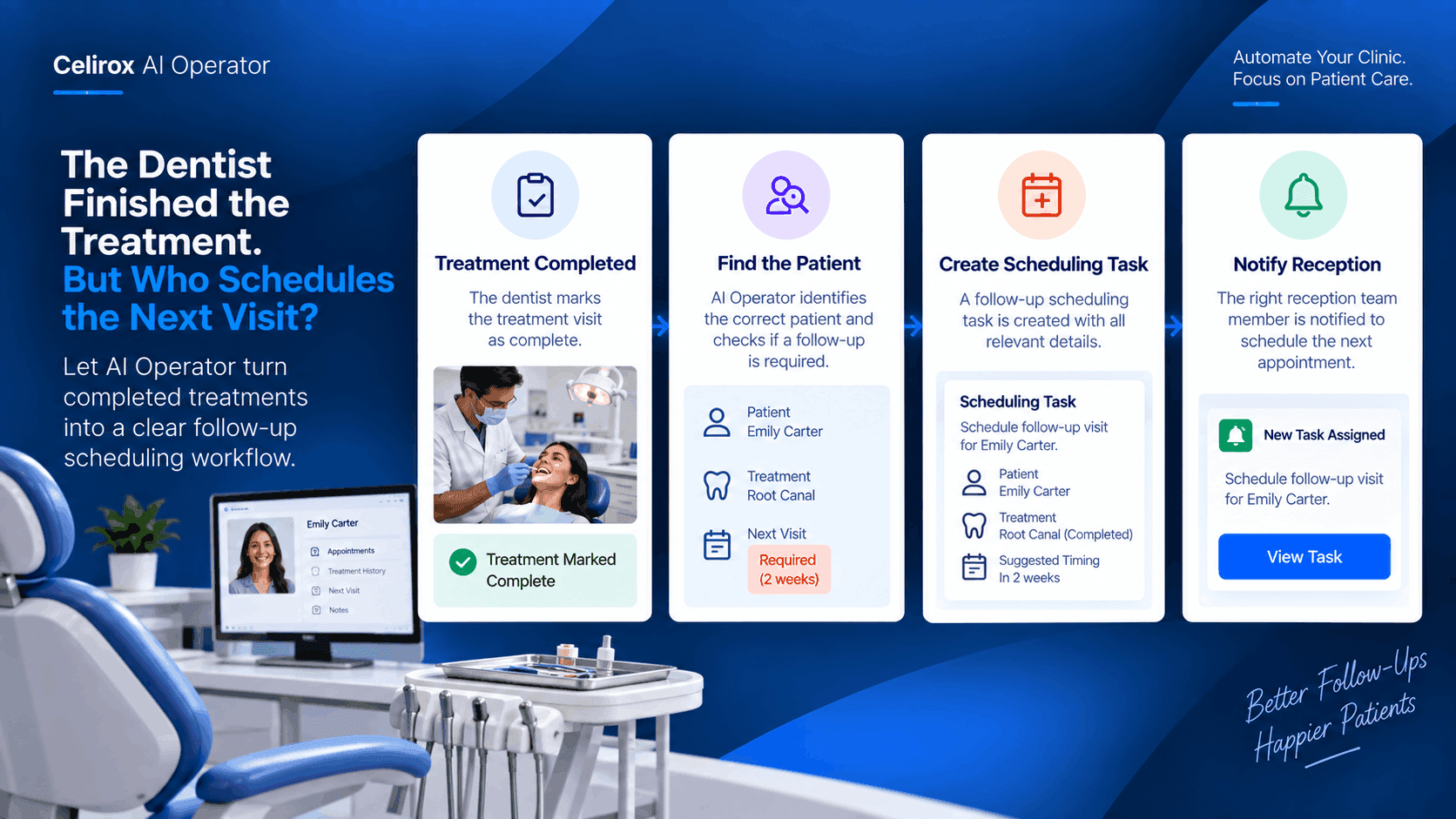
The dentist finishes today's treatment.
The patient leaves the clinic.
The clinical work for today is done.
But the patient's treatment may not be finished.
There is another visit that needs to happen.
The dentist has already recorded what was completed. The reception team knows the patient will need to come back.
Still, someone has to remember to schedule that next visit.
And when the clinic is busy, small follow-up tasks can easily get buried under everything else happening at the front desk.
The Treatment Is Only One Step
A dental treatment can involve more than one appointment.
Today's visit may be completed, but the patient's next step still needs to be arranged.
The problem is not that the clinic doesn't know this.
The information is already in the patient's record.
The problem is the handoff between the treatment record and the scheduling process.
The dentist finishes the visit.
Reception needs to act on what happened.
That connection can be automated.
Reception Has Enough To Manage
A busy reception desk is already handling calls, appointments, cancellations, payments, and patients arriving at the clinic.
Adding another task to the list sounds small.
But repeated throughout the week, these follow-ups become another source of administrative work.
Someone has to notice that a treatment was completed.
Then they have to identify the patient.
Then they have to check what needs to happen next.
Then they need to create the scheduling task.
The work is simple.
Remembering to do it consistently is the difficult part.
Let The Completed Visit Start The Workflow
The workflow can begin with a clear event:
Today's treatment is marked complete.
That event can become the trigger for the administrative follow-up.
AI Operator can coordinate the connected systems involved in the process when the required applications are available.
Instead of asking reception to constantly check completed treatment records, the workflow can bring the follow-up task to them.
The completed visit becomes the signal.
Find The Right Patient
Once the treatment is completed, the workflow needs the relevant patient and appointment context.
The goal is not to create a generic reminder for everyone who visited the clinic.
It is to connect the completed treatment with the correct patient record.
That gives reception the information they actually need to handle the next step.
The team doesn't have to search through multiple records just to reconstruct what happened during the previous visit.
Create The Scheduling Task
The next step is straightforward.
If the treatment requires another visit according to the clinic's process, AI Operator can create an internal task for reception.
The task can contain the relevant patient and appointment context.
The receptionist then knows exactly why the follow-up exists.
Instead of:
“Someone needs to schedule this patient.”
The team gets:
“This patient's treatment visit is complete. The next appointment needs to be scheduled.”
That is a much clearer handoff.
Notify The Right Person
Creating a task is useful.
Making sure the right person sees it is even more important.
A clinic may have several reception staff members or different people responsible for appointment coordination.
The workflow can send the follow-up to the appropriate internal channel or person according to the clinic's setup.
That removes another manual step.
The dentist doesn't need to message reception.
Reception doesn't need to discover the completed visit later.
The workflow connects the two sides.
Keep Humans In The Scheduling Loop
Appointment scheduling can involve patient availability, dentist availability, and clinic preferences.
The AI does not need to make those decisions on behalf of the clinic.
The useful part is making sure the follow-up does not get forgotten.
AI Operator can create the scheduling task and provide the context.
Reception can then handle the actual appointment coordination according to the clinic's process.
The automation handles the handoff.
The clinic keeps the decision.
One Completed Visit, One Next Step
The workflow doesn't need to become a complete dental practice-management system.
It can remain focused on one specific situation.
Treatment completed.
The system recognizes the completed visit.
Follow-up required.
AI Operator creates the scheduling task.
Reception is notified.
The team handles the next appointment.
That's enough.
The clinic has turned one predictable handoff into a predictable workflow.
Why This Small Handoff Matters
The problem with administrative work is that individual tasks rarely feel important.
One missed scheduling reminder may only take a few minutes to fix.
But when the same thing happens repeatedly, staff spend time checking records, sending internal messages, and following up on tasks that could have been triggered automatically.
The clinic already has the event that matters.
The treatment was completed.
Using that event as the starting point makes the process more consistent.
Make The Next Visit Easier To Remember
The dentist should be focused on the patient in front of them.
Reception should be focused on running the front desk.
Neither should have to rely entirely on memory to connect one completed treatment with the next administrative action.
AI Operator can help bridge that gap.
When the treatment record reaches the appropriate completion point, the next scheduling task can be created and routed to the right person.
The clinic still controls the appointment.
The workflow simply makes sure the task reaches the team.
A Simple Workflow Behind The Scenes
From the clinic's perspective, the automation can be summarized in four steps:
Treatment completed → patient identified → follow-up scheduling task created → reception notified.
There is no complicated customer journey.
No unnecessary communication.
No need to automate every part of the clinic.
Just one recurring administrative handoff that happens after a completed treatment.
That is often where automation has the most practical value.
Frequently Asked Questions
Can AI Operator automate workflows for dental clinics?
AI Operator can coordinate workflows across connected applications. A dental clinic can use a completed treatment event as the starting point for an internal scheduling workflow when the required systems and connections are available.
Does AI Operator decide when a patient needs another treatment?
The clinic should define its own process. The workflow can use the clinic's existing record or status as the trigger rather than independently making a clinical decision.
Does AI Operator automatically book the patient's next appointment?
Not necessarily. The workflow can create and route the scheduling task while reception remains responsible for coordinating the actual appointment.
Can the workflow notify the reception team?
Yes, when the relevant communication or task-management application is connected, the workflow can route the follow-up to the appropriate team or person.
Why automate this instead of using a reminder?
The purpose is to connect the completed treatment with the administrative action automatically. Instead of relying on someone to remember to check completed visits, the workflow can create the follow-up task from the event itself.
Don't Let A Finished Visit Become A Forgotten Follow-Up
The dentist finished today's treatment.
That does not necessarily mean the patient's appointment journey is finished.
There may still be another visit to arrange.
The clinic already has the information needed to start that process. What is often missing is a reliable connection between the completed treatment and the reception team's next task.
AI Operator can help create that connection.
Treatment completed → follow-up identified → scheduling task created → reception notified.
The dentist can finish the clinical work.
Reception can handle the appointment.
And the workflow can make sure the handoff between them doesn't depend on someone remembering it later.
When one business step creates another, let the workflow carry the information forward.