A Customer Buys the Dress. But What About the Shoes?
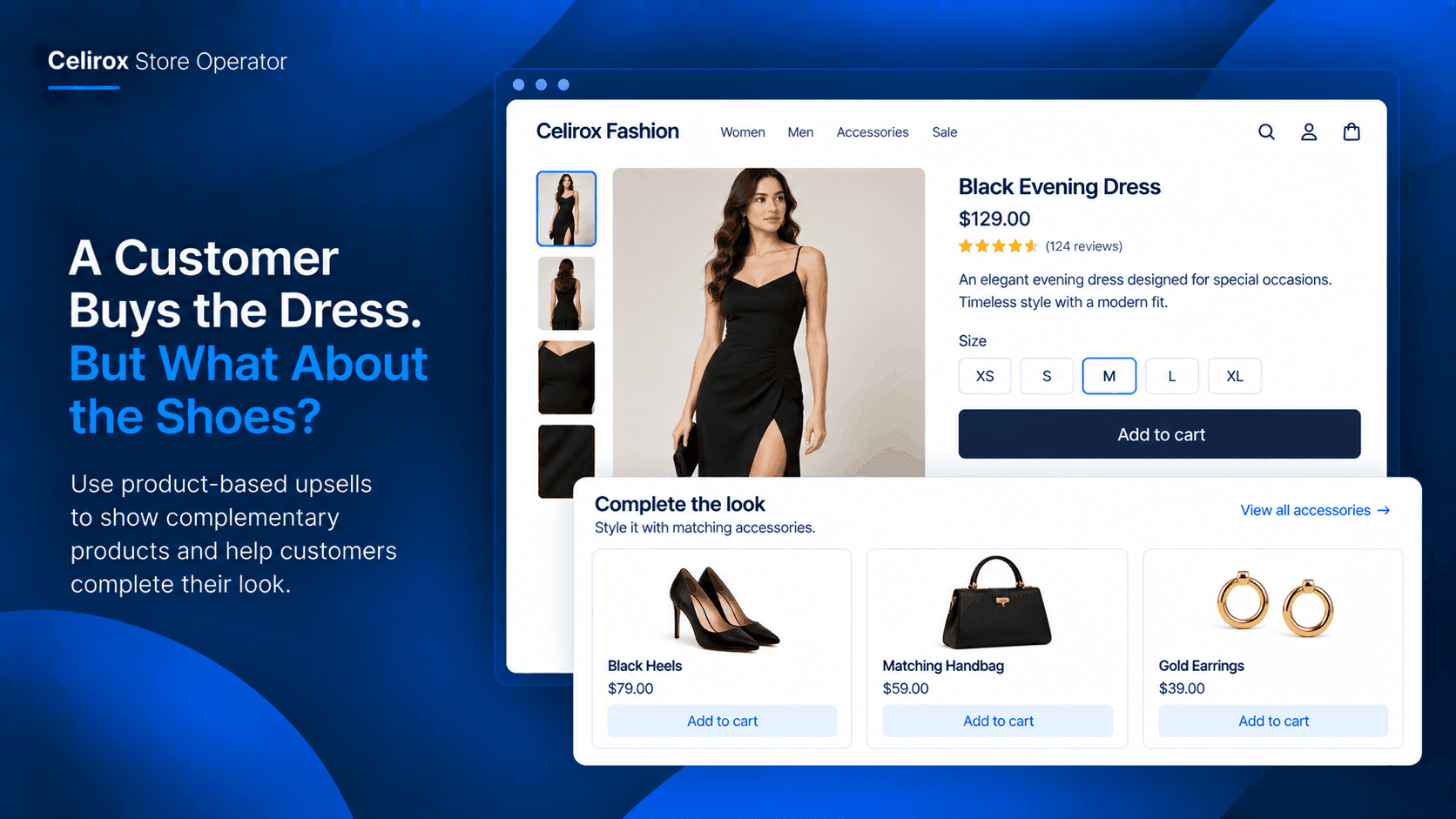
A customer is looking for a dress.
They find one they love.
The color is right.
The style is right.
The price works.
They are ready to buy.
But there is something else the store owner knows.
That dress looks great with a particular pair of heels.
There is also a handbag that was selected to match it.
All three products are already in the store.
The customer just does not know that.
They could search through the catalog and eventually find them.
But most customers are not going to do that.
They found the dress they wanted.
They may simply buy it and leave.
This is where a product-based upsell can make the shopping journey more useful.
The Customer Starts With One Product
Fashion shopping often starts with a single item.
A customer searches for a dress.
Another searches for a jacket.
Someone else starts with a pair of shoes.
But the final purchase can involve several products.
The customer may need an outfit rather than one individual product.
The challenge for the merchant is making those connections visible.
A store might have hundreds of products.
Customers cannot be expected to know which ones were designed to work together.
The merchant does.
That product knowledge can become part of the storefront experience.
The Matching Products Are Already There
Imagine a fashion store selling:
Black Evening Dress — $129
Black Heels — $79
Matching Handbag — $59
The products are all available.
But a customer viewing the dress may never visit the pages for the heels or handbag.
There is no problem with the catalog.
The problem is discovery.
The customer needs a reason to notice the related products.
A simple recommendation can provide that reason.
Show The Outfit, Not Just The Dress
Instead of ending the product experience with the dress, the store could introduce a small section:
Complete the look
Black Heels — $79
Matching Handbag — $59
The customer immediately understands the relationship.
These products are not random recommendations.
They are part of the same outfit.
The store is helping the customer see the bigger purchase they may already have been imagining.
Relevance Matters More Than More Products
An upsell does not need to show everything the store sells.
In fact, showing too many products can make the recommendation less useful.
The customer is viewing a black evening dress.
Showing five unrelated products creates noise.
Showing matching heels and a handbag creates context.
The recommendation has a clear reason:
These products work with the product you're already considering.
That is what makes product-based merchandising useful.
Turn Product Knowledge Into Discovery
The merchant may already know exactly which products belong together.
The dress works with the heels.
The heels work with the handbag.
The handbag completes the outfit.
Customers may not have that same knowledge.
They see individual product pages.
The merchant sees the collection as a whole.
Product-based upselling helps bring some of that merchant knowledge into the customer's shopping journey.
Start With Your Strongest Products
A merchant does not need to connect every product in the catalog immediately.
Start with products that already have obvious complementary items.
For example:
Evening Dress → Heels
Evening Dress → Handbag
Suit → Dress Shoes
Blazer → Trousers
Casual Dress → Sandals
The strongest relationships are usually the easiest to understand.
If the recommendation makes sense immediately, customers are more likely to see it as helpful.
Make The Recommendation Part Of The Journey
The timing matters.
A customer viewing a dress is already thinking about whether to buy it.
That is a natural moment to introduce products that complete the outfit.
The recommendation does not need to interrupt the customer.
It can simply appear as part of the product experience.
The message could be as simple as:
Complete the look
or:
Pairs well with
or:
Style it with
The wording can change.
The idea stays the same.
Not Every Upsell Needs A Discount
Merchants sometimes think an upsell needs a special offer.
It does not.
The customer may want the complementary product because it solves another part of their shopping problem.
If the customer needs shoes for the dress, showing the shoes is already useful.
There does not need to be a 10% discount attached to the recommendation.
The value comes from helping the customer discover the right product.
Make Shopping Easier
Consider the alternative.
The customer buys the dress.
Later, they realize they need shoes.
They return to the store.
They search for heels.
They compare several options.
They try to find something that matches.
That is additional work.
A relevant recommendation can remove some of that work.
The customer can discover the matching products while they are already making the purchase decision.
The merchant makes the catalog easier to navigate.
The customer gets a more complete shopping experience.
A Small Recommendation Can Change The Order
The customer originally came for one product.
They may still buy only that product.
That is completely fine.
But now they have seen two relevant products they may genuinely need.
Perhaps they add the handbag.
Perhaps they add the shoes.
Perhaps they simply remember them for a future purchase.
The recommendation has created another opportunity without forcing the customer to buy anything.
That is an important distinction.
A useful upsell should help customers discover.
It should not pressure them.
Think In Product Relationships
A useful way to approach this is to stop thinking about products only as individual catalog entries.
Think about relationships.
This goes with that.
This completes that.
Customers who need this may also need that.
For fashion stores, these relationships can be especially natural.
A dress can connect to shoes.
A suit can connect to a shirt.
A jacket can connect to trousers.
A handbag can connect to accessories.
Once the relationships are identified, the store can use them to improve product discovery.
Give Customers A Complete Outfit
The strongest fashion recommendations often tell a story.
The story is not:
“Here are more products.”
It is:
“Here is how you can complete the look.”
That subtle difference matters.
The customer is already imagining themselves wearing the dress.
Showing the matching shoes and handbag helps them imagine the complete outfit.
The recommendation becomes part of the customer's decision-making process.
Keep The Main Product Important
An upsell should never make the original product difficult to understand.
The dress remains the main product.
The recommendation supports it.
A clean product experience could look like:
Black Evening Dress
Product images.
Price.
Size selection.
Purchase button.
Then:
Complete the look
Matching heels.
Matching handbag.
The customer's original buying path remains clear.
The additional products simply provide another option.
Build Around Real Combinations
The best recommendations should come from genuine product relationships.
If a handbag does not actually work with the dress, do not recommend it simply because it is another product with a high margin.
Customers notice when recommendations feel random.
Instead, choose combinations that your merchandising team already believes belong together.
That could come from:
- Matching colors
- Matching collections
- Similar styles
- Coordinated designs
- Common customer purchases
- Products intentionally created as a set
The more natural the relationship, the more useful the recommendation becomes.
A Simple Store Operator Workflow
A merchant could start with one popular dress.
They identify two complementary products:
Main product: Black Evening Dress
Related product: Black Heels
Related product: Matching Handbag
The merchant then creates a product-focused storefront upsell around the dress.
A customer visits the dress page.
The related products are surfaced.
The customer can choose whether to add them.
The merchant does not need to manually message each shopper.
The recommendation becomes part of the storefront experience.
Store Operator supports storefront enhancements and product-related upsell workflows through its automation capabilities. :contentReference[oaicite:0]{index=0}
Expand Only When It Makes Sense
Once the first combination works, the merchant can build more.
For example:
Red Party Dress → Gold Heels
Linen Dress → Sandals
Men's Suit → Formal Shoes
Denim Jacket → Casual Trousers
The catalog becomes easier to shop because products are connected through useful relationships.
The merchant is not simply adding more products.
They are helping customers understand how the products fit together.
Frequently Asked Questions
What is a product-based upsell?
A product-based upsell recommends a related product based on the item a customer is already viewing or considering.
What works well as a fashion upsell?
Shoes, handbags, accessories, jackets, trousers, and other products that naturally complement the main item can work well.
Does a product upsell need a discount?
No. A recommendation can simply help customers discover a complementary product.
Should I recommend many products?
Not necessarily. A small number of highly relevant products can make the recommendation easier to understand.
Can this work with other product categories?
Yes. The same idea can be used wherever products naturally belong together, such as furniture, electronics, beauty products, sports equipment, or home goods.
Your Catalog Already Contains The Opportunity
The merchant may already have everything needed.
The dress exists.
The shoes exist.
The handbag exists.
The customer is already interested in the dress.
The missing piece is the connection.
Product-based upselling makes that connection visible.
Instead of expecting customers to search the entire catalog, the store can show them products that naturally belong with what they are already considering.
That makes product discovery easier without making the shopping experience complicated.
Help Customers Complete The Look
The customer came for the dress.
Maybe they only need the dress.
But maybe they also need the shoes.
Maybe the handbag completes the outfit.
The merchant already knows those products work together.
Showing that relationship at the right moment gives the customer an easier way to discover them.
That is what makes a product-based upsell useful.
It is not simply about getting customers to buy more.
It is about helping them find what makes sense next.
Turn Product Relationships Into Better Shopping
A Shopify catalog is more than a list of individual products.
Products have relationships.
Some match.
Some complement each other.
Some naturally belong in the same purchase.
Celirox Store Operator can help merchants turn those relationships into storefront upsell opportunities, allowing complementary products to be surfaced around the products customers are already viewing.
For a fashion store, that could mean a dress leads naturally to the right shoes and handbag.
The customer gets a clearer path to completing the outfit.
The merchant gets another opportunity to showcase products already in the catalog.
And the store becomes easier to shop.