Selling B2B and D2C? How to Dynamically Adapt Your Checkout
The Headache of the Hybrid Storefront
For years, the e-commerce playbook dictated that brands running both Direct-to-Consumer (D2C) and Business-to-Business (B2B) operations needed completely separate infrastructure. You had a beautiful Shopify store for retail customers, and a clunky, password-protected portal (often running on a different CMS entirely) for your wholesale buyers.
This dual-stack approach is an operational nightmare. It forces merchants to manage inventory across two disjointed systems, update product catalogs twice, and consolidate reporting manually at the end of the month.
Recognizing this, many merchants attempt to consolidate their operations into a single "Hybrid" Shopify storefront. While this solves the inventory syncing issue, it creates a massive new bottleneck at the most critical stage: the checkout.
A wholesale buyer ordering 500 units of a product requires a at its core different transactional experience than a retail customer buying a single t-shirt. If you force a B2B client through a standard D2C checkout, you run into three critical friction points:
- The Tax Exemption Problem: Wholesale buyers are usually tax-exempt. A static checkout will stubbornly try to charge them retail sales tax, forcing them to either abandon the cart or forcing your customer service team to issue manual tax refunds post-purchase.
- The Shipping Mismatch: A D2C customer wants USPS Priority or Free ePacket shipping. A B2B buyer ordering a pallet needs Less-Than-Truckload (LTL) Freight options. A static checkout shows all options to all users, resulting in B2B clients selecting inappropriate retail shipping, or worse, D2C customers accidentally selecting expensive freight.
- The Payment Gateway Conflict: D2C customers pay with credit cards or Buy Now, Pay Later (BNPL) apps. B2B buyers operate on Net-30 or Net-60 payment terms, often paying via wire transfer or ACH. A static checkout cannot differentiate between the two.
Dynamic Checkout Adaptation with SmartFlow
To successfully run a hybrid store, the checkout must be contextually aware. It needs to look at the user and adapt its rules in real-time.
With Shopify Checkout Extensibility and SmartFlow Checkout, you can finally tailor the payment flow perfectly to the user without maintaining two separate websites.
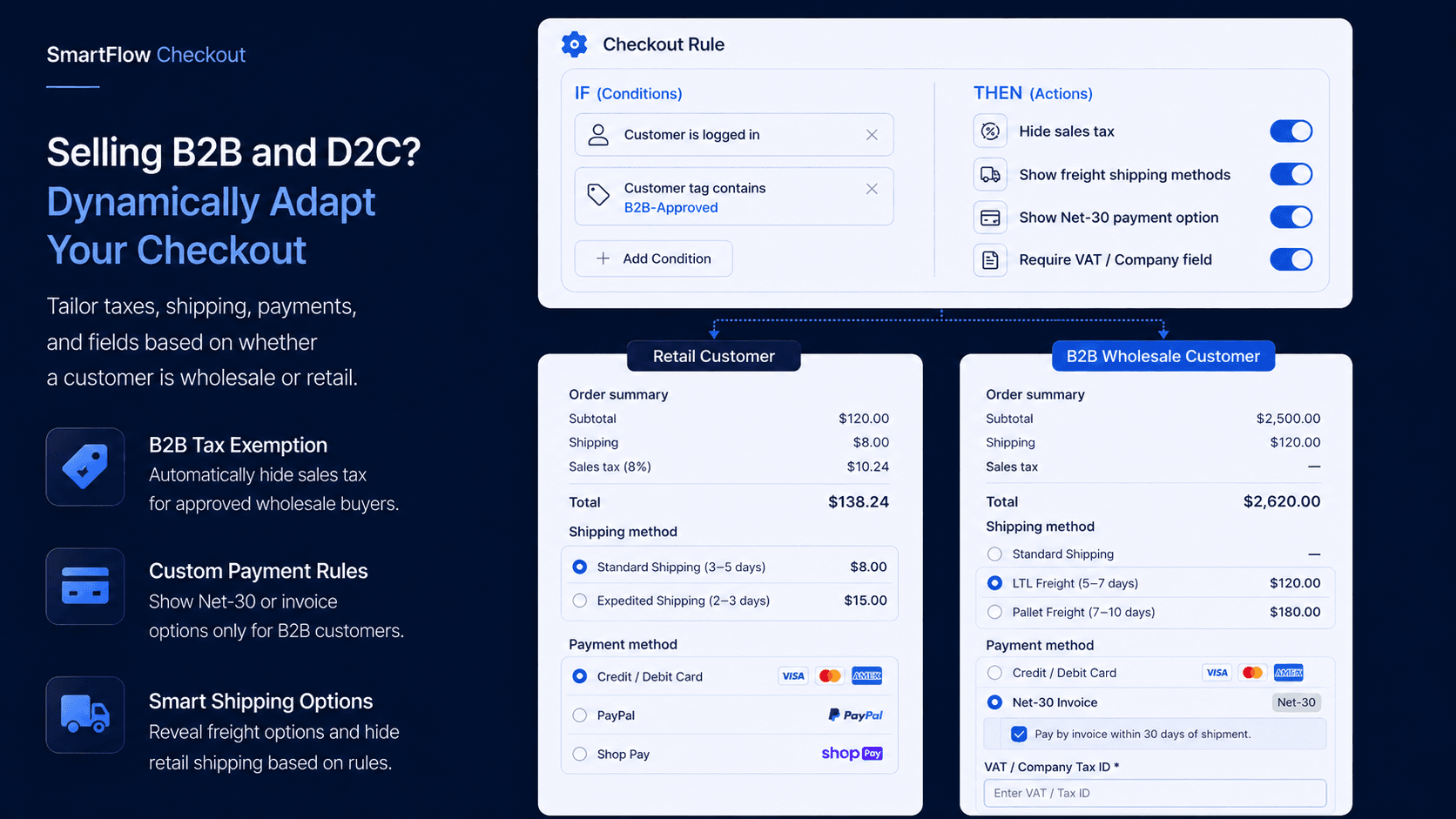
SmartFlow allows you to build conditional logic trees based on Customer Tags. When a user creates a wholesale account on your store, you tag their profile with "B2B_Approved." From that moment on, whenever they log in and initiate a checkout, SmartFlow recognizes the tag and instantly restructures the page.
Critical B2B Rules You Can Launch Today
You do not need to write complex Liquid code or hire a developer to build these adaptations. SmartFlow's visual engine lets you configure these rules in minutes:
1. Instant Tax Exemption Routing
Stop issuing manual tax refunds. You can configure a SmartFlow rule that states: If Customer Tag equals 'B2B_Approved', hide the standard tax calculation block and inject a custom UI field requesting their Reseller Tax ID. This ensures absolute compliance while removing the financial friction for the buyer.
2. Segregating Shipping Methods
Keep your logistics clean. Create a rule that states: If Customer Tag equals 'B2B_Approved', hide all standard D2C shipping rates (USPS, UPS Ground) and exclusively reveal the 'LTL Freight' and 'Local Warehouse Pickup' options. Conversely, ensure your D2C customers never see a $250 Freight charge that might scare them off the site.
3. Unlocking Net-30 Payment Terms
B2B transactions live and die by cash flow terms. You can utilize SmartFlow to configure payment gateway visibility. Rule: If Customer Tag equals 'B2B_Approved', hide consumer BNPL options (like Afterpay or Klarna) and reveal a custom manual payment method titled "Net-30 Invoice". This allows the wholesale buyer to complete the checkout to reserve the inventory, generating a Draft Order in your backend for your accounts receivable team to process normally.
The Impact on Operations
By deploying dynamic checkout rules, you achieve the holy grail of e-commerce operations: a single unified backend (one inventory pool, one reporting dashboard) with a perfectly bifurcated frontend experience.
Your D2C customers enjoy a fast, simple retail checkout, while your high-value B2B clients receive the customized, professional purchasing experience they expect. Stop maintaining two websites and start using a smarter checkout.