Stop the Bleed: Automating Product Hiding Based on Return Velocity
The Silent Margin Killer
In the fast-paced world of direct-to-consumer (D2C) e-commerce, speed is everything. Brands are constantly launching new collections, rotating seasonal inventory, and pushing aggressive marketing campaigns. However, this required velocity introduces a massive operational vulnerability: manufacturing defects and quality control failures that slip through the cracks.
Consider a scenario where your brand launches a new line of premium outerwear. Everything looks perfect on the models, the marketing creative is highly engaging, and the launch day sales exceed all projections. But there is a hidden, underlying problem: the factory accidentally mislabeled the sizing on the inner tags. The "Medium" jackets are actually cut to a "Small" specification.
Within five to seven days, the initial wave of orders arrives at your customers' doorsteps. Almost immediately, the return requests begin rolling in. This is where the structural weakness of traditional retail operations reveals itself.
The Latency of Manual Quality Assurance
In a traditional e-commerce operation, identifying a defect of this nature takes entirely too long. The feedback loop is disconnected from the point of sale. The workflow usually looks like this:
- The Influx of Data: Customers initiate returns via platforms like Loop Returns, Returnly, or your native Shopify portal over the course of a week.
- The End-of-Month Review: The customer experience (CX) manager exports a massive CSV file at the end of the month (or bi-weekly) to analyze return reasons and support ticket trends.
- The Data Crunch: A merchandising analyst spends hours manipulating pivot tables to identify patterns across thousands of SKUs.
- The Actionable Insight: Finally, two to three weeks after the launch, the team realizes that the new outerwear line has an unprecedented 45% return rate specifically tied to "sizing issues."
- The Intervention: The product is manually hidden from the store, and a warehouse audit is requested.
During those three weeks of latency, your business continued to spend thousands of dollars on Meta Ads and Google Performance Max campaigns driving paid traffic directly to a defective product. You sold 500 additional units. This results in 500 more angry customers, 500 more reverse-shipping logistics fees, and a severe, potentially irrecoverable hit to your overall profitability for the quarter.
The latency between the event (the customer returning the item) and the action (the merchant hiding the product) is a complete structural failure. If your team is already stretched thin, perhaps from managing overwhelming customer support volumes, relying on manual quality assurance (QA) is simply unsustainable.
Deploying an Autonomous Quality Assurance System
To protect your gross margins, the feedback loop must be instantaneous. You cannot afford to wait for an end-of-month reporting cycle; your storefront needs an independent mechanism to pull the emergency brake the moment a product goes rogue.
Celirox Store Operator serves as an autonomous Quality Assurance system. It actively listens to your returns data in real-time, processes the mathematical implications, and takes immediate preventative action without requiring human approval.
Here is how the automated workflow compares to a manual operational standard:
| Metric | Manual QA Process | Celirox Store Operator | |:---|:---|:---| | Detection Speed | 2-3 Weeks (Dependent on reporting cycles) | Real-Time (Event-driven API webhooks) | | Data Analysis | Manual spreadsheet pivot tables | Algorithmic statistical thresholding | | Action Taken | Human logs in to unpublish product | API instantly changes product to 'Draft' | | Team Alert | Asynchronous email thread | High-priority Slack or Teams alert |
How It Works: The Architecture of Autonomous Pruning
You do not need an engineering team to build complex data pipelines or write custom Ruby scripts. You simply deploy a conversational, plain-English directive to the Celirox Store Operator.
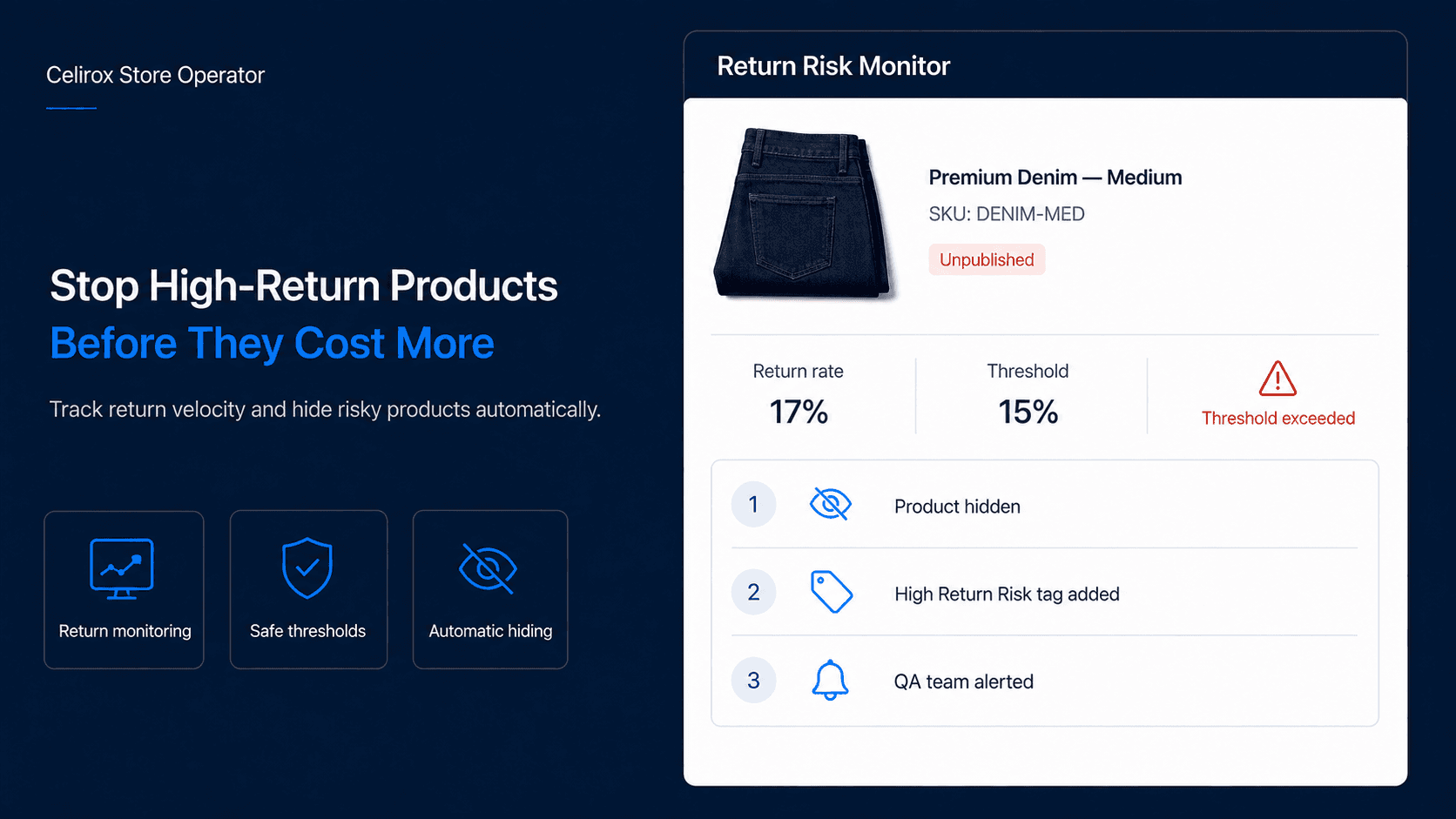
For example, you might instruct the system: "Maintain a rolling 14-day calculation of the return rate for every active SKU in the catalog. If any SKU generates a return rate higher than 15% (with a minimum threshold of 20 total sales to ensure statistical significance), immediately unpublish the product. Tag it in Shopify as 'High Return Risk' and send an alert to the #merchandising-alerts Slack channel."
When this logic is deployed, the Store Operator executes a rigorous backend routine:
Step 1: Real-Time Event Listening
The Store Operator hooks directly into your returns infrastructure. Every single time a customer clicks "Submit Return," the AI logs the event against the specific variant SKU in its internal memory.
Step 2: Statistical Thresholding
The algorithm constantly calculates the rolling return velocity. Crucially, it understands statistical significance. If you sell 2 units of a niche accessory and 1 is returned, that is a 50% return rate, but the volume is far too low to warrant a catalog-wide emergency. The AI requires a baseline volume (e.g., 20 sales) before the defensive algorithm engages, completely preventing false positives from pausing your revenue.
Step 3: Instant Storefront Pruning
The moment a high-volume SKU crosses your defined threshold (e.g., >15%), the Store Operator acts. It uses the Shopify Admin API to instantly change the product status from 'Active' to 'Draft' (or removes it from specific sales channels). The defective item is hidden from the public immediately, stopping the financial bleeding before another ad dollar is wasted.
Step 4: Root Cause Alerting
Hiding the product protects the customer, but the internal team must investigate the root cause. The AI pushes a highly detailed alert into Slack: “🚨 Action Required: SKU-OUTER-MED reached a 17% return rate in the last 7 days (Primary Reason: 'Too Small'). The product has been automatically unpublished from the storefront. Please initiate a warehouse audit.”
The Financial Mathematics of Proactive Action
The return on investment for autonomous product hiding is highly measurable. By cutting the latency from three weeks to three days, you prevent hundreds of defective units from being shipped. You eliminate the reverse-logistics freight costs, the restocking labor in the warehouse, and the customer service hours spent apologizing for a known issue.
Transition your business from a reactive reporting model to a proactive, algorithmic defense. Protect your ad spend, preserve the trust of your customers, and let automation mathematically defend your margins.