Stay Ahead of the Market: Automating Competitor Price Monitoring
The Race to the Bottom (and the Top)
In hyper-competitive e-commerce sectors—such as consumer electronics, fitness supplements, and fast fashion—pricing is the ultimate battleground. When consumers view products as commoditized, their purchasing decision is driven almost entirely by the bottom-line price.
If your primary competitor silently drops the price of their best-selling whey protein by 15% on a Tuesday, and you don't notice until Friday, you have effectively lost three days of revenue. Your Facebook Ads are still running, driving traffic to a product page that is now mathematically uncompetitive, resulting in a plummeting Return on Ad Spend (ROAS).
Conversely, if a competitor goes out of stock or aggressively raises their prices due to supply chain issues, you have a massive opportunity to increase your own prices and expand your margin. But you can only capitalize on this if you know it happened.
The Inefficiency of Manual Monitoring
Traditionally, maintaining price parity required brute-force manual labor. A junior merchandising analyst would maintain a massive spreadsheet filled with hundreds of competitor URLs. Every morning, they would click through these links, visually scan the competitor's product page, write down the current price, and highlight any discrepancies.
This manual workflow is fatally flawed:
- It is Unscalable: A human can reasonably track perhaps 50 products a day. If your catalog has 2,000 SKUs across five major competitors, manual tracking is impossible.
- It is Prone to Error: Staring at numbers for hours leads to inevitable data entry mistakes.
- It is Expensive: Paying a full-time salary for an employee to simply hit "refresh" and copy-paste numbers is a severe misallocation of capital.
While some legacy scraping tools exist, they rely on rigid CSS selectors (e.g., "Scrape the text inside the .price-tag class"). If the competitor updates their theme or changes their HTML structure, the scraper breaks, requiring an engineer to fix it.
Deploying an Autonomous Market Analyst
The modern solution to competitive intelligence is deploying a multimodal Large Language Model (LLM).
The Celirox AI Operator serves as an autonomous, highly intelligent market analyst. Because it utilizes vision and advanced semantic understanding, it does not rely on fragile HTML selectors. It navigates to a competitor's website and "reads" the page exactly like a human would, instantly locating the price, the stock status, and any promotional banners.
Orchestrating the Monitoring Protocol
You do not need to be a developer to configure this web-scraping architecture. You simply issue a strategic directive to the AI Operator:
"Monitor our top 3 competitors (CompetitorA.com, CompetitorB.com, CompetitorC.com). Every morning at 8:00 AM EST, navigate to their 'Best Sellers' collections. Extract the product titles, current prices, and stock status. Cross-reference these products with our own Shopify catalog. If a competitor undercuts our price by more than 5% on a matching product, instantly send an alert to the #merchandising Slack channel with a recommended price adjustment."
When you deploy this command, the AI Operator executes a sophisticated daily routine:
1. Multimodal Web Navigation
The AI spins up headless browser instances to navigate the target URLs. It easily bypasses standard popup modals (like email capture forms) that routinely break older scraping bots. It uses its vision capabilities to identify the actual "Buy Box" on the competitor's page, accurately extracting the price even if it is embedded in a complex graphic or a dynamic script.
2. Semantic Product Matching
One of the hardest parts of competitive analysis is matching products that have slightly different names. If your product is named "Optimum Nutrition Gold Standard Whey 5lb" and the competitor calls it "ON Whey Protein 5 lbs - Gold Standard," a traditional script will fail to match them. Celirox AI Operator uses semantic reasoning to understand that these are the exact same product, ensuring the pricing comparison is perfectly accurate.
3. Real-Time Actionable Alerts
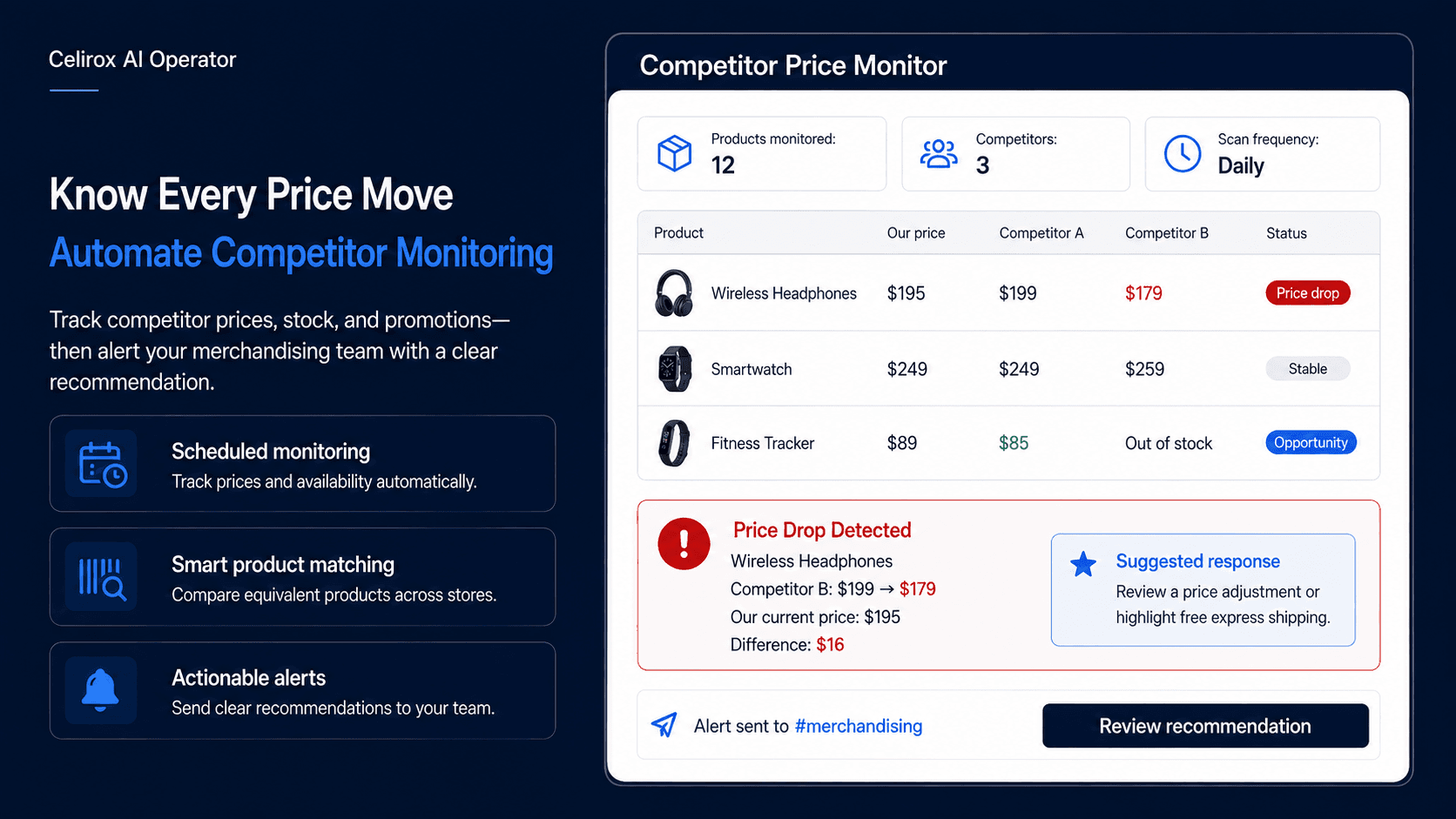
The AI Operator doesn't just dump a massive CSV file on your desk. It synthesizes the data. If it detects a critical pricing threat, it pushes a formatted alert directly into your company's communication hub (Slack or Microsoft Teams).
Slack Alert: "⚠️ Price Drop Detected: Competitor B just lowered the price of the 'Wireless Noise-Canceling Headphones' from $199 to $179. We are currently priced at $195. Recommendation: Drop our price to $175 to maintain parity, or activate the 'Free Express Shipping' promotional banner to justify the premium."
4. Promotional Intelligence
Beyond just numbers, the AI Operator can read the context of the competitor's site. It can read a banner that says "Buy One Get One 50% Off - Ends Friday" and factor that promotional logic into its analysis, alerting your team that the competitor is running a flash sale, not a permanent price reduction.
Strategic Agility
By automating competitive intelligence, your merchandising team is no longer playing defense. They are freed from the drudgery of data collection and can focus entirely on strategic pricing maneuvers.