Win Back Lost Sales: Automating 'Back in Stock' Notifications
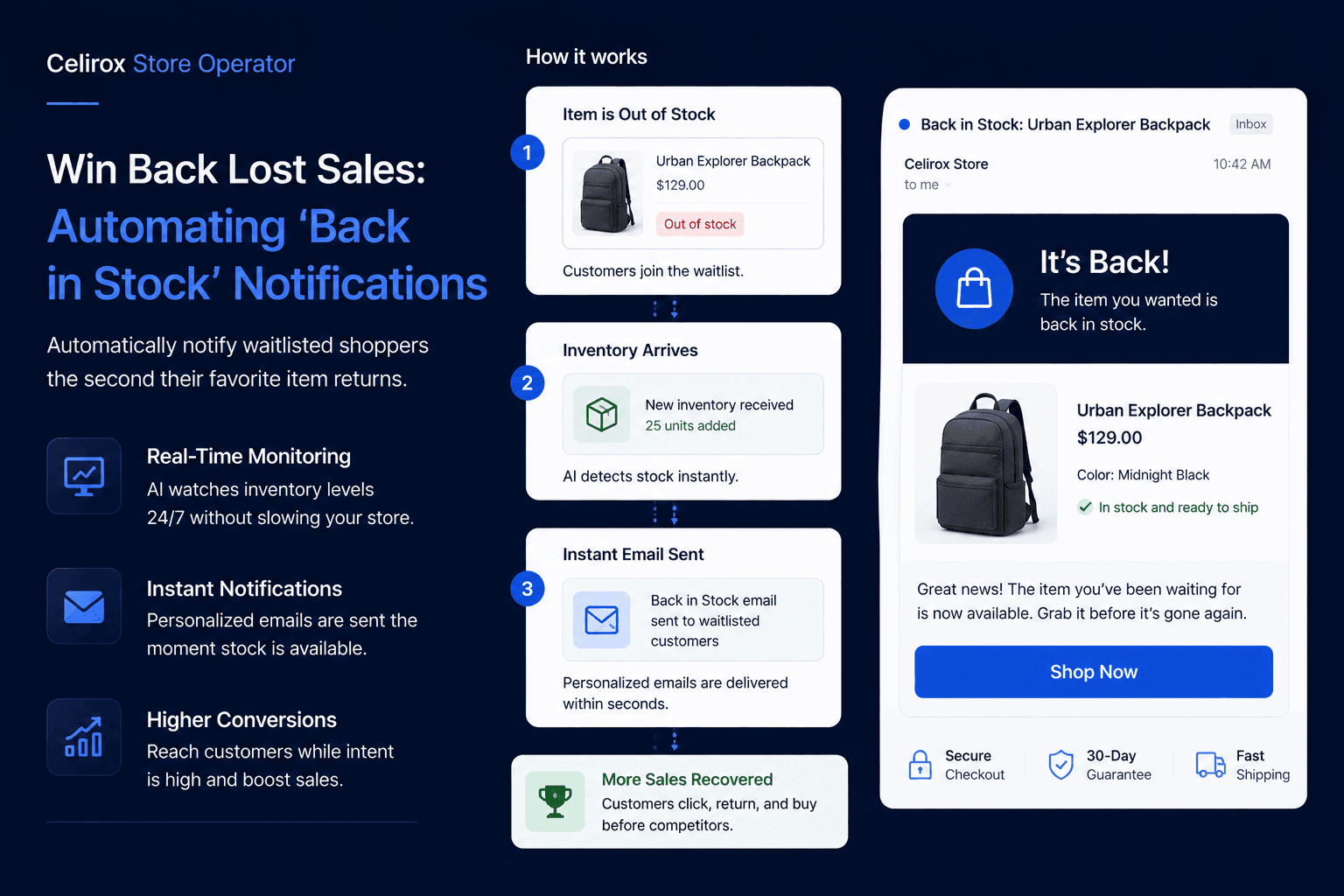
The Challenge of Out-of-Stock Inventory
In the fast-paced world of e-commerce, running out of a popular item is often viewed as a badge of honor—a sign of a highly successful marketing campaign or a viral social media post. However, beneath the surface of that "Sold Out" badge lies a significant operational challenge. When a potential customer lands on a product page and discovers they cannot make a purchase, the immediate result is a lost conversion. The secondary, and perhaps more damaging, result is a frustrated customer who may turn to a competitor.
To mitigate this, merchants implement waitlists. By allowing customers to submit their email addresses to be notified when the item returns, you capture high-intent leads. However, the execution of these waitlists is where many merchants stumble. Managing back-in-stock notifications manually is a logistical nightmare that rarely yields the desired results.
Why Manual Notification Systems Fail
The primary issue with manual waitlist management is latency. The lifecycle of an out-of-stock product typically looks like this:
- The product sells out, and customers begin joining the waitlist.
- Days or weeks pass.
- Inventory arrives at the warehouse or 3PL (Third-Party Logistics) provider.
- The 3PL scans the inventory into their system, which syncs with Shopify.
- Hours or even days later, a team member notices the inventory is back above zero.
- The team member exports the waitlist CSV from Shopify or a basic app.
- The CSV is uploaded to an email marketing platform like Klaviyo or Mailchimp.
- An email campaign is drafted, approved, and finally sent.
This delay is severe for conversion rates. The excitement a customer felt when they originally attempted to buy the product diminishes rapidly. If a customer receives an email three days after the inventory actually arrived, there is a high probability they have already spent their discretionary income elsewhere. Furthermore, if you send an email blast to a list of 1,000 people, but you only received 200 units in the restock, you risk selling out again before the majority of the waitlist even opens the email, leading to further frustration.
Enter Intelligent Automation with Celirox Store Operator
To solve this latency issue, the notification process must be entirely decoupled from human intervention. It must be programmatic, real-time, and intelligent. This is exactly what the Celirox Store Operator achieves. By leveraging AI to configure complex event-driven architectures, Celirox removes the manual burden from your team and ensures notifications are dispatched the exact second inventory becomes available.
Check out the interactive demo below to see how this automation is configured in seconds:
The Technical Architecture of Instant Re-engagement
When you instruct the Celirox Store Operator to handle your back-in-stock notifications, you aren't just setting up a basic email trigger. You are deploying a sophisticated monitoring system that integrates deeply with Shopify's backend.
Instead of writing custom scripts or relying on bloated third-party apps that slow down your theme, you simply provide a natural language command: "Monitor the Summer Collection. Whenever a product's inventory goes above 0, instantly email everyone on the waitlist with a direct link to buy, but throttle the emails so we don't oversell."
Behind the scenes, Celirox executes a multi-step technical orchestration:
1. Webhook-Driven Inventory Monitoring
Rather than polling the Shopify API every few minutes (which consumes API limits and introduces delays), Celirox registers secure webhooks listening specifically for the inventory_levels/update topic. The absolute millisecond your 3PL or warehouse management system updates the inventory count in Shopify, Celirox receives the payload. This ensures zero latency between stock arrival and system awareness.
2. Intelligent Batching and Throttling
One of the most complex aspects of back-in-stock notifications is managing the ratio of waitlisted customers to available inventory. If you have 5,000 people on a waitlist but only restock 500 units, emailing all 5,000 people simultaneously is a recipe for disaster. It guarantees that 4,500 people will click the link only to find the item sold out again.
Celirox handles this programmatic throttling automatically. Based on your historical conversion rates, the AI calculates the optimal batch size. It might send the email to the first 1,500 people on the list, monitor the inventory depletion in real-time, and only send the next batch if inventory remains after a predefined window. This creates a fair, smooth experience for your customers and prevents accidental overselling.
3. effortless Checkout Generation
To maximize conversions, the notification email shouldn't just send the customer back to the product page to start the shopping journey over again. Celirox automatically generates unique Shopify Checkout Permalinks. When the customer clicks the "Buy Now" button in their email, they are taken directly to the checkout page with the exact variant they waitlisted already pre-loaded in their cart. By removing the cart page step, you significantly reduce friction and increase the likelihood of a completed transaction.
Setting Up the Automation
Configuring this complex workflow requires zero coding knowledge. The Celirox interface translates your business logic into executable code.
- Open the Celirox Interface: Access the Store Operator chat directly from your Shopify admin panel.
- Define the Scope: Specify whether you want this automation applied to your entire catalog, a specific collection, or individual SKUs.
- Customize the Messaging: Tell the AI the tone and style of the email you want to send. The AI will generate a responsive, brand-aligned HTML email template instantly.
- Deploy: Confirm the automation. Celirox injects the necessary lead-capture forms into your product pages natively (without heavy JavaScript payloads) and activates the webhook listeners.
The Bottom Line: Recovering Lost Revenue
Implementing an automated, intelligent back-in-stock system is not just a customer service improvement; it is a direct revenue recovery strategy. By eliminating the latency between stock arrival and customer notification, and by utilizing intelligent batching to prevent secondary stockouts, merchants consistently see double-digit increases in waitlist conversion rates.
Stop relying on manual spreadsheets and delayed email blasts. Let an intelligent AI teammate handle your inventory re-engagement strategy so you can focus on scaling your brand.