12 Residents Report the Same Water Leak. Does Your Property Manager See 12 Problems or One?
Imagine managing a residential apartment building with 80 occupied apartments.
One morning, a resident notices water dripping from the ceiling near the common corridor. They send a WhatsApp message to the property manager.
A few minutes later, another resident reports water on the floor. Someone else sends a photograph. Three more residents contact the building office, each describing what they have noticed.
By lunchtime, the property manager has received twelve separate complaints.
But there may be only one underlying problem: a water leak affecting the same area.
Now someone has to read every message, compare the descriptions, check the photographs, identify the location, and contact the maintenance team.
The difficult part isn't receiving the reports. It's understanding which reports may be connected and organizing them into something the team can act on.
Why Multiple Reports Create Confusion
Residents don't report problems in the same way.
One person might write, "Water is coming from the ceiling near the lift."
Another might say, "The corridor floor is wet again."
A third resident may simply send a photograph without explaining where it was taken.
All three reports could relate to the same incident, but the property manager needs to examine the details before making that connection.
This creates several practical challenges:
- Duplicate reports: The same maintenance issue gets reported multiple times.
- Scattered information: Descriptions and photographs arrive through different communication channels.
- Unclear locations: Residents may describe the same area using different names.
- Repeated follow-ups: Staff members may ask residents for information that has already been provided.
- Delayed coordination: Maintenance teams may not receive one clear summary of the situation.
When these reports remain separate, the team has to do additional work just to understand what is happening.
What If AI Could Organize Related Complaints?
Imagine an AI-assisted workflow that receives incoming resident reports from configured communication channels.
Instead of treating every message as an entirely separate task, the workflow can analyze the available information and look for possible connections.
For example, consider these reports:
| Resident report | Possible shared detail |
|---|---|
| Water dripping near the second-floor lift | Second-floor corridor |
| Wet floor outside apartment 204 | Nearby common area |
| Ceiling leak near the staircase | Same building section |
| Water spreading along the corridor | Potentially related incident |
AI can help compare descriptions, extract locations, and prepare a combined summary for review.
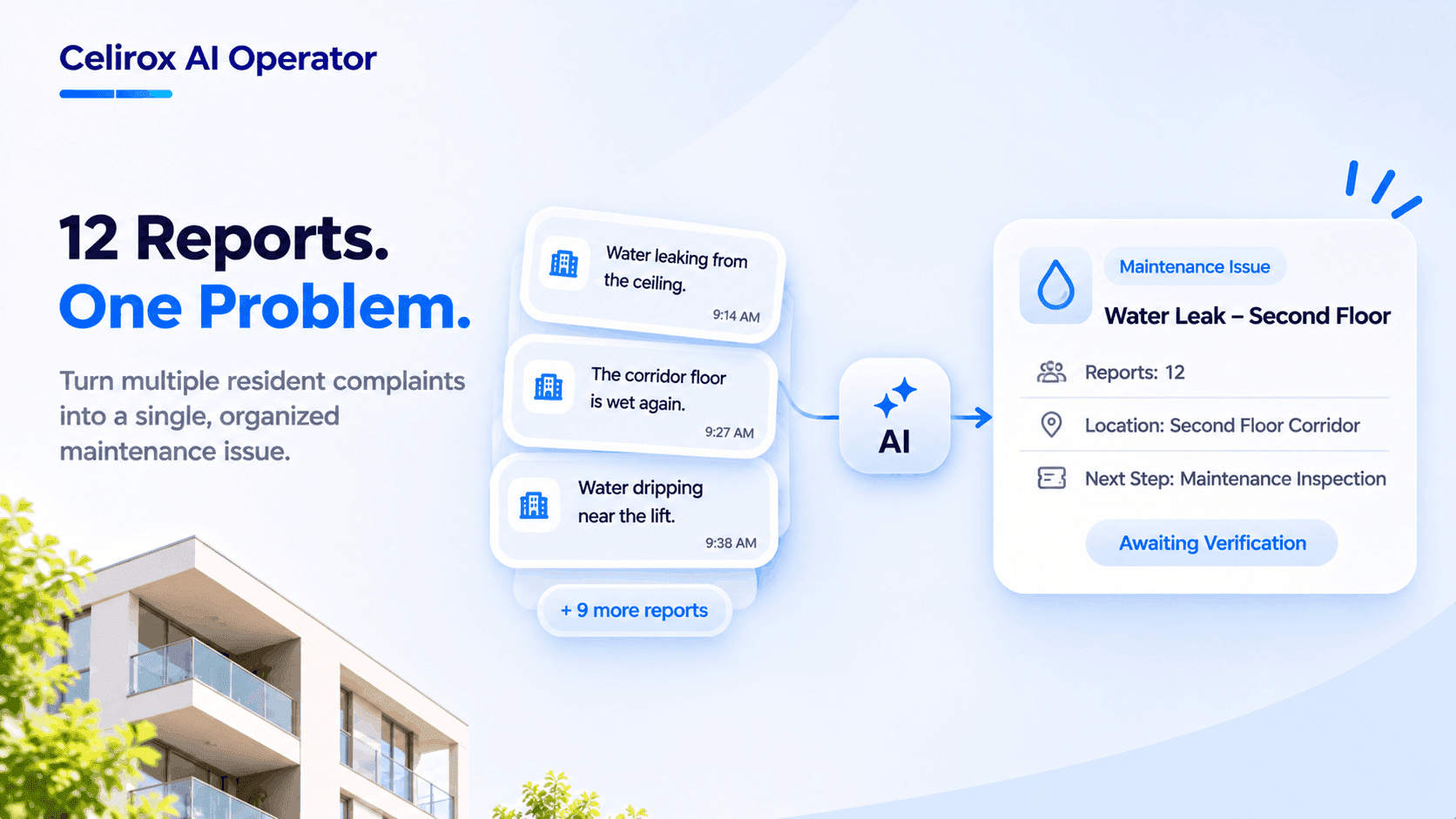
The result might look like this:
Maintenance issue: Possible water leak on the second floor
- Reports received: 12
- Reported area: Second-floor corridor and nearby apartments
- Information available: Resident descriptions and photographs
- Suggested next step: Maintenance inspection
- Status: Awaiting verification
This gives the property manager a more organized starting point than twelve disconnected messages.
Importantly, similar descriptions do not prove that every complaint has the same cause. Someone should verify the location and incident before merging reports or closing individual complaints.
How an AI-Assisted Maintenance Workflow Can Work
A practical workflow can be organized into five stages.
1. Collect incoming reports
Residents submit maintenance complaints through the communication channels supported by the property manager's setup. These might include connected messaging applications, forms, or other configured sources.
2. Extract important information
AI processes the available message content and identifies useful details, such as the reported problem, apartment number, building area, description, and attached information where supported.
3. Identify potentially related reports
The workflow compares descriptions and location details to identify reports that may refer to the same incident.
Potential matches should be presented for verification rather than automatically treated as confirmed duplicates.
4. Prepare an organized issue summary
Related information can be structured into a summary containing the reported problem, affected location, number of reports, and available evidence.
5. Notify the responsible team
A configured workflow can pass the summary to the appropriate maintenance or property management application, where a responsible person can review and assign the next action.
This process helps organize incoming information without removing the need for inspection, prioritization, or human decision-making.
How Celirox AI Operator Fits Into Property Management
Celirox AI Operator brings AI processing and connected workflows together.
For a residential property management use case, a configured workflow could receive reports from connected applications, use AI to extract relevant information, organize the details, and pass the result to another connected application or notification step.
For example, when several residents report a possible water leak, the workflow could help prepare a structured summary for the property manager to review.
The manager can then verify whether the reports describe the same incident and decide which maintenance action is necessary.
The exact workflow depends on the connected applications, available inputs, and configuration. AI should assist with organizing and processing reports, not independently confirm building damage or make safety decisions.
The objective is to reduce the administrative effort involved in handling scattered information so property teams can focus more attention on resolving the actual maintenance problem.
What Property Managers Should Keep in Mind
Automation is useful only when the information it produces is reliable and actionable.
Before implementing an AI-assisted maintenance workflow, consider these points:
- Keep original reports: Preserve individual resident messages and photographs for reference.
- Verify duplicate detection: Similar reports may describe different problems.
- Protect resident information: Limit access to personal details and use appropriate data handling practices.
- Prioritize urgent issues: Water leaks, electrical hazards, and other potentially dangerous situations require prompt human assessment.
- Maintain clear ownership: Every confirmed maintenance issue should have a responsible person or team.
- Communicate updates: Residents should know when their report has been received and what happens next.
AI can help organize information, but property management teams remain responsible for the decisions and actions that follow.
Frequently Asked Questions
Can AI identify duplicate maintenance complaints?
AI can compare incoming descriptions and identify reports that may refer to the same issue. However, property managers should verify potential matches before combining complaints into one maintenance case.
Can AI organize resident messages from different channels?
This is possible when the relevant communication applications are supported and connected to the workflow. The available information and processing steps depend on the integrations and configuration.
What information should a maintenance report contain?
Useful information includes the reported problem, building location, apartment number when relevant, description, photographs if available, reporting time, and contact details needed for follow-up.
Can an AI workflow automatically assign maintenance jobs?
A configured workflow may pass organized information to a connected task or property management application. Assignment rules should be defined by the property management team, particularly for urgent or safety-related issues.
Is AI property management suitable for smaller apartment buildings?
It can be useful wherever staff receive repeated reports or handle information across multiple communication channels. The workflow should be proportionate to the building's size and actual maintenance process.
Twelve Messages Should Not Mean Twelve Separate Investigations
When residents report the same underlying problem, property managers need a way to understand the bigger picture without manually piecing together every message.
AI-assisted workflows can help organize descriptions, identify potentially related reports, and prepare structured information for the people responsible for maintenance.
Start with one recurring problem, such as water leaks or lift complaints. Define the information your team needs, connect the relevant communication sources, and keep human verification in the process.
The goal isn't to replace property managers. It's to help them spend less time sorting through messages and more time resolving residents' problems.
Explore Celirox AI Operator to discover how AI-powered workflows can help organize information and connect business processes.