AI Contract Review: Find Important Clauses Before You Sign
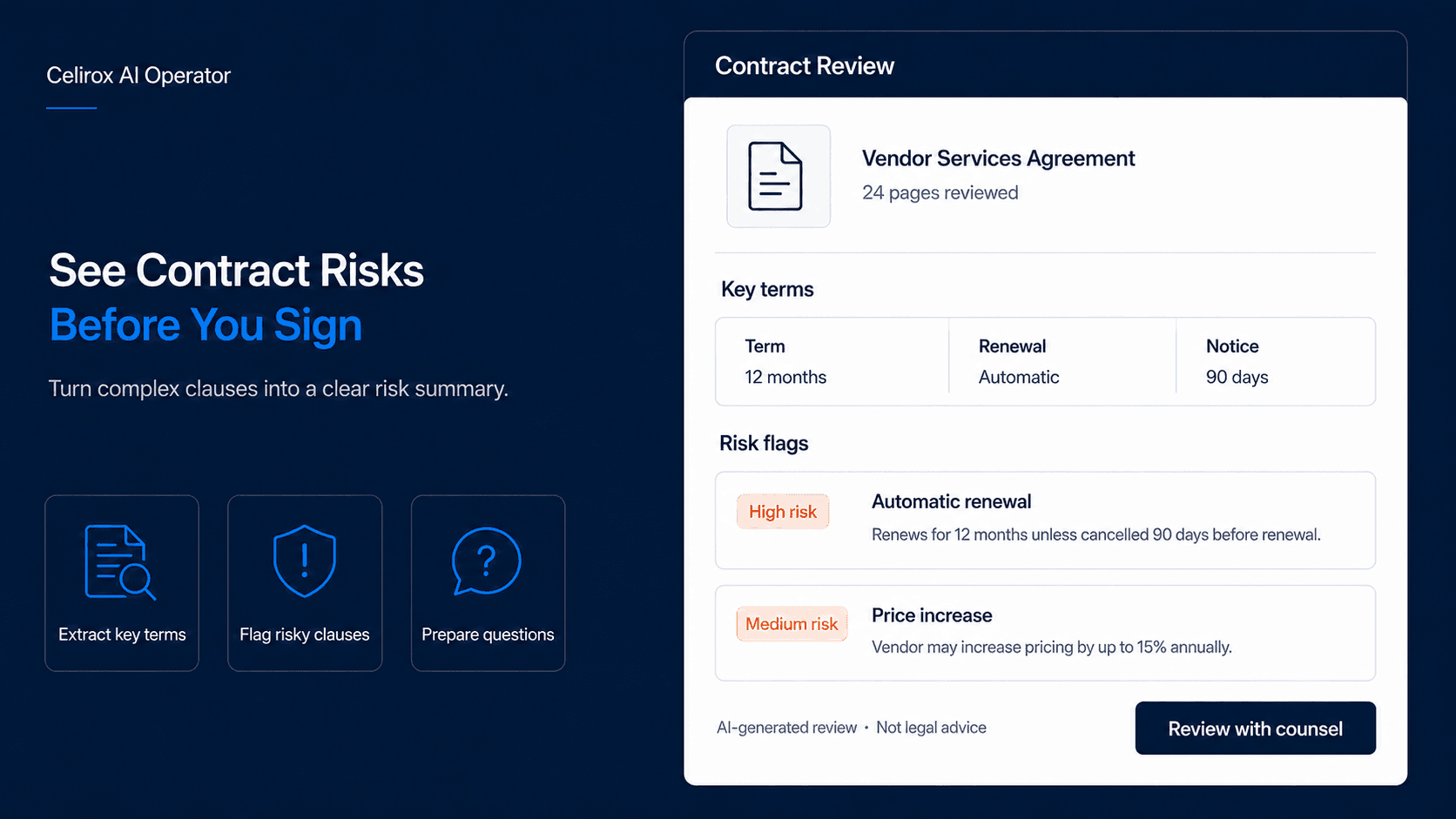
Find What Actually Matters
Imagine your company is about to sign a new software agreement.
The sales conversation went well.
Pricing looks reasonable.
Implementation starts next month.
Then someone sends over a 32-page contract.
You already know the headline terms:
$4,000 per month. One-year agreement.
But deeper in the document are questions that may matter just as much.
Does the contract renew automatically? How much notice is required to cancel? Can the vendor increase prices? What happens if the service fails? Can either party terminate early? Is there an exclusivity requirement?
The challenge is not simply reading 32 pages.
It is knowing which parts deserve attention before someone signs.
A useful contract review should surface what matters, not simply summarize everything.
What AI Contract Review Means
AI contract review uses document understanding to help extract, organize, and analyze information inside agreements.
A practical workflow might look like:
Contract received → Terms extracted → Important clauses identified → Company rules compared → Exceptions surfaced → Human reviews
The objective should not be:
AI says the contract is safe.
A more useful outcome is:
Here are the commercial terms, unusual provisions, missing information, and clauses that deserve closer review.
That distinction matters because contract decisions depend on legal, financial, operational, and business context.
AI can help organize the information.
It should not pretend to make the final legal judgment.
Start With Commercial Terms
Before thinking about broader legal risk, a business usually needs a clear picture of what it is agreeing to commercially.
For a software agreement, that may include:
- Contract duration
- Renewal period
- Subscription price
- Payment terms
- Usage limits
- Price adjustment rights
Different agreements need different review priorities.
A supplier agreement may require more attention to minimum quantities, delivery obligations, returns, exclusivity, and payment schedules.
A lease may require closer review of rent increases, deposits, maintenance, renewal options, and early termination.
A professional services agreement may focus more heavily on scope, deliverables, acceptance, intellectual property, and change requests.
The document type should determine what the review looks for.
A generic checklist applied to every contract can create noise instead of useful guidance.
Where AI Operator Fits
With Celirox AI Operator, a business can describe the contract-review outcome it wants.
For example:
"Review this vendor agreement. Extract the commercial terms, renewal and termination rules, pricing-change provisions, liability language, exclusivity restrictions, data obligations, and anything that differs from our normal review policy. Prepare a concise summary and flag anything that needs human review."
The process becomes:
Read → Extract → Organize → Compare → Flag → Prepare review
Instead of starting with dozens of pages of legal language, the reviewer begins with a structured view of the areas that deserve attention.
The Operator can also connect findings to other business processes.
If a contract contains a renewal deadline, approval requirement, or payment obligation, that information does not need to remain trapped inside the PDF.
It can become part of the operating workflow.
Watch Renewal and Pricing
Automatic renewal clauses are easy to overlook and operationally important.
Imagine a contract says:
"The Agreement will automatically renew for successive twelve-month periods unless either party provides written notice of non-renewal at least 90 days before the end of the then-current term."
The useful information is:
Renewal: Automatic 12-month renewal
Notice required: 90 days
Action: Review before cancellation window closes
The next step could be operational:
Record deadline → Remind contract owner → Review usage and pricing → Decide whether to renew
Pricing clauses deserve similar attention.
Suppose the agreement says the provider may change fees with 30 days' notice.
The question is not simply whether that sentence exists.
The business may need to ask whether increases are capped, whether they can happen during the current term, whether termination is allowed after an increase, and whether changes should apply only at renewal.
AI Operator can help identify those questions.
The negotiation decision remains with the people responsible for the agreement.
Review Risk With Context
Termination, liability, indemnification, warranties, and other risk-related clauses should be handled carefully.
Imagine the agreement gives the vendor the right to terminate with 30 days' notice but provides no similar right to your company.
That does not automatically mean the contract is unacceptable.
It means the asymmetry deserves attention.
Liability clauses are similar.
A review may surface:
Section 11 - Limitation of Liability
Summary: Liability is generally capped at fees paid during the previous 12 months, with certain exceptions.
That gives the reviewer useful orientation.
But deciding whether the clause is acceptable can depend on the company's industry, jurisdiction, insurance coverage, data exposure, bargaining position, and type of transaction.
This is why automated review should avoid labeling every unfamiliar clause:
HIGH RISK
A better system distinguishes between commercial attention, review recommended, missing or unclear information, and standard terms that simply need to be recorded.
If everything is flagged as critical, nothing is prioritized.
Compare Against Company Policy
Contract review becomes much more useful when the business has its own review rules.
Imagine your procurement policy says:
- Auto-renewal notice should be 30 days or less
- Annual price increases should not exceed 5%
- Agreements above $50,000 require CFO approval
- Exclusivity requires legal review
- Governing law outside approved jurisdictions requires review
Now the contract can be compared against those expectations.
For example:
Contract: 90-day cancellation notice
Company preference: 30 days
Result: Review recommended
Or:
Annual contract value: $72,000
Approval threshold: $50,000
Result: CFO approval required
This moves the workflow beyond generic document summarization.
The system is no longer asking only:
What does the contract say?
It is also asking:
How does this compare with what our business normally accepts?
That is where contract review becomes part of a real operating process.
Turn Clauses Into Actions
Reading the contract is only one part of the job.
The business still needs to act on what it agreed to.
Suppose a software contract has:
Annual renewal: November 1
Cancellation notice: 60 days
Waiting until October to decide whether to renew is too late.
The useful action is to record the cancellation deadline and begin review before it arrives.
A workflow could become:
Contract approved → Record renewal → Set review deadline → Check usage and pricing → Ask owner → Renew or cancel
Other clauses can create similar operational actions.
A contract may require finance approval, periodic compliance checks, data deletion after termination, insurance certificates, vendor reviews, or specific payment dates.
Once those obligations are extracted, AI Operator can help connect them to reminders, approvals, vendor records, and monitoring workflows.
The contract stops being just a PDF in a folder.
Its obligations become part of the business process.
Keep Findings Verifiable
Contract language can be subtle.
Definitions may appear many pages earlier.
An amendment may override part of the original agreement.
An order form may conflict with the master agreement.
A sentence that looks unusual by itself may make sense when read with another section.
That is why important findings should remain traceable to the source document.
A useful review might show:
Auto-renewal
Section: 4.2
Summary: Agreement renews for another 12 months unless notice is provided 90 days before expiration.
Why review it: Notice period is longer than the company's preferred 30-day standard.
Suggested next step: Ask whether the notice period can be reduced.
This is much more useful than:
Auto-renewal risk detected
The reviewer needs enough context to verify the result.
Potential conflicts should also be surfaced rather than silently resolved.
If an order form says 24 months and the master agreement says 12 months, the correct response is:
Confirm which term controls before approval.
Not:
Contract term: 24 months
when the documents disagree.
Keep Humans in Control
AI-assisted review can help organize information, but contracts can carry significant legal and financial consequences.
Important findings should be checked against the original agreement before signing or making consequential decisions.
Qualified legal review becomes especially important when agreements involve major financial exposure, complex indemnification, intellectual property, regulatory obligations, sensitive data, international jurisdictions, mergers, litigation rights, unusual exclusivity, or high-value property commitments.
The higher the consequence of getting the interpretation wrong, the stronger the case for professional review.
Confidentiality also matters.
Contracts may contain pricing, customer information, employee data, security requirements, intellectual property, banking details, and strategic information.
Businesses should understand how any system handling those documents manages access, permissions, retention, and data processing.
Use AI to find what deserves attention, not to remove responsibility from the people signing the agreement.
Measure the Review Process
Contract review should not be measured only by how quickly a document is summarized.
A more useful question is whether important terms are being found, reviewed, and acted on consistently.
Useful metrics can include:
- Contracts reviewed before signature
- Policy exceptions identified
- Renewal deadlines captured
- Approval requirements triggered correctly
- Missed cancellation windows
- Findings corrected during human review
- Obligations tracked after signature
You can also look at review quality.
Are reviewers constantly correcting clause summaries?
Are important exceptions being missed?
Are too many harmless clauses being flagged?
Are contract owners receiving renewal reminders early enough to make a decision?
The goal is not to generate the longest review report.
It is to make the contract easier to understand, verify, approve, and manage afterward.
Frequently Asked Questions
What is AI contract review?
AI contract review uses document-analysis models to help extract terms, summarize provisions, identify clauses for closer examination, and organize findings for human review.
Can AI detect automatic renewal clauses?
It can help identify renewal and cancellation language and extract details such as renewal periods and notice requirements. Important findings should still be checked against the original contract.
Can AI review different contract types?
Yes. Workflows can be designed for SaaS agreements, vendor contracts, service agreements, leases, and other business documents, with review criteria adapted to each document type.
Can AI Operator replace a lawyer?
No. Celirox AI Operator can help organize contracts, surface relevant provisions, compare terms with business rules, and prepare questions. Legal interpretation and advice should come from qualified professionals when appropriate.
Can contract review trigger other workflows?
Yes. Renewal dates, approval requirements, payment obligations, and other extracted terms can become inputs to reminders, approvals, vendor management, and operational monitoring.
Should every unusual clause be considered high risk?
No. Unfamiliar language may be standard or acceptable in context. A useful review should distinguish between normal information, commercial attention, uncertainty, and provisions that genuinely need closer examination.
Make Contracts Operational
A contract can contain a renewal date nobody remembers.
A cancellation window nobody calendars.
A pricing clause finance never sees.
A responsibility operations discovers only after something goes wrong.
Finding those details before signing is useful.
Making sure the business acts on them afterward is even more useful.
Celirox AI Operator can help turn contract information into a structured operating process:
Read → Extract → Compare → Flag → Review → Approve → Track
The goal is not to let software make legal decisions for the company.
It is to help the people making those decisions find important information faster, compare it more consistently, and avoid losing obligations inside another long document.