Stop Losing Promises in Email: Turn Commitments Into Follow-Up Tasks
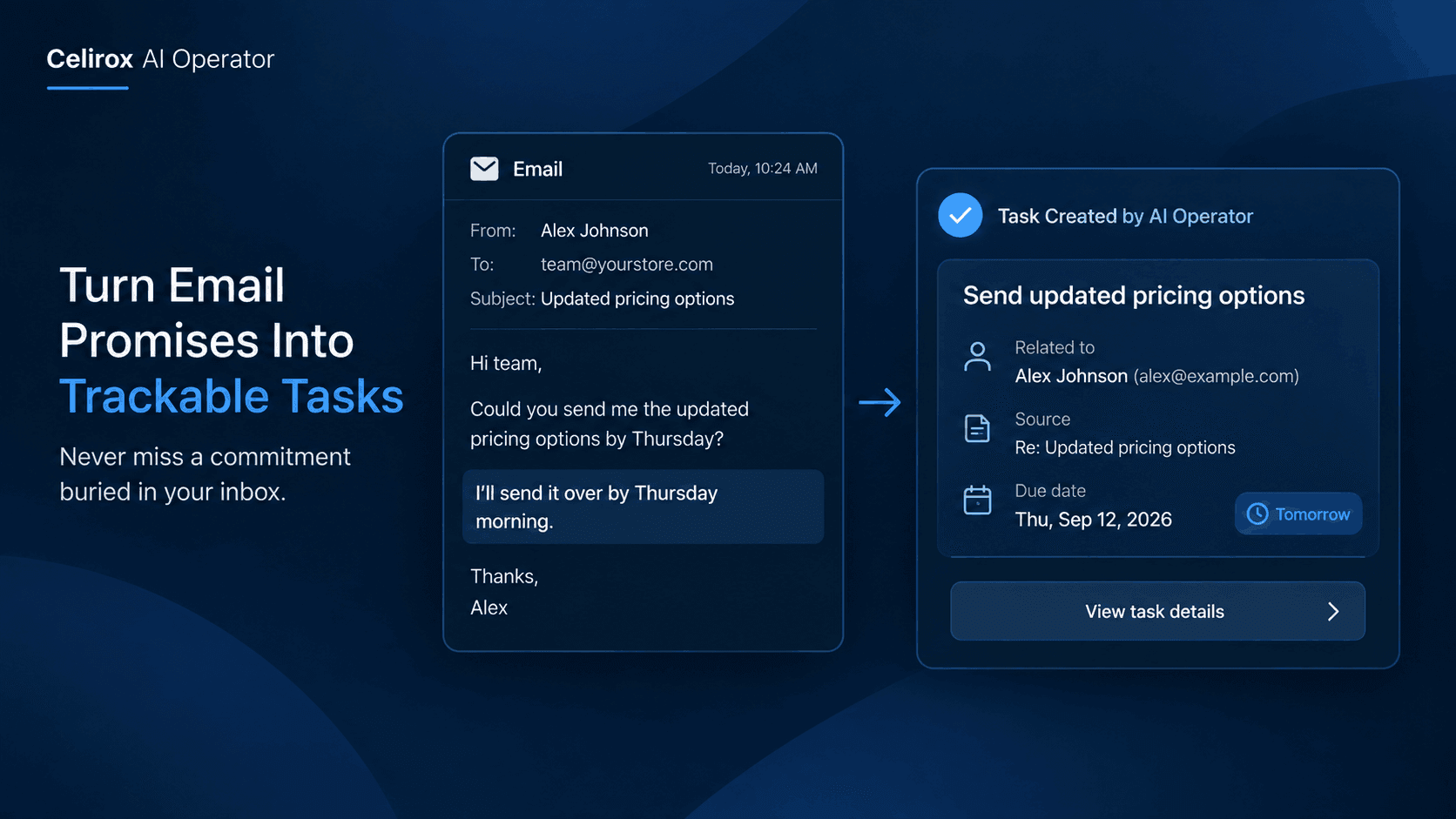
The Promise Is Easy To Miss
A customer sends an email.
They ask for a revised proposal before Friday.
Someone on the team replies:
"I'll send it over by Thursday."
The conversation ends.
Then another customer emails.
A meeting starts.
Slack notifications appear.
More work arrives.
The original email slowly moves down the inbox.
Thursday arrives.
The proposal was never sent.
Nobody intentionally ignored the customer. The commitment simply disappeared inside an ordinary email thread.
This is one of the easiest ways for important work to get lost.
Commitments Hide Inside Conversations
Not every email looks like a task.
An email might contain a question, an update, a request, and a promise in the same conversation.
For example:
"Thanks for the details. I'll review the document and send you my feedback tomorrow."
There may be no formal task created anywhere.
The commitment exists only inside the email.
Another message might say:
"I'll check with the team and get back to you next week."
Again, there is a clear responsibility, but no task in a task-management system.
These small commitments happen every day across sales, customer support, operations, management, and internal teams.
From Email To Action
The useful part is not simply reading the email.
It is recognizing when an email contains something that needs to happen.
AI Operator can help identify commitments such as:
- Send a document.
- Follow up with a customer.
- Review a proposal.
- Check something with a teammate.
- Provide requested information.
- Complete a promised action.
- Follow up by a specific date.
The commitment can then become something the team can actually track instead of remaining buried in the conversation.
A Customer Shouldn't Have To Chase
Imagine a sales conversation.
A prospect asks:
"Can you send me the updated pricing options tomorrow?"
The salesperson responds:
"Absolutely. I'll send them tomorrow morning."
The commitment is clear.
But if nothing tracks it, the customer may eventually have to send another email:
"Just checking if you had a chance to send this."
That creates an unnecessary follow-up loop.
When the promise becomes a task or reminder, the salesperson has a visible action before the customer needs to ask again.
The customer gets a better experience.
The team gets fewer avoidable follow-ups.
Capture The Deadline Too
A commitment becomes much more useful when its timing is understood.
Consider the difference between:
"I'll send the document."
and:
"I'll send the document by Friday."
The second statement contains an obvious deadline.
AI Operator can use the context in the email to help structure the commitment around the expected timing.
That means the resulting task can contain the important details rather than simply saying:
"Send document."
A useful task might instead capture what needs to be done, who it relates to, and when it was promised.
Keep The Original Context
A task without context can create another problem.
Someone sees:
"Follow up with customer."
But which customer?
About what?
Based on which conversation?
The email itself contains the answers.
The original message provides the customer, subject, request, and surrounding conversation that explains why the task exists.
AI Operator can use that context when turning the commitment into an actionable item.
This makes the task more useful than a manually typed reminder created days later.
Small Promises Add Up
One missed commitment may not seem serious.
But businesses make hundreds of small promises.
A sales representative promises to send pricing.
A support agent promises to check an issue.
A manager promises to review a document.
An operations employee promises to confirm a delivery.
A founder promises to introduce someone.
Individually, each commitment looks small.
Collectively, they represent a significant amount of work that needs to be remembered.
The challenge is not always knowing what to do.
It is remembering everything that was promised.
Reduce The Mental Load
People often compensate for this problem by keeping information in their heads.
"I need to remember to reply to that."
"I promised to send that tomorrow."
"I need to check with Sarah."
"I'll deal with that later."
This creates unnecessary mental overhead.
The inbox becomes part email system, part task manager, and part personal memory.
AI Operator can help separate those responsibilities by turning actionable commitments into structured work.
The email remains the source of context.
The task becomes the thing that needs to happen.
Make Follow-Up More Reliable
A strong follow-up process should not depend entirely on memory.
When a commitment is identified and turned into an actionable task, it becomes easier to review outstanding work.
A team member can see what still needs to be completed.
Managers can have better visibility into pending commitments.
Customers are less likely to need to send repeated reminders.
And important actions are less likely to disappear simply because an email became old.
Works Beyond Customer Emails
This automation is not limited to customer conversations.
Internal emails can contain commitments too.
A manager might write:
"I'll review the budget tomorrow."
A colleague might say:
"I'll send the spreadsheet after lunch."
An employee might respond:
"I'll confirm this with the vendor."
These are all potential actions hidden inside normal workplace communication.
AI Operator can help surface those commitments so they can be handled as work rather than forgotten as conversation.
Turn Conversation Into Workflow
Email is excellent for communication.
It is not always excellent for tracking commitments.
That is where an AI-powered workflow can help.
The process can look like this:
Email arrives → Commitment is identified → Context is understood → Task or reminder is created → Action gets completed
The important difference is that the team does not have to manually convert every promise into a task.
The repetitive part can be handled automatically.
Make Promises Visible
The goal is not to turn every sentence in an inbox into a task.
The goal is to identify meaningful commitments that actually require action.
That distinction matters.
A newsletter does not need a task.
A routine notification does not need a task.
But when someone says:
"I'll send the revised agreement tomorrow."
that should not be treated like ordinary email text.
It represents work.
Making that commitment visible is the first step toward making sure it gets completed.
Build A More Reliable Workday
The best automation often solves a problem people have accepted as normal.
For many teams, losing track of email commitments is one of those problems.
People search their inboxes.
They scroll through old conversations.
They remember something at the last minute.
They wait for customers to follow up.
AI Operator can help change that workflow by turning important commitments into actionable work.
Instead of relying on memory, teams can rely on a process.
Frequently Asked Questions
What can AI Operator identify in emails?
AI Operator can identify actionable commitments and promised follow-up work contained in email conversations, such as sending information, reviewing documents, checking something, or responding by a certain time.
Can email commitments become tasks?
Yes. The workflow can turn relevant commitments into structured tasks or reminders so they are easier to track.
Can the deadline from an email be used?
When a commitment includes timing, that context can be used when structuring the resulting task or reminder.
Does this only work for customer emails?
No. Commitments can appear in customer conversations, internal emails, sales discussions, operations messages, and other workplace communication.
Why is this useful?
It reduces the chance that important promises disappear inside busy inboxes and helps teams keep follow-up work visible.
Don't Let Promises Get Buried
A promise made in an email is still a commitment.
The problem is that inboxes are designed to manage conversations, not guarantee that every promised action gets completed.
Celirox AI Operator can help bridge that gap.
It can identify meaningful commitments, capture the surrounding context, and turn promised actions into trackable work.
So instead of remembering every promise yourself:
Let the workflow remember what needs to happen next.