Automatically Find Shopify Products With Missing or Poor SEO Metadata
SEO Problems Build Quietly
Imagine a Shopify store with 1,500 active products.
Some were added this week.
Others have been in the catalog for years.
Different people created them at different times.
One product has a strong meta title and description.
Another has no meta description at all.
Several products use nearly identical copy.
A recently published collection of products still has placeholder SEO text.
Nothing in the store appears broken.
Customers can browse.
Checkout works.
Orders still arrive.
But the catalog is slowly becoming inconsistent.
Someone could open every product in Shopify admin, inspect the SEO fields, compare titles, review descriptions, and make a list of what needs fixing.
Then they would need to repeat that process as new products are added.
The problem is not knowing that SEO metadata matters. It is keeping hundreds or thousands of product records consistently maintained over time.
That is a backend catalog task Store Operator can help manage.
Define What Needs Review
Not every product with different metadata has a problem.
The merchant first needs to define what should count as an SEO issue.
That might include:
- Missing SEO title
- Missing meta description
- Duplicate titles across products
- Duplicate meta descriptions
- Placeholder or obviously incomplete copy
- Metadata that no longer reflects the current product
- Newly published products that have not been reviewed
The rules should match the merchant's actual catalog process.
A simple starting condition could be:
Active product + missing SEO title or description → SEO review required
Another merchant may want:
Duplicate meta description across several active products → Review
The goal is not to create arbitrary character-count rules just because a tool can measure them.
The useful question is:
Does this metadata clearly and accurately describe this specific product for someone discovering it in search?
Run a Scheduled SEO Review
This is a good recurring Store Operator task because the problem keeps returning.
A merchant could say:
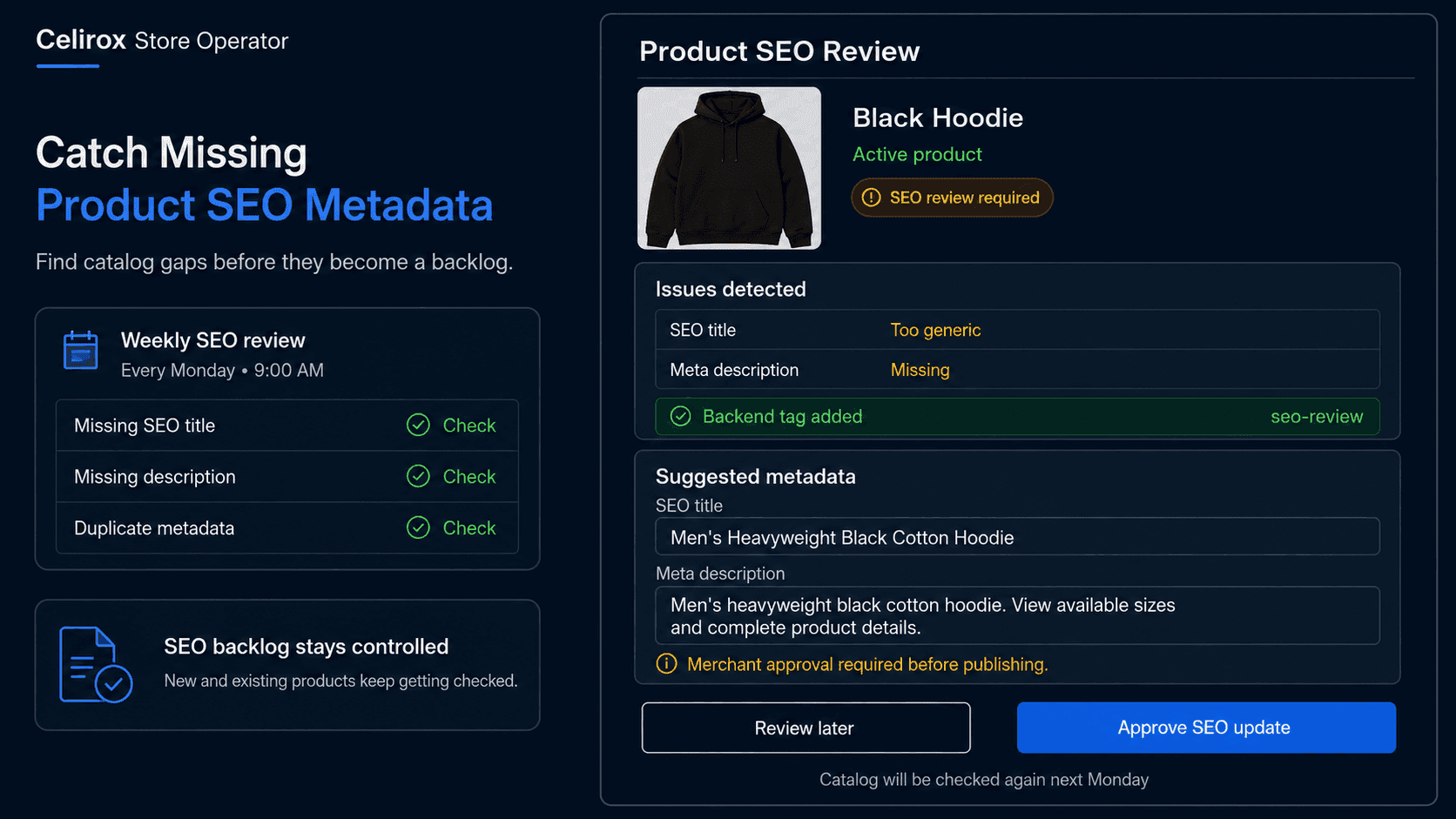
"Every Monday, review all active products. Find products with missing SEO titles, missing meta descriptions, duplicate metadata, or obvious placeholder copy. Group them by issue and show me what needs attention."
The workflow becomes:
Scheduled review → Check products → Detect SEO gaps → Group issues → Prepare review
The merchant no longer has to remember to perform another catalog audit.
The task runs on the schedule they choose.
That matters because SEO maintenance is rarely urgent enough to interrupt the day.
It is exactly the kind of task that gets postponed until hundreds of products need attention.
A recurring review keeps the backlog smaller.
Catch Problems When Published
Scheduled reviews are useful for existing catalog issues.
Event-driven rules can prevent new ones from accumulating.
For example:
"Whenever a product is published without an SEO title or meta description, add the tag seo-review and prepare suggested metadata."
Now the flow becomes:
Product published → Check SEO fields → Missing information found → Add seo-review → Prepare suggestion
The merchant does not have to wait until Monday's catalog review to discover the problem.
This is especially useful when several people or systems create products.
One employee may complete every SEO field.
Another may focus only on product title, price, images, and inventory.
A product import may create records without complete search metadata.
The event rule acts as a quality check around the publishing process.
Prepare Better Metadata
Finding missing fields is useful.
The repetitive part often continues when someone has to write the replacement copy.
Store Operator can prepare suggestions based on the product information already available.
For example, it can consider the product title, description, category, important attributes, and other relevant product details.
A merchant might say:
"For products tagged seo-review, prepare a concise SEO title and meta description based only on the actual product information. Do not invent materials, benefits, certifications, or features that are not present in the product data."
That last instruction matters.
Better SEO metadata should still be accurate.
The objective is not to produce exaggerated search copy.
It is to make each product easier to understand.
For example:
Weak title
Black Hoodie
could become something more specific when supported by the product data:
Men's Heavyweight Black Cotton Hoodie
The useful improvement comes from specificity.
Not keyword stuffing.
Keep Approval for Content Changes
A missing tag can often be added safely.
Changing customer-facing search metadata deserves more care.
That is why a useful workflow can separate detection from publication.
For example:
Missing metadata detected → Draft improvement → Merchant reviews → Approved copy applied
The merchant may want automatic updates for simple cases.
For important products, high-traffic pages, regulated categories, or brand-sensitive copy, approval may be preferable.
A rule could be:
New product with blank metadata → Prepare draft
Merchant approves → Update SEO fields
Or:
Low-risk formatting cleanup → Update automatically
Major title rewrite → Require approval
The workflow should reflect the merchant's comfort level.
Store Operator helps reduce the repetitive work without forcing every content decision to happen without review.
Use Tags to Organize Work
A backend tag can make the SEO process easier for the whole team.
For example:
seo-review
seo-draft-ready
seo-approved
Suppose Store Operator finds 47 products with missing or duplicate metadata.
Instead of keeping the result only in a report, it can maintain a review status the merchant can use inside Shopify.
A workflow might be:
Issue detected → Add seo-review
Then:
Suggested metadata prepared → Add seo-draft-ready
After the approved update:
SEO fields completed → Remove seo-review
The exact tags can be simpler if the merchant prefers.
The important part is keeping the status current.
A review tag that remains forever after the problem has been fixed creates another maintenance problem.
Avoid Creating Duplicate Copy
Generating metadata in bulk creates its own risk.
Imagine 100 similar products.
If every description becomes:
Shop our premium product with quality design and fast shipping.
the fields are technically complete.
They are not very useful.
Each product should be described according to what actually makes it different.
That may include its product type, color, material, size, compatible model, intended use, or another genuine attribute.
Store Operator should also flag situations where several active products already have identical or nearly identical metadata.
The goal is not:
Every field has text
It is:
Each important product has accurate metadata that distinguishes it clearly enough from related products.
For highly similar variants or products, the merchant may still choose consistent wording.
The decision should be intentional rather than the result of copied placeholders.
Recheck After Changes
SEO maintenance should not end after one batch update.
New products will be added.
Existing products will change.
Titles may be rewritten.
Collections may be reorganized.
A product that had accurate metadata six months ago may no longer match the page.
That is why the scheduled workflow continues to matter after the first cleanup.
A useful operating loop becomes:
Review → Detect → Prepare → Approve → Update → Recheck
The merchant can also change the rules over time.
Perhaps the first goal is simply finding missing fields.
Once that backlog is clean, the next review can focus on duplicates or outdated metadata.
This is more manageable than trying to fix every possible SEO issue across the catalog in one giant project.
Measure Catalog Maintenance
The value of this workflow is mainly operational.
Useful measurements can include:
- Products missing SEO metadata
- Duplicate metadata issues found
- Products awaiting review
- Suggested updates approved
- Products published without complete SEO fields
- Time spent manually auditing product records
The merchant can also track whether the backlog is improving.
Imagine the first review finds:
186 products needing attention
A month later:
42
Later:
8
That tells the team the catalog process is becoming more consistent.
The goal is not to generate as many AI-written descriptions as possible.
It is to keep important product metadata accurate and complete without requiring someone to repeatedly inspect every product by hand.
Frequently Asked Questions
What Shopify SEO metadata should product pages have?
Product pages can include search-engine listing information such as an SEO title and meta description. Merchants should keep those fields accurate, specific to the product, and aligned with the actual page content.
Can Store Operator find products with missing metadata?
Yes. Store Operator can be used to review relevant product records and identify products that meet merchant-defined conditions such as missing SEO titles or descriptions.
Can it check the catalog on a schedule?
Yes. Scheduled recurring tasks can run periodic product reviews without the merchant manually starting the same audit each time.
Can a new product be checked when it is published?
Yes. Event-driven rules can be defined around product activity so a merchant can identify published products that still need SEO review.
Can Store Operator write the metadata too?
Store Operator can help prepare suggested SEO metadata using the product information available to it. Merchants should ensure the resulting copy remains accurate and does not invent unsupported product claims.
Can I review suggestions before they are applied?
Yes. The workflow can be designed so content changes are prepared first and applied only after merchant approval.
Can products be tagged for SEO review?
Yes. Backend tags such as seo-review can be used to organize products that need attention, and the workflow can remove or update those tags when the condition changes.
Should every product have completely different metadata?
Not necessarily. Similar products may naturally share some wording, but important pages should avoid generic copied text that fails to describe what is actually different about each product.
Make SEO Maintenance Routine
A merchant may understand SEO perfectly and still have hundreds of incomplete product records.
The problem is often not knowledge.
It is repetition.
New products keep arriving.
Old products change.
Different people update different parts of the catalog.
Eventually someone has to inspect everything again.
Store Operator can turn that into an ongoing operating process:
Monitor catalog → Find SEO gaps → Tag for review → Prepare improvements → Approve → Update → Recheck
That combines scheduled reviews, event-driven rules, backend product maintenance, content preparation, and merchant approval in one practical Shopify workflow.
Celirox Store Operator helps keep the work moving without requiring someone to manually inspect hundreds of product pages every week.