You Added a New Product. Now Create the Marketplace Listing.
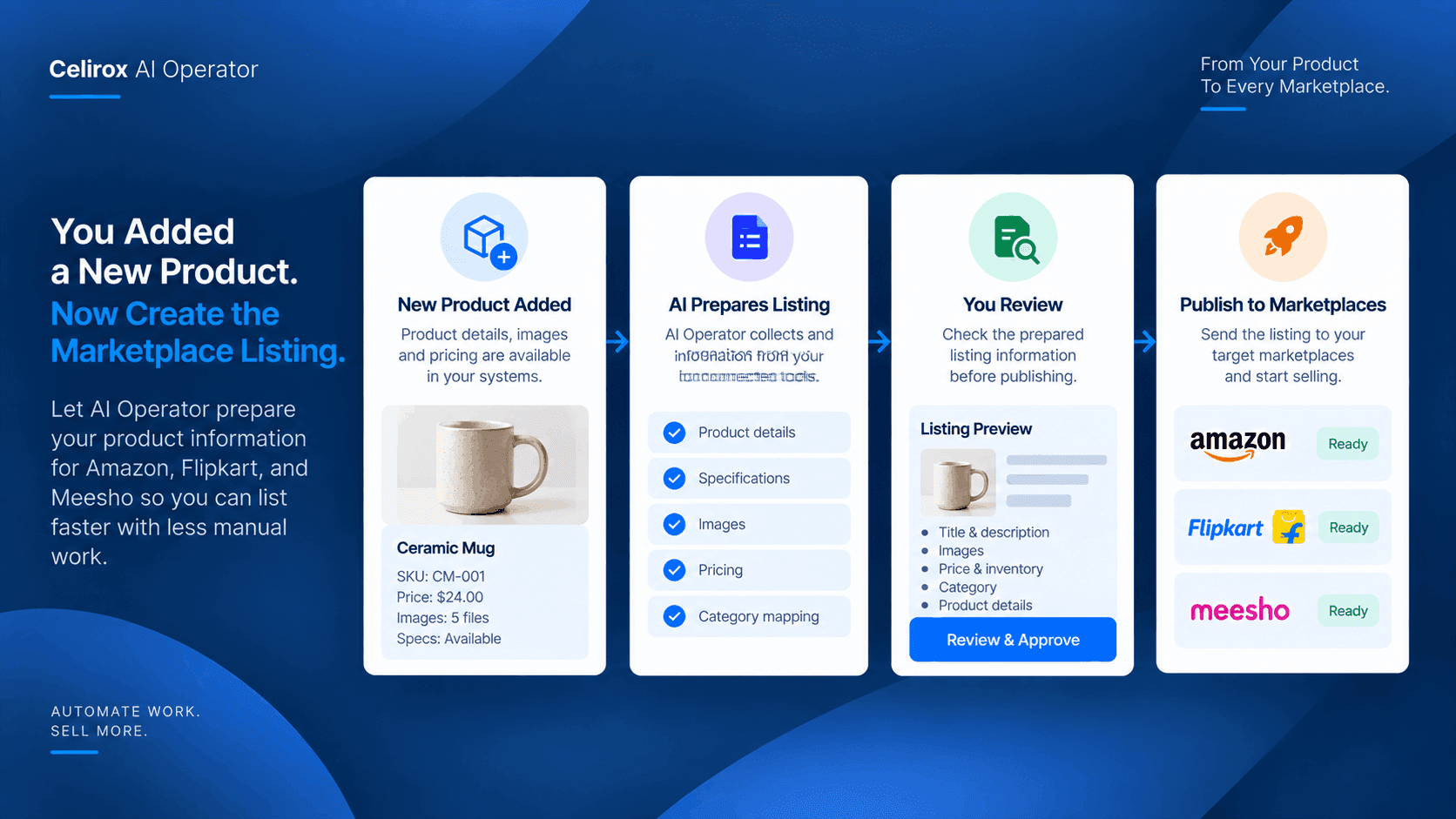
A seller adds a new product to the business.
The product name is ready. The specifications are in a document. The images are sitting in a folder. The price has already been decided.
So why isn't the product listed yet?
Because the actual work starts after the product is ready.
Someone still has to collect the information, organize it, prepare the listing details, enter everything into the marketplace workflow, and check whether anything important was missed.
For sellers working across marketplaces such as Amazon, Flipkart, and Meesho, this can become a repetitive part of every product launch.
The product isn't the problem.
Getting the product listing ready is.
A New Product Creates More Work
Imagine an e-commerce seller adding a new kitchen product to their catalog.
The product team has already prepared the basic information. The photographer has uploaded the product images. The pricing team has confirmed the selling price.
Now someone from the marketplace team has to take all of that information and turn it into a listing.
They open the product document.
Then the image folder.
Then the marketplace account.
Then another document to check specifications.
Then they start entering everything.
One product may not feel like much work.
But when ten, twenty, or fifty products are being added, the same process starts consuming hours.
The Information Already Exists
This is what makes the task frustrating.
The seller usually isn't creating information from nothing.
The information already exists somewhere inside the business.
Product specifications may be in a spreadsheet. Images may be stored in Drive. Pricing may be maintained separately. Internal product records may contain names, SKUs, dimensions, and other details.
The marketplace worker becomes the person responsible for connecting all those pieces.
That is where an AI workflow can help.
AI Can Prepare the Listing Work
Instead of asking someone to repeatedly collect the same information, AI Operator can coordinate the preparation process.
A workflow can start when a new product is ready for marketplace listing.
AI Operator can then work through the information available to the business, organize the relevant product details, and prepare the information needed for the listing workflow.
The seller's team doesn't have to repeatedly start from an empty listing screen.
They receive an organized result that is ready for the next step.
One Product, One Clear Workflow
The automation can remain simple.
New product information becomes available.
AI Operator identifies the product and gathers the relevant information.
The product details are organized.
Name, specifications, pricing information, dimensions, and other available listing details are prepared in a consistent structure.
The listing workflow is prepared.
The information is moved into the seller's marketplace process so the team does not have to manually rebuild the same information every time.
The seller reviews it.
Instead of spending the time collecting and preparing everything, the seller can focus on checking the finished listing before publishing.
The goal isn't to remove the seller from the process.
It is to remove the repetitive preparation around it.
Why Marketplace Sellers Feel This
Marketplace selling creates a different kind of operational workload.
A seller may have hundreds of products, but each product still needs individual attention when it is introduced or changed.
The marketplace doesn't know that the information already exists in the seller's internal systems.
The seller has to move it from one place to another.
That creates a lot of small tasks:
- Finding the correct product information
- Checking which images belong to the product
- Collecting specifications
- Preparing listing details
- Entering information into marketplace workflows
- Checking for missing information
None of these tasks individually looks complicated.
Together, they become a significant part of marketplace operations.
Keep The Seller In Control
Product listings directly affect what customers see.
That makes approval important.
A useful AI workflow should prepare repetitive work without forcing a seller to blindly publish whatever the AI produces.
AI Operator can handle the preparation and coordination while the business keeps the final review step.
That gives the seller a practical division of work:
AI handles the repetitive preparation.
The seller makes the final decision.
This is especially useful when product information needs to be checked before it becomes customer-facing.
From Product Data To Marketplace
The bigger opportunity isn't simply generating product descriptions.
It is connecting the work that happens around a product.
A new product can begin with information stored across different business tools.
Instead of making an employee manually collect that information every time, an AI agent can coordinate the process and prepare the next step.
That turns product listing from a repeated manual task into a defined business workflow.
For marketplace sellers, that distinction matters.
The value is not just writing something faster.
The value is moving a product from “ready internally” toward “ready for marketplace review” without making someone manually connect every step.
The Seller Should Sell, Not Copy Data
Marketplace sellers already have enough work to manage.
They need to monitor sales, handle customers, coordinate fulfillment, manage pricing, track products, and keep their business moving.
Spending repeated hours moving product information between systems is not where their attention creates the most value.
A product should not require the same manual preparation every time a new listing is created.
With AI Operator, that preparation can become a workflow.
The seller still reviews the important details.
But the repetitive work leading up to that review can be coordinated by AI.
Frequently Asked Questions
Can AI Operator help marketplace sellers?
Yes. AI Operator is designed to automate business workflows by connecting tasks and applications. For marketplace sellers, this can be used to coordinate repetitive product-listing preparation work.
Is this only for Amazon sellers?
No. The workflow can be designed around a seller's business process rather than being limited to one marketplace. Sellers working with platforms such as Amazon, Flipkart, and Meesho can use the same underlying workflow concept where the required integrations and actions are available.
Does the AI publish every product automatically?
The workflow can be structured so that the seller reviews the prepared listing information before the final publishing step. This is useful when customer-facing product information needs human approval.
What information can be prepared?
That depends on the information available in the connected business systems. A workflow can organize details such as product names, specifications, pricing information, dimensions, and other relevant product data.
Can this work with information stored in different tools?
Yes. The purpose of an AI agent workflow is to coordinate work across connected applications rather than requiring an employee to manually move information between every system.
Make New Product Listings Less Manual
Adding a product should feel like a business decision, not the beginning of another long data-entry task.
The product already exists.
The information already exists.
The images already exist.
What is often missing is the connection between all of those pieces and the marketplace listing process.
That is the kind of repetitive operational work AI Operator can help coordinate.
Instead of having your team repeatedly gather product information and rebuild the same listing workflow, let AI handle the preparation while your team stays responsible for the final review.
Build the workflow once. Let AI handle the repetitive work.