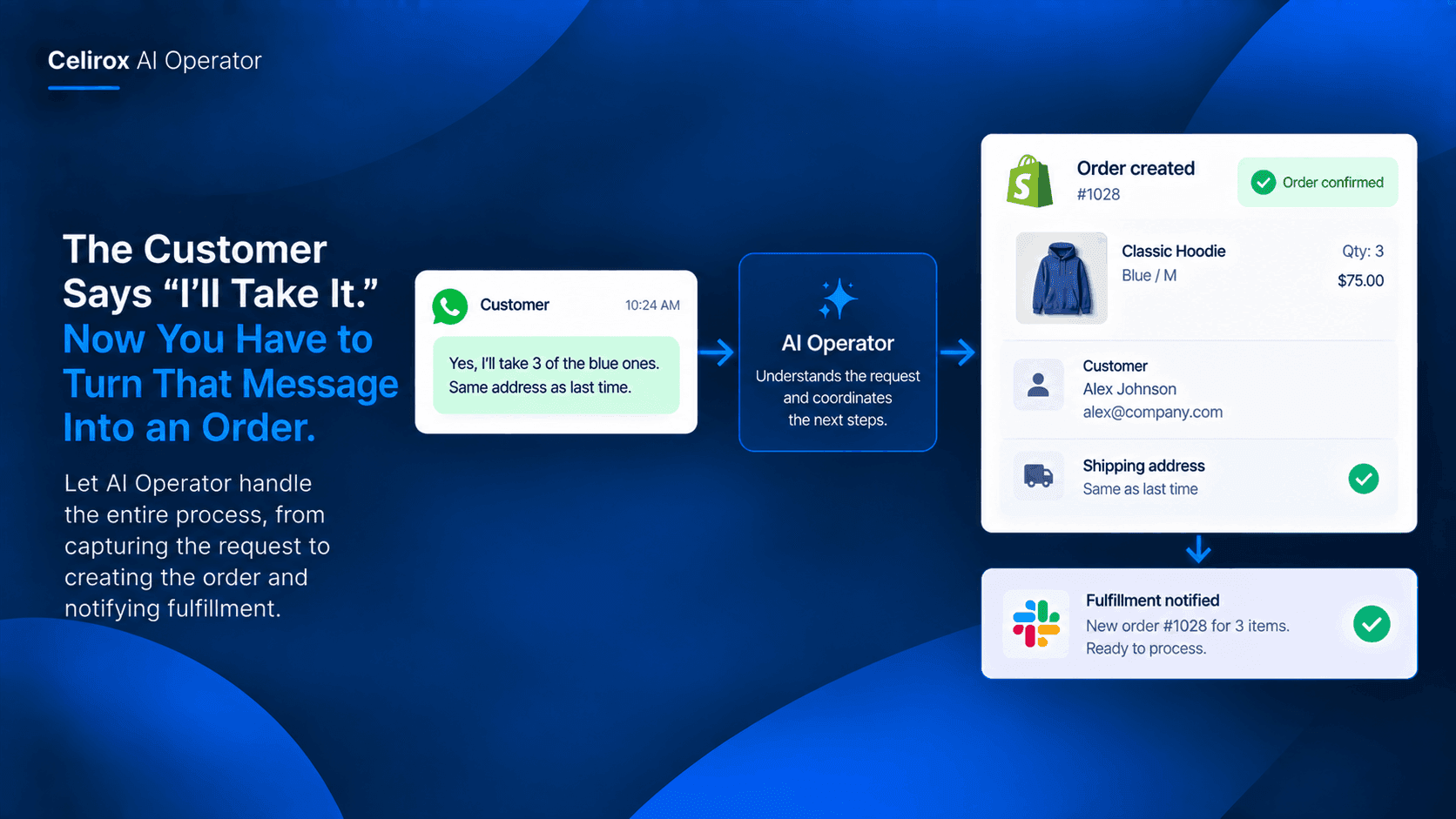
The Customer Says “I’ll Take It.” Now You Have to Turn That Message Into an Order.
The conversation started with a simple question.
“How much is this product?”
The business owner replied with the price.
The customer asked one more question.
Then came the message every seller wants to receive:
“Yes, I'll take 3.”
The sale is happening.
But the work is not finished.
The owner still needs to figure out exactly which product the customer wants, confirm the quantity, capture the customer's details, record the order, check payment, and tell whoever is responsible for fulfillment.
For a small business, that may all be handled by one person.
So a simple customer message can quickly turn into another administrative task.
The Customer Doesn't Think In Systems
Customers usually do not place conversational orders by thinking about business software.
They simply say:
“I'll take two.”
Or:
“Send me the blue one.”
Or:
“Yes, I need five.”
The business has to translate that message into structured information.
The product needs to be identified.
The quantity needs to be recorded.
The customer needs to be connected to the purchase.
The order needs to move into the business's process.
That translation is where much of the manual work happens.
This Is Common For Small Businesses
Not every business receives every order through an online checkout.
A local seller may receive orders through WhatsApp.
A wholesaler may receive them through email.
A freelancer may confirm a service through direct messages.
A home business may sell through social conversations.
The customer may never fill out a formal order form.
Instead, the conversation itself contains the order.
That works well for the customer.
But someone still has to turn the conversation into something the business can act on.
A Simple Message Can Contain A Lot
Consider this message:
“Yes, I'll take three of the blue ones. Same address as last time.”
To the customer, that is perfectly clear.
To the business, it contains several pieces of information.
Decision: The customer wants to buy.
Quantity: Three.
Variant: Blue.
Customer: The person in the conversation.
Address: Use the customer's existing information.
The owner now has to translate all of that into the business's order process.
That is exactly the kind of repetitive coordination where AI can be useful.
Turn The Conversation Into Action
Instead of treating the message as another email or chat that needs a manual reply, the business can treat the purchase confirmation as a workflow trigger.
The process could look like:
Customer confirms purchase
↓
AI identifies product and quantity
↓
Customer information is retrieved
↓
Order record is created
↓
Payment status is checked or recorded
↓
Fulfillment receives the order
The customer does not need to know what happens behind the scenes.
They simply receive confirmation.
The business gets a structured process.
AI Operator Can Connect The Steps
Celirox AI Operator is designed to coordinate business workflows across connected applications.
That makes conversational purchasing an interesting use case.
The customer's message provides the context.
The workflow can then interpret what the customer is asking for and coordinate the actions needed to move the purchase forward.
Instead of creating a separate automation for every tiny action, the business can think about the complete job:
Turn this confirmed purchase into an actionable order.
That is a more natural way to automate the process.
Start With What The Customer Actually Said
The first step is understanding the purchase confirmation.
Suppose the conversation contains:
Product: Blue Hoodie
Quantity: 3
Customer: Existing customer
Shipping: Existing address
The workflow can use that information to begin creating the order.
This is different from simply forwarding the message to someone else.
The goal is to extract the useful business information already contained inside the conversation.
Use Existing Customer Information
Returning customers make this even more interesting.
A customer might say:
“I'll take two more. Send them to the same address.”
The business may already have the customer's information stored in another system.
The owner should not have to ask for the same details again every time.
A connected workflow can retrieve relevant customer information when it is available and use it as part of the order process.
That can make repeat purchases much faster to handle.
Create A Record That The Business Can Use
A conversation is useful for communication.
An order record is useful for operations.
The fulfillment person needs to know:
What was ordered?
How many?
For whom?
Where should it go?
Has it been paid?
The AI workflow can turn the conversational information into a structured business record that can be used by the next person in the process.
That prevents the fulfillment team from having to read through an entire conversation just to figure out what needs to be shipped.
Don't Make Fulfillment Read The Chat
Imagine a small business where five orders arrive through messages during the afternoon.
The owner forwards each conversation to the person handling fulfillment.
That person now has to open every message and figure out:
Which product?
Which variant?
How many?
Which customer?
What address?
Has payment been received?
This is unnecessary work.
The better workflow is:
Conversation → structured order information → fulfillment
The person handling fulfillment receives the information they actually need.
Payment Can Be Part Of The Process
A customer saying:
“I'll take it”
does not always mean payment is complete.
The business may need to wait for payment.
That means the workflow can distinguish between:
Purchase confirmed
and
Payment completed
For example:
Customer confirms order
→ create order as pending payment
→ send payment instructions
→ wait for payment confirmation
→ notify fulfillment
The exact workflow depends on how the business operates.
The important point is that the customer's message can start a process rather than simply become another unread conversation.
Small Businesses Need This Most
A large company may have separate sales, order-entry, finance, and fulfillment teams.
A small business often has one person doing all four jobs.
That makes repetitive order processing especially expensive in terms of time.
The owner may be answering customers in the morning, preparing orders in the afternoon, and handling accounts in the evening.
Every manual order entry adds another interruption.
Automation can give that person back some of that time.
Keep Human Review Where It Matters
Not every conversational order should necessarily become an automatic fulfillment instruction.
Some messages may be unclear.
A customer might say:
“I'll take three, but can you change the color?”
That may require clarification.
Another customer may request a large custom order.
That may need approval.
The workflow can be designed so that uncertain or unusual cases are sent for review instead of being treated as routine.
For example:
Clear standard order
→ create the order.
Unclear or unusual request
→ ask for clarification or route for review.
This keeps the automation practical.
A Local Business Example
Imagine a small bakery that takes custom cake orders through messages.
A customer writes:
“Yes, I'll take the chocolate cake for Saturday. Same size as last time, but write ‘Happy Birthday Maya’ on it.”
That message contains a lot of information.
The bakery needs to identify:
Product: Chocolate cake
Date: Saturday
Size: Previous order size
Customization: Birthday message
Customer: Existing customer
The owner could manually enter all of that into the bakery's order system.
Or an AI-driven workflow could interpret the message and prepare the order information for the next step.
The customer gets a faster response.
The bakery gets a more organized order.
Another Example: Wholesale Orders
Now consider a small wholesaler.
A retailer sends:
“We'll take 50 units of the black model. Please send them to the same address as last month.”
Again, the customer is not filling out a form.
They are communicating naturally.
The business needs to translate the conversation into:
Product
Variant
Quantity
Customer
Shipping information
Order status
That is exactly the kind of repetitive translation an AI workflow can help coordinate.
The Workflow Should Follow The Business
Every small business has slightly different steps.
One may create an invoice first.
Another may create an order record.
Another may request payment before confirming fulfillment.
Another may require an employee to review every order.
AI Operator does not need to force all of them into one process.
The workflow can be designed around the business's actual sequence.
The principle remains:
Capture the customer decision once, then move the information through the required steps.
From Conversation To Fulfillment
The biggest improvement is removing the manual bridge between customer communication and operations.
Without automation:
Customer message
→ owner reads it
→ owner interprets it
→ owner copies details
→ owner creates order
→ owner checks payment
→ owner tells fulfillment
With a connected workflow:
Customer confirmation
→ AI interprets the request
→ relevant information is gathered
→ order process begins
→ next team or system receives the required information
The business owner can step in when judgment is actually required.
Don't Lose Orders Inside Conversations
One of the biggest risks of conversational selling is that the conversation becomes the only record of the purchase.
The customer said yes.
The owner saw it.
Then the message gets buried under newer conversations.
A structured order record changes that.
The purchase becomes part of the business's operational system rather than remaining inside a chat thread.
That makes it easier to track, fulfill, and follow up.
Make Repeat Purchases Easier
Repeat customers create another opportunity.
A customer might simply write:
“Same as last month. Send two more.”
A human who knows the customer can understand that immediately.
An AI workflow can use connected customer and business information to help reconstruct the relevant order details.
That can make repeat purchases much less repetitive for the business.
The customer does not have to provide information the business already has.
The owner does not have to search through old conversations manually.
A Better Way To Handle “Yes, I'll Take It”
The phrase sounds like the easiest part of selling.
But operationally, it is a transition point.
The customer has moved from interested to buying.
The business now needs to move from conversation to order.
That transition is where AI Operator can be useful.
Instead of leaving the owner to manually translate the customer's decision into several business actions, the workflow can coordinate those steps.
Frequently Asked Questions
Can AI Operator turn customer messages into orders?
AI Operator can coordinate workflows that interpret information from connected business applications and use that information to perform the next business actions. The exact order-creation workflow depends on the connected applications and how the business configures the process.
Is this useful if customers order through chat?
Yes. Conversational ordering is particularly relevant for small businesses that receive purchases through email, messaging, or other communication channels instead of a formal checkout.
Can it handle quantity and product information?
A workflow can be designed to interpret information such as product names, variants, and quantities from a customer request when the required information is available.
What if the customer message is unclear?
The workflow can be designed to route uncertain cases for clarification or human review rather than treating every message as a confirmed order.
Can payment be included in the workflow?
Yes, payment status can be part of the workflow when the relevant payment or business application is connected. The process can distinguish between a customer confirming an order and the payment actually being completed.
A Customer Message Should Not Become Manual Data Entry
The customer already did their part.
They made the decision.
They told the business what they wanted.
The business should not have to manually copy that information across several systems every time.
For small businesses especially, those little tasks consume valuable time.
AI Operator can help connect the conversation to the operational work that follows.
Customer confirms.
The request is understood.
The order process begins.
The right information reaches the right place.
That is a much more useful role for AI than simply writing another reply.
Let The Sale Move Forward Automatically
Small businesses often win customers through personal conversations.
That is a strength.
The problem comes when every successful conversation creates another manual administrative process.
AI Operator can help bridge that gap.
A customer can continue communicating naturally.
The business can continue selling personally.
Behind the conversation, connected workflows can handle the repetitive steps required to turn that decision into an organized order.
The goal is not to remove the human relationship.
It is to remove the unnecessary work that comes after the customer says yes.