Stop High-Risk Business Changes From Happening Without Approval
Approval Should Follow Risk
Imagine a support team receives two refund requests.
The first is:
Refund amount: $38
Reason: Duplicate charge
Customer: Standard monthly account
Policy: Clearly eligible
The second is:
Refund amount: $4,800
Customer: Enterprise account
Reason: Service dispute
Open issue: Contract terms under review
Treating both requests exactly the same creates a problem.
If every $38 refund waits for a manager, routine work becomes slow.
If the $4,800 enterprise refund happens automatically, the business may accept a significant financial or contractual consequence without review.
The better question is not:
Should AI act automatically or should a human approve everything?
It is:
At what point does this specific action become important enough that a person should make the decision?
That is the foundation of a useful approval workflow.
Why Approval Systems Become Slow
Approval itself is rarely the only problem.
The work around approval creates much of the delay.
Imagine a manager receives:
"Can I refund this customer?"
Before answering, they may need to find the account, check the payment, read support history, understand the reason, review policy, inspect previous refunds, and determine whether the customer is strategically important.
The decision might take thirty seconds.
Gathering enough context to make it can take much longer.
This pattern appears across departments.
Finance receives a payment request without the purchase record.
Security receives an access-removal request without knowing whether the employee actually left.
Sales receives a request to change a large deal without knowing why.
The approval request should therefore contain more than a button.
It should contain the evidence required to make a responsible decision.
Define Clear Approval Boundaries
A strong approval process starts with explicit business rules.
For example:
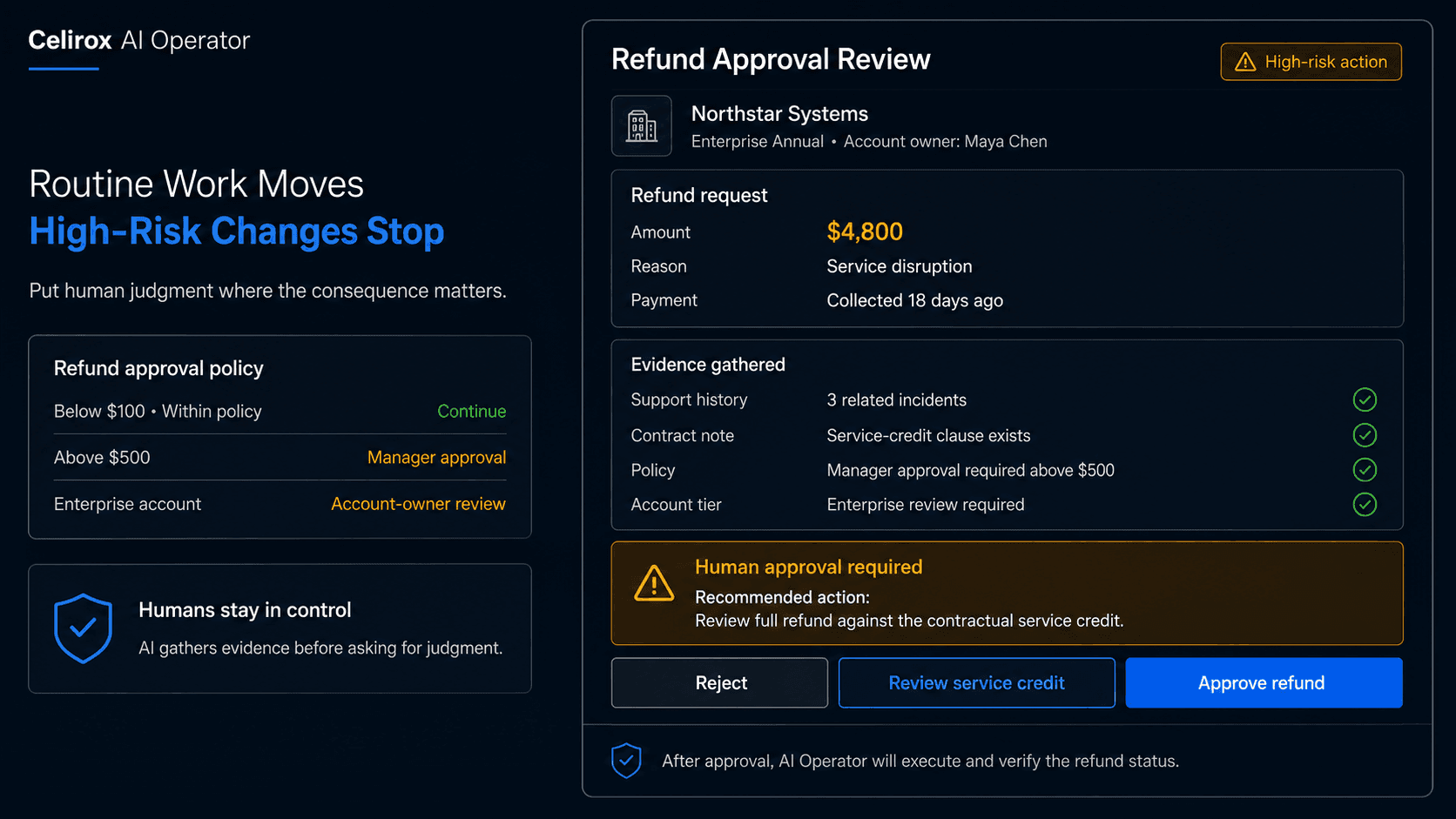
Refund below $100 + clearly within policy → Continue
Refund above $500 → Manager approval
Enterprise account refund → Account-owner review
Payment-detail change for vendor → Finance approval
Administrator access removal → Security approval
High-value CRM stage change → Sales leader review
The exact thresholds will differ by company.
What matters is defining them before the request arrives.
Approval criteria can depend on:
- Financial value
- Customer or account tier
- Security impact
- Contractual consequences
- Policy exceptions
- Data sensitivity
- Confidence in the underlying evidence
This allows routine work to continue without turning every action into a meeting.
At the same time, consequential actions stop before they cross a boundary the business cares about.
Where AI Operator Fits
With Celirox AI Operator, a business can describe those approval rules in plain English.
For example:
"Process routine refund requests according to our refund policy. If the amount is above $500, the customer is enterprise, or the request falls outside policy, gather the billing history, support context, account value, and reason for the refund. Prepare the recommended action and ask the appropriate person for approval. After approval, perform the action and verify the refund completed."
The operating loop becomes:
Receive request → Investigate → Check policy → Assess risk → Act or ask → Execute → Verify
The Operator does not need to ask for approval merely because it can.
It asks because a defined business condition requires human judgment.
That distinction prevents human-in-the-loop workflows from becoming human-in-every-loop workflows.
Give Approvers the Evidence
A weak approval request might say:
Approve $4,800 refund?
A stronger request could say:
Customer: Northstar Systems
Plan: Enterprise Annual
Refund requested: $4,800
Payment: Successfully collected 18 days ago
Reason: Service disruption
Support history: 3 related incidents
Contract note: Service-credit clause exists
Standard policy: Manager approval required above $500
Recommended action: Review refund vs contractual service credit
Approve / Reject
Now the approver understands why the decision reached them.
They do not need to open several systems before they can even think about the request.
This is where AI Operator can reduce approval friction without reducing oversight.
It gathers context before asking for judgment.
Different Departments Need Different Rules
Approval logic should match the consequence of the action.
Consider finance.
A routine invoice that matches the purchase order may follow the normal process.
A request to change a vendor's bank account before a $75,000 payment deserves a very different level of scrutiny.
Customer success has another pattern.
A small credit that clearly fits policy may be routine.
A large enterprise concession could affect revenue, contract expectations, and renewal negotiations.
Security is different again.
Creating a standard user account may be low risk.
Removing administrator access or disabling an executive account may deserve review.
Sales might allow routine CRM cleanup but require approval before changing a $250,000 opportunity from Negotiation to Closed Lost.
The same AI Operator can support these workflows because the approval rule comes from the business process, not from one universal threshold.
Do Not Approve Bad Evidence
Approval is not useful if the underlying information is wrong.
Imagine the Operator receives a request:
Cancel customer subscription
The CRM says:
Account closed
Billing says:
Subscription active
Support says:
Customer asked to downgrade, not cancel
There is conflicting evidence.
The correct response is not:
Ask manager to approve cancellation
The first step is:
Resolve or surface the disagreement.
A useful workflow might say:
Requested action: Cancel subscription
Conflict found: Support request says downgrade
CRM: Closed
Billing: Active
Recommended next step: Confirm intended customer request before action
This prevents the approval layer from becoming a rubber stamp for incomplete or contradictory information.
Human review works best when the system first determines what is actually known.
Verify After Approval
Approval does not mean the action succeeded.
Suppose a finance manager approves a vendor payment.
The payment request may still fail.
A CRM change can be rejected by permissions.
A refund may remain pending.
An access-removal request may execute in one system while the user's account stays active elsewhere.
The workflow should therefore continue after the human decision.
A stronger process is:
Approval received → Action executed → Result checked → Expected state confirmed
For example:
Refund approved → Refund submitted → Payment system checked → Refund status confirmed
Or:
Access removal approved → Identity account disabled → Application access checked → Access removal verified
The business should not confuse:
Human approved the action
with:
The business outcome actually happened
Verification closes that gap.
Avoid Approval Bottlenecks
Adding human approval everywhere can make operations slower than the manual process it replaced.
Imagine every one of these requires a manager:
$12 refund
Customer tag update
Routine CRM correction
Standard onboarding task
Internal notification
The manager becomes the workflow.
That defeats the purpose.
A better model uses three paths:
Low risk + clear evidence → Act
Higher risk + clear evidence → Ask for approval
Uncertain or conflicting evidence → Investigate or escalate
This lets humans focus on decisions where judgment changes the outcome.
The business can also revise thresholds over time.
If a certain class of approved requests is consistently safe, the company may decide to allow more of them automatically.
If another class produces mistakes, the approval boundary can become stricter.
The rules should evolve with operating experience.
Measure Approval Quality
The number of approval requests is not a useful success metric by itself.
More approvals can mean stronger control.
Or unnecessary friction.
Useful measurements can include:
- Routine actions completed without approval
- Actions escalated for review
- Approval response time
- Approval requests missing required evidence
- Rejected high-risk actions
- Actions that failed after approval
- Cases escalated because evidence conflicted
- Repeated exceptions to the same policy
The business should also watch where approvers spend their time.
If a manager approves 98% of identical low-value requests without changing anything, the rule may be too conservative.
If high-value actions regularly proceed without the right reviewer, the rule may be too loose.
The goal is not maximum automation.
It is appropriate control with minimum unnecessary delay.
Frequently Asked Questions
What is a human-in-the-loop approval workflow?
It is a process where software can investigate and prepare work, but defined actions pause for human judgment before they are executed.
Should every AI action require approval?
No. Routine, low-risk actions with clear evidence may not need approval if the business has explicitly permitted them. Consequential, ambiguous, sensitive, or policy-exception cases may require review.
What can trigger an approval requirement?
Examples include financial thresholds, enterprise accounts, security-sensitive changes, policy exceptions, contractual impact, low-confidence evidence, or other business-defined conditions.
Can AI Operator gather information before asking for approval?
Yes. AI Operator can investigate connected systems and prepare relevant context so the approver can review the evidence instead of reconstructing the case manually.
Can different departments use different approval rules?
Yes. Finance, support, customer success, sales, security, HR, and other teams may each have different thresholds and approval requirements.
What happens after someone approves an action?
The workflow can execute the approved action and then verify that the expected state actually occurred.
What if the systems contain conflicting information?
The Operator should surface the conflict or investigate further rather than presenting an approval request as though the evidence were certain.
Can approval policies change over time?
Yes. Businesses can adjust thresholds and conditions as they learn which actions are safe to execute routinely and which require more oversight.
Put Humans at the Right Point
Good operations do not require a person to click Approve on everything.
They also do not require software to make every decision alone.
The useful boundary sits between those extremes.
Routine work can move.
Consequential work can stop.
Uncertain situations can be investigated.
And when a person is needed, they should receive enough context to make the decision quickly.
Investigate → Check policy → Assess risk → Act or ask → Execute → Verify
Celirox AI Operator helps businesses build that operating pattern across connected systems, keeping human judgment where the consequence matters without forcing people to supervise every repetitive task.
The goal is not to remove approval.
It is to make approval happen at the point where it actually adds value.