One Notebook Is Easy to Buy. But Your Customers Usually Need More.
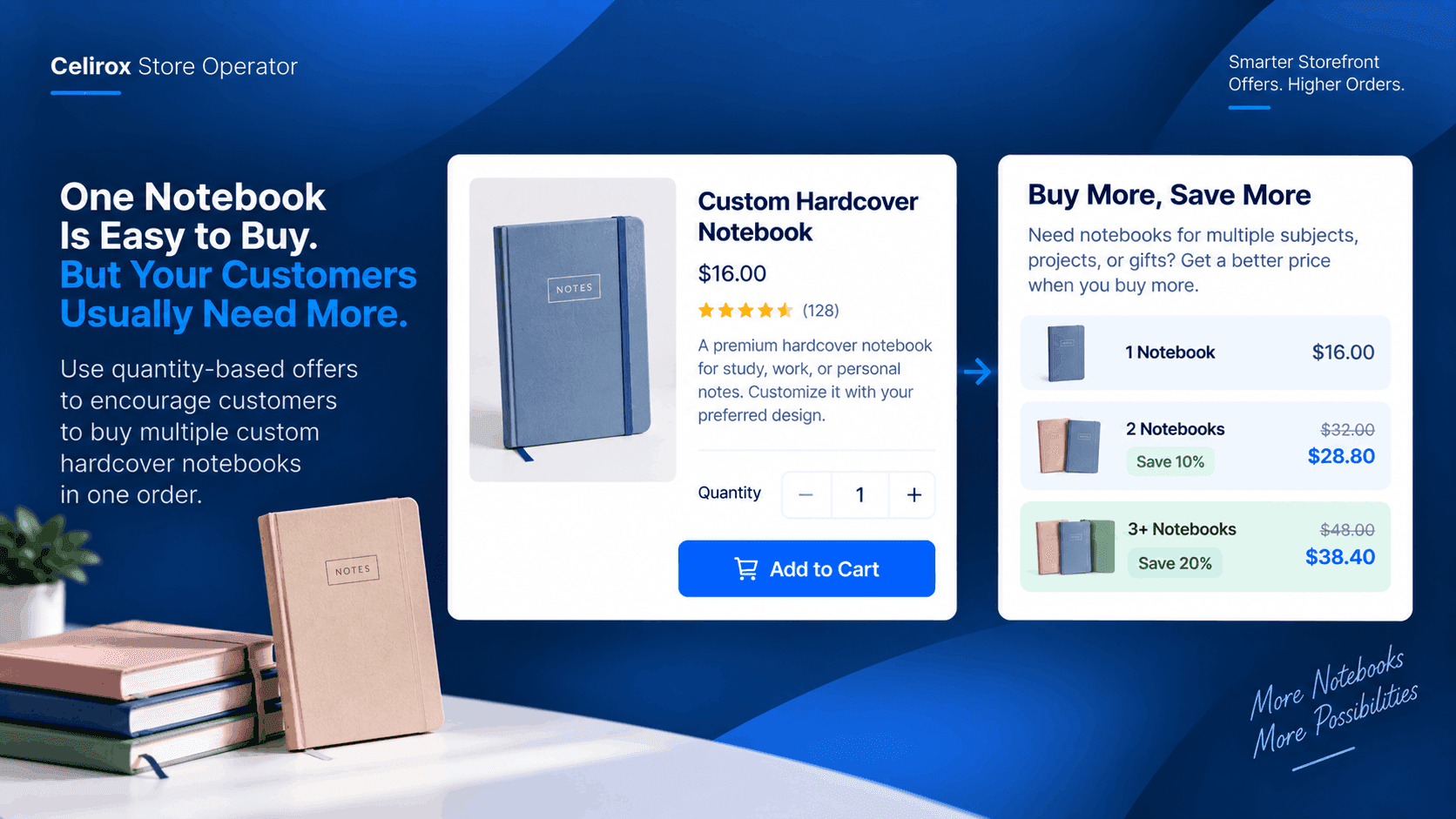
A student walks into an online stationery store looking for a notebook.
They find a Custom Hardcover Notebook they like.
One goes into the cart.
Then they remember something.
They need another notebook for a different subject.
Maybe another for a personal project.
And perhaps one more for their desk at home.
The store sells the notebook individually, so buying one is perfectly normal.
But there is an opportunity here.
Instead of simply selling one notebook, the store can make buying several feel like the better choice.
The Customer Didn't Need One
Stationery is different from many other products.
People often buy multiple notebooks at once.
A student might need separate notebooks for different subjects.
A professional might want one for meetings and another for personal notes.
Someone shopping for gifts might need several identical notebooks.
The customer who initially added one notebook may naturally need more.
The challenge is giving them a reason to make that larger purchase now.
A Simple Quantity Offer
The store can create a straightforward offer around the Custom Hardcover Notebook.
For example:
Buy 2 notebooks and get a better price.
Or:
Buy 3 or more and receive a quantity-based offer.
The exact promotion is up to the store.
The important part is that the offer is connected to quantity.
The customer isn't being pushed toward an unrelated product.
They are simply being given a reason to purchase more of the product they already want.
The Storefront Can Encourage More
A customer looking at one notebook may not immediately think about buying three.
That is where a storefront offer can change the decision.
Instead of showing only the individual product price, the store can communicate that buying multiple notebooks unlocks a better offer.
The customer can then decide whether the larger quantity makes sense.
For a stationery store, that can feel natural because notebooks are often useful in multiples.
The promotion supports a purchase the customer may already be considering.
The Story Starts With One Notebook
Imagine the customer has one Custom Hardcover Notebook in their cart.
They are ready to buy.
Then they notice the quantity offer.
The store gives them a simple choice:
Buy one as planned.
Or:
Add another notebook and receive the configured offer.
The customer may already know exactly where the second notebook will be used.
The promotion simply makes buying both at once more attractive.
No Complicated Bundle Needed
The store doesn't necessarily need to create a completely separate product bundle.
The same Custom Hardcover Notebook can remain the product.
The offer is based on how many units the customer purchases.
That keeps the shopping experience straightforward.
The customer chooses the quantity.
The store's configured rule determines when the offer applies.
Store Operator can support storefront automation and quantity-based offers as part of the store's workflow. :contentReference[oaicite:0]{index=0}
More Notebooks, One Order
For the store, the benefit is not just a bigger cart.
It can also mean fewer separate purchases from customers who were likely to need multiple notebooks anyway.
Instead of buying one today and returning later for another, the customer may decide to purchase the quantity they need in a single order.
That makes the promotion useful for both sides.
The customer gets an incentive to buy multiple units.
The store gets an opportunity to increase the quantity sold per order.
Make The Offer Easy To Understand
A quantity promotion should not make the customer calculate complicated rules.
The message can stay simple.
Buy more, save more.
The customer should immediately understand what quantity unlocks the offer and what they receive in return.
The store can then let the customer decide whether the larger quantity is worthwhile.
The purpose is not to force a bigger purchase.
It is to make the option visible.
One Product Can Have A Different Strategy
The stationery store may sell hundreds of products.
Pens might be sold individually.
A desk organizer might be purchased once.
A premium planner might have a completely different promotion.
The Custom Hardcover Notebook is different because customers may naturally want several.
That means the store can build a quantity-focused offer around this particular product instead of applying the same promotion to everything.
The merchandising strategy follows the product.
The Customer Has A Reason To Add Another
The most useful promotions often work with something the customer already wants.
The shopper came for a notebook.
The store isn't asking them to suddenly buy something unrelated.
It is showing them a reason to consider buying another notebook.
That small distinction can make the offer feel much more natural.
The customer gets something useful.
The store gets a larger order.
And the promotion has a clear purpose.
Turn One Notebook Into A Bigger Order
The workflow is simple.
Customer chooses the Custom Hardcover Notebook.
They add one unit to the cart.
The store presents the quantity offer.
The customer sees that purchasing additional notebooks can unlock the configured promotion.
The customer increases the quantity.
The quantity condition is met.
The offer applies.
The customer completes the larger order.
There is no need for a complicated product journey.
Just one product and one relevant quantity-based incentive.
Frequently Asked Questions
Can Store Operator create quantity-based offers?
Store Operator supports storefront automation and workflows involving quantity-based offers. :contentReference[oaicite:1]{index=1}
Does the customer have to buy multiple different products?
No. This use case is specifically about purchasing multiple units of the same Custom Hardcover Notebook.
Why use a quantity offer for notebooks?
Customers often have practical reasons to purchase several notebooks at once, such as different subjects, projects, work purposes, or gifts. A quantity offer can make that larger purchase more attractive.
Does the offer need to apply to the entire store?
No. The promotion can be designed around the product and business scenario being targeted rather than treating every store product the same way.
Is this the same as a product bundle?
Not necessarily. A quantity offer can encourage customers to purchase multiple units of the same product, while a traditional bundle can combine different products.
Give Customers A Reason To Buy The Next One
The customer came looking for one notebook.
But one notebook may not be all they need.
The Custom Hardcover Notebook can become a useful quantity-based promotion because buying several is already a natural possibility for stationery shoppers.
Instead of waiting for customers to discover that themselves, the store can make the offer visible at the right moment.
Store Operator helps turn that simple merchandising idea into a storefront workflow.
Sometimes the easiest way to grow an order isn't another product. It's giving the customer a reason to buy more of the product they already chose.