Your Amazon Seller Account Has a New Return. Who Is Checking It?
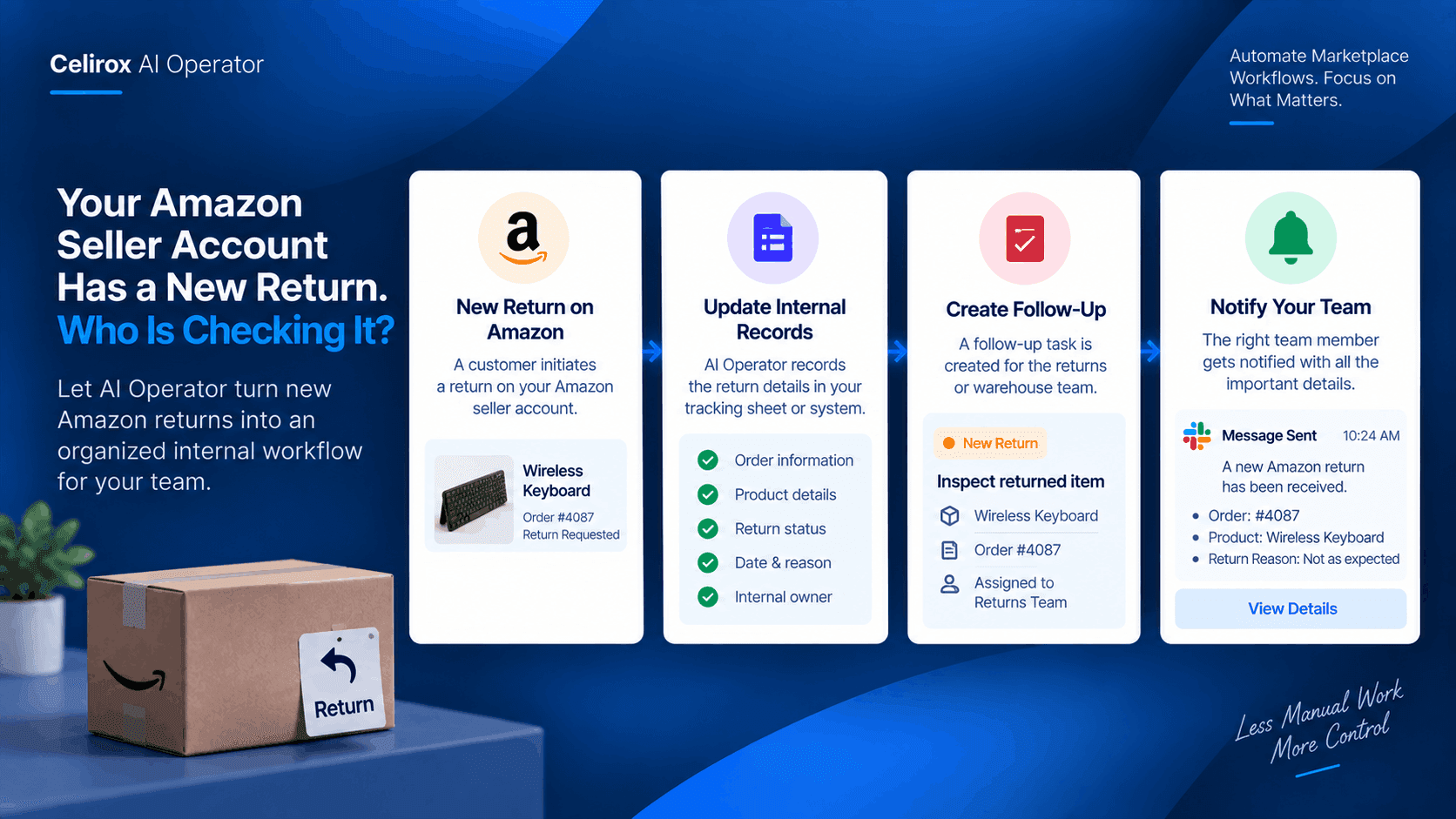
A customer bought a wireless keyboard from an Amazon seller.
A few days later, the customer starts a return.
Amazon records the return.
The seller's marketplace account has the information.
But the warehouse team doesn't necessarily know about it yet.
The returns person may not have seen it.
And the internal tracking sheet may still show the order as completed.
Nothing is technically broken.
The problem is that one important event happened inside one system, while the people who need to act on it are somewhere else.
That small gap can create unnecessary work.
A Return Creates Another Task
For a marketplace seller, a return is not just a status change.
Someone may need to check the returned item.
Someone may need to receive it at the warehouse.
Someone may need to update internal records.
Someone may need to determine what happens next.
The seller already has enough operational work.
They shouldn't also have to repeatedly check the marketplace account just to discover whether a new return needs attention.
The Notification Isn't The Workflow
This is where many marketplace processes stop too early.
Amazon can tell the seller that a return has happened.
But receiving a notification does not automatically mean the right employee has been informed.
The seller still has to connect the dots.
A return happened.
Who needs to know?
The order needs follow-up.
Where should it be recorded?
The returned item needs attention.
Who is responsible?
Those are separate actions.
AI Operator can help connect them into one workflow.
Start With The Amazon Return
The workflow begins when a new return event becomes available to the seller.
Instead of asking an employee to repeatedly check the marketplace account, the return can become the starting point for the internal process.
The workflow can identify the relevant order and collect the information needed for the next steps.
The seller doesn't need to manually rebuild the context every time a return arrives.
The return becomes an actionable business event.
Send It To The Right Place
Once the return is identified, the information can be recorded in the seller's internal tracking system.
For example, the seller may maintain a return tracker containing:
- Order information
- Product information
- Return status
- Date received
- Internal owner
- Follow-up status
The important part is consistency.
Every new return should enter the same internal process instead of depending on someone remembering to update the tracker.
Tell The Returns Team
The next step is getting the information to the person who actually needs to act.
A return notification sitting inside an Amazon account doesn't help much if the warehouse or returns team doesn't know about it.
AI Operator can coordinate the notification step as part of the workflow.
The responsible person can receive the relevant return information and know that the order requires attention.
That removes another manual handoff from the seller's daily routine.
Keep The Workflow Focused
This doesn't need to become a giant returns-management system.
The workflow can stay focused on one event:
A new Amazon return arrives.
From there:
Identify the order.
Record the return internally.
Create the required follow-up.
Notify the responsible person.
That's enough to remove a meaningful amount of repetitive coordination.
The seller can still decide how the returned product should ultimately be handled.
AI Operator simply makes sure the event reaches the right people and systems.
Why This Matters For Marketplace Sellers
Marketplace sellers often manage operations across several places.
The marketplace contains order information.
Internal spreadsheets contain operational tracking.
Communication tools contain team messages.
Warehouse teams handle physical products.
The seller becomes the connection between all of them.
That works when the business is small.
As order volume grows, more events mean more opportunities for something to be overlooked.
Returns are particularly easy to miss because they happen after the original sale has already been completed.
The seller may mentally move on to the next order while the return creates a completely new task.
One Return Should Trigger One Process
The real advantage is not simply saving a few clicks.
It is creating a predictable response to a predictable business event.
Every time a new Amazon return appears, the same basic process can happen:
Return received → order identified → internal record updated → follow-up created → responsible team notified.
The team knows what happens next.
The seller doesn't have to remember every step.
And a return doesn't remain trapped inside the marketplace account.
Let AI Handle The Handoffs
Marketplace selling involves plenty of repetitive coordination.
A seller may be good at selling products without wanting to spend the day checking marketplace notifications and forwarding information to different employees.
That is exactly where an AI agent can be useful.
AI Operator can connect the applications and actions involved in the workflow so that a business event can move forward without requiring someone to manually coordinate every step.
The seller remains in control.
The AI handles the repetitive handoffs.
Frequently Asked Questions
Can AI Operator automate workflows for Amazon sellers?
AI Operator can coordinate business workflows across connected applications. For an Amazon seller, a return can be used as the starting event for an internal follow-up process when the necessary marketplace and business-system connections are available.
What happens when a new return is received?
A workflow can identify the relevant order, record the return in an internal system, create a follow-up, and notify the responsible person.
Does AI Operator decide what to do with the returned product?
Not necessarily. The workflow can focus on coordination rather than making the business decision about the physical product.
Can the return be recorded in a spreadsheet?
If the seller's spreadsheet is connected to the workflow, AI Operator can use it as part of the internal tracking process.
Is this only useful for large Amazon sellers?
No. Even a smaller seller can benefit when marketplace events require several manual steps across different tools.
Don't Let Returns Stop At The Marketplace
The Amazon return is only the beginning of the work.
Someone still needs to know about it.
Someone needs to record it.
Someone needs to follow up.
And someone needs to make sure the returned product doesn't disappear into an operational gap.
AI Operator can turn that sequence into a repeatable workflow.
Instead of asking someone to constantly check the Amazon account and manually pass information from one system to another, the return can trigger the internal process automatically.
When a return happens, the important thing is not just knowing about it. It's making sure the right person knows what happens next.