The Client Sent the Documents. Now Find What’s Missing.
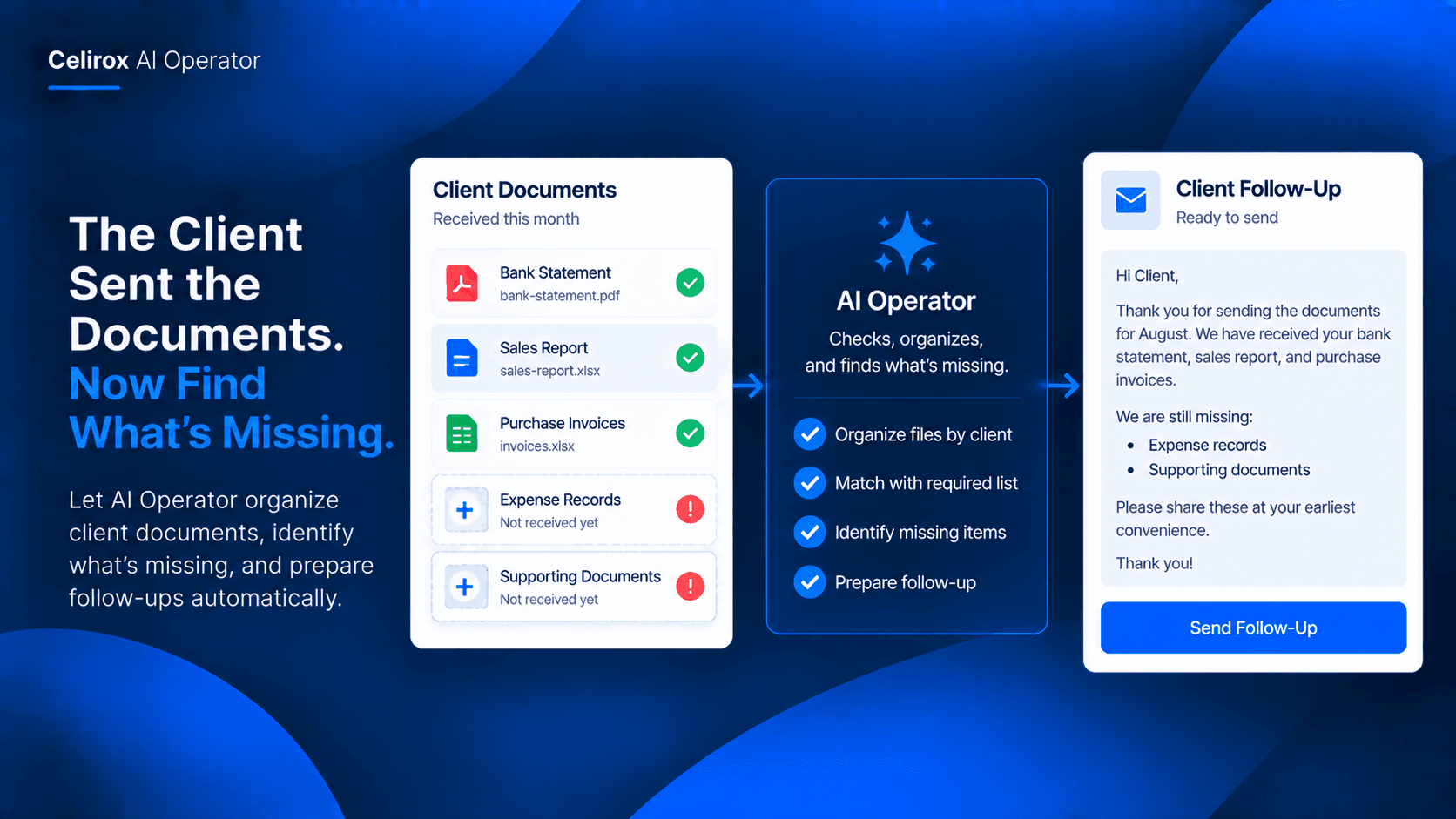
It is the beginning of another month.
A client sends a few financial documents to the accounting team.
The bank statement is there.
A few invoices are attached.
But something is missing.
The accountant now has to figure out what arrived, what belongs to this client, what still needs to be collected, and what needs to be requested before the work can begin.
For one client, that may be manageable.
For dozens of clients, it becomes a recurring administrative job.
Monthly Documents Keep Coming
CA firms and accounting teams work with information that changes every month.
Bank statements.
Purchase invoices.
Sales records.
Expense documents.
Tax-related information.
Supporting files.
The exact requirements depend on the client and the work being performed.
The problem is rarely receiving documents.
The problem is keeping track of everything after they arrive.
One Client Can Send Half
Imagine a business client needs to provide five items for its monthly accounting work.
The client sends:
Bank statement
Purchase invoices
Sales report
But the expense documents and another required report are missing.
Someone on the accounting team has to notice that.
If they do not, the missing information may only be discovered later when the accountant starts working on the client's records.
That creates another round of messages and delays.
Turn Documents Into A Process
Instead of treating every incoming file as an isolated attachment, the firm can define a workflow around the client's monthly document collection.
When documents arrive, the workflow can organize the information around the appropriate client.
The files can be placed in the expected location.
The submitted information can be checked against what the workflow expects.
If something is missing, that becomes the next action.
This turns a collection of files into a more structured process.
Keep Each Client Organized
A CA firm may have many clients with similar-looking documents.
A bank statement from Client A should not end up mixed with Client B's files.
The same applies to invoices, reports, and supporting documents.
An AI-powered workflow can help organize incoming information according to the client and the firm's defined process.
That gives the accounting team a cleaner starting point when it is time to work on the client's records.
Find Missing Information Earlier
The most useful part of the workflow may not be organizing what arrived.
It is identifying what did not arrive.
Suppose the firm's monthly checklist expects:
Bank statement
Sales report
Purchase invoices
Expense records
Supporting documents
The client submits only three of those items.
Instead of someone manually checking the folder and trying to remember what is missing, the workflow can surface the outstanding information according to the firm's defined requirements.
That makes the missing-item problem visible earlier.
Prepare The Follow-Up
Once something is missing, someone eventually needs to contact the client.
But the accountant should not have to rediscover the problem first.
The workflow can prepare the information needed for the follow-up:
Client: ABC Manufacturing
Period: August
Received: Bank statement, sales report, purchase invoices
Missing: Expense records, supporting documents
Now the responsible team member has a clear picture of the situation.
The follow-up becomes much simpler.
Reduce The Back-And-Forth
Without an organized process, document collection can become a cycle:
"Please send the bank statement."
"Here it is."
"We also need the expense records."
"Sending them now."
"One more document is missing."
Each additional message costs time for both the client and the accounting team.
Identifying missing information earlier can help reduce unnecessary back-and-forth.
The client gets a clearer request.
The accountant gets a clearer response.
Start With One Monthly Process
A firm does not need to automate every accounting workflow at once.
Start with one recurring client process.
For example:
Process: Monthly bookkeeping documents
Client: Business client
Expected: Defined set of financial documents
Incoming: Email, form, or connected source
Action: Organize documents
Check: Identify missing items
Next step: Prepare client follow-up
Once the process works for one type of client work, the firm can consider other recurring document-collection workflows.
Let People Handle The Accounting
The purpose of the workflow is not to replace the accountant's judgment.
The accountant still needs to review financial information and perform the professional work.
The repetitive administrative steps are different.
Sorting files.
Checking whether expected information arrived.
Finding missing documents.
Preparing another request to the client.
These are the kinds of connected tasks an AI Operator can help coordinate so the accounting team can start with better-organized information.
Common Questions
Is this only for CA firms?
The workflow is particularly relevant to CA firms, accountants, and finance teams that repeatedly collect documents from business clients.
Can it identify missing documents?
It can be designed to check incoming information against the requirements defined for a particular workflow and surface items that have not been received.
Can client files be organized automatically?
When the relevant storage and other applications are connected, AI Operator can coordinate workflows that organize incoming information and files according to the business process.
Does AI Operator perform the accounting work?
No. The workflow is focused on the administrative coordination around document collection. Accounting professionals remain responsible for reviewing the information and performing their professional work.
Start The Month With Less Chasing
Every month, clients send documents.
Every month, accounting teams have to organize them.
And every month, someone ends up asking:
"What are we still waiting for?"
That question does not need to be answered from memory.
AI Operator can help turn recurring client document collection into a connected workflow: organize what arrives, identify what is missing, and prepare the next step for the team.
The accountant can then spend less time managing the collection process and more time working with the information itself.
Try Celirox AI Operator
Connect the tools your accounting team already uses and turn repetitive client-document workflows into organized, AI-powered processes.